
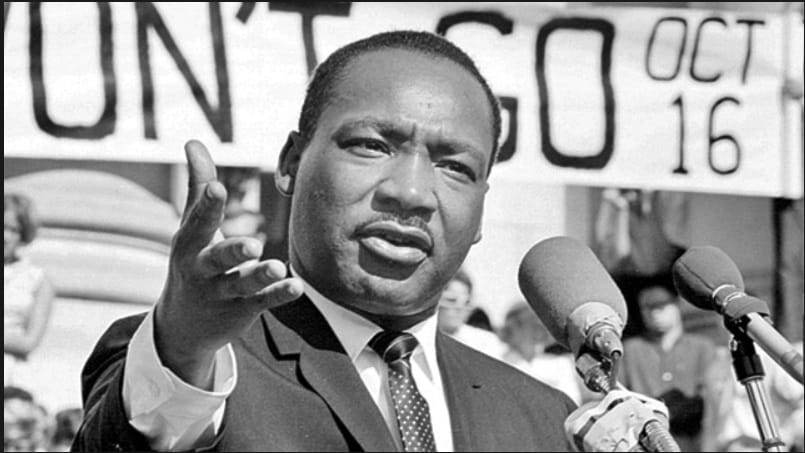
In his Pulitzer Prize-winning biography of Martin Luther King Jr., Jonathan Eig tells the story of King’s relationship with Stanley Levison, who served as “a key advisor and [King’s] closest white friend.” Levison shared his vision for racial equality, but not his faith. King challenged Levison, pointing out that his passion for justice demanded a belief in God: “Levison’s moral fervor was such that King refused to believe his friend’s agnosticism. ‘You don’t know it, Stan,’ King said, ‘but you believe in God.’”
In his words to Levison, King illustrated what twentieth century theologian Cornelius Van Til called “borrowed capital,” the idea that other worldviews must borrow presuppositions from Christianity to reach their conclusions. In this century some Christian apologists employ “subversive fulfillment,” a related concept which teaches that secular desires can only be fulfilled within the Christian story and that modern values only make sense within a Christian worldview. Those who reject Christianity while adopting its conclusions want what Mark Sayers calls “the Kingdom without the King.”
In Dominion: How the Christian Revolution Remade the World Tom Holland recognizes a similar contrast between King and the Beatles:
The Beatles did not—as Martin Luther King had done—derive their understanding of love as the force that animated the universe from a close reading of scripture. Instead, they took it for granted. Cut loose from its theological moorings, the distinctively Christian understanding of love that had done so much to animate the civil rights movement began to float free over an ever more psychedelic landscape.
Holland realizes that the Beatles had appropriated the fruit of Christianity without its foundation. King, on the other hand, came to his convictions through his immersion in Scripture. I note King’s Christian foundations because in recent years it has become a favorite pastime of the “irreverent right” to use this holiday to parade and catalogue his sexual immorality as well as his denial of several core Christian beliefs. How should we respond to this particular symptom of the larger “vibe shift” on the right? I recommend one path forward: tell the truth. All of it.
King was certainly not an evangelical, and he rejected Jesus’ literal, bodily resurrection. He had a number of sexual partners while married to his wife Coretta. He held views on a variety of topics that would make any traditional conservative squirm uncomfortably. Acknowledging these realities exhibits what Aaron Renn calls “scrupulousness on facts,” the practice of being up front about uncomfortable truths. Brutal honesty about King reduces radicalization, increases trust, and robs provocateurs of the opportunity to gain credibility by revealing taboo truths to the ignorant. However, we must accompany these inconvenient facts with the truth about how King’s Christian worldview influenced his actions and words in the civil rights movement.
In his Letter from a Birmingham Jail King quoted Jesus’ teaching in the Sermon on the Mount to love our enemies and to pray for those who persecute us. He affirmed the Christian tradition when he said, “A just law is a man made code that squares with the moral law or the law of God. An unjust law is a code that is out of harmony with the moral law.” He pointed to “the refusal of Shadrach, Meshach and Abednego to obey the laws of Nebuchadnezzar” in Daniel 3 as an example of civil disobedience. He applauded the courage of early Christians, who considered themselves “a colony of heaven” and “brought an end to such ancient evils as infanticide and gladiatorial contests.” More broadly, King taught his followers to turn the other cheek and rooted human rights and dignity in the Imago Dei.
Those who foreground King’s failures miss these and other points, one of which is that a non-violent civil rights movement was never a foregone conclusion. Today we celebrate MLK, not Stokely Carmichael or Huey Newton. Both of those men criticized and rejected King’s peaceful approach. More recently we saw a rash of “mostly peaceful protests” in response to George Floyd’s tragic death in 2020. We could adapt Ross Douthat’s famous observation about the religious right to say, “If you dislike the Christian civil rights movement, wait till you meet the non-Christian civil rights movement.” If you cannot handle King, just wait until you read In Defense of Looting.
God’s common grace means that we will find much good in non-Christian movements for justice. Human depravity means we will also discover many shortcomings and failures in Christian efforts. Nevertheless, we should not be surprised if chaos ensues when Christians cede moral leadership to the world. As he joined others in leading the civil rights movement, King remained tethered to a Christian understanding of non-violence and human dignity and worth. This produced a distinctively Christian approach that stood in contrast to those of his contemporaries.
So let us honor MLK today. We can remember that King led a movement founded on the bedrock principle that we must honor all people because each one is made in God’s image. We do not have to engage in hagiography or tell half-truths. Nor do we need a man to mirror all our beliefs in order to celebrate his accomplishments, unless, like Narcissus, we insist on constantly seeing our own reflection. We can commend King for working for reconciliation, not retribution. And – like King to Levison – we can challenge our co-belligerents who embrace justice but reject God with their own contradiction and inconsistency.
The Weekly Digest
Premier Thought Every Thursday.
All of our recent essays and podcasts, delivered to you. Free.
Free. Delivered Thursday mornings.