
(Join Matthew Loftus and Mere Orthodoxy editor-in-chief Jake Meador next week for an online forum discussing his book.)
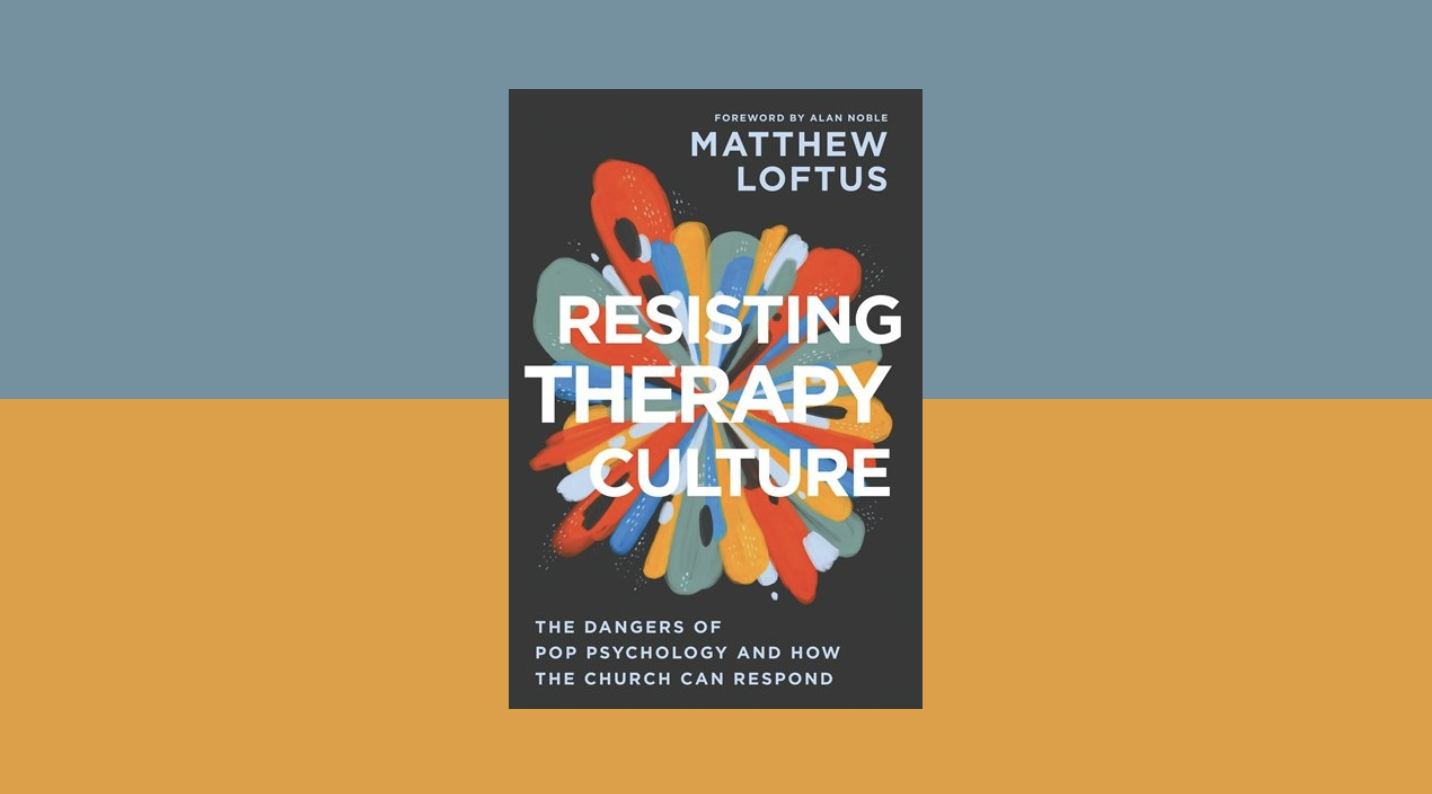
Matthew Loftus. Resisting Therapy Culture: The Dangers of Pop Psychology and How the Church Can Respond. InterVarsity Press, 2026. $21.99. 224 pp.
If you spend any time in conservative circles—whether those who are conservative Christian or merely conservative politically—chances are that you have been exposed to something like the following narrative. Half a millennium ago, Western thought was dominated by the assumptions of orthodox Christianity. There was a clear sense of communal identity and the common good. The world was seen as enchanted—full of spiritual realities. Then with the metaphysics of William of Ockham, the theology of Martin Luther, or the philosophy of René Descartes, everything took a turn toward the individual and his or her pursuit of truth, whether in the form of scientific rationalism or expressive emotivism.
The narrative goes a bit differently depending on the focus of the commentator. Some chiefly blame the thinkers of the Enlightenment—Kant, Hume, Rousseau—while others save their fire for the Romantic poets or the psychosexuality of Sigmund Freud. The resulting societal malaise goes by different names: emotivism and managerialism (per Alasdair MacIntyre), technocracy (per Jacques Ellul), secularism (per Charles Taylor), or the therapeutic (per Philip Rieff).
This last designation speaks most clearly to our psychological depths. We live in what the sociologist Frank Furedi dubbed “therapy culture” in his 2003 book Therapy Culture: Cultivating Vulnerability in an Uncertain Age. The term is now widely used to describe what many consider a societal emergency: the co-opting of psychological terminology and concepts by the wellness industry, social media influencers, political activists, and even your next door neighbor to create an entire therapeutic way of life, a mindset far removed from the original intent of professionally certified therapists.
In his new book Resisting Therapy Culture: The Dangers of Pop Psychology and How the Church Can Respond, Matthew Loftus approaches the issue from the perspective of a physician, missionary, and theological writer. His first sentence gets right to the point: “Therapy culture is out of control, and it’s making people sicker.” He locates its toxicity in “the medicalization of normal emotional and spiritual experience, the judgment of all activities by their perceived impact on mental health, and the loss of agency that is induced by the first two components and then aggravates them in turn.” This creates an iatrogenic effect in which the prescribed treatment harms the patient rather than helping them.
Even if you have not been listening to the proclamations of the broadly conservative intelligentsia over the past decade or two, you understand what Loftus is describing. We have all witnessed the proliferation of “trigger warnings,” the expanding definition of “trauma” to include nearly anything unpleasant, the labeling of all kinds of people as “toxic,” the constant admonitions to “speak your truth” and look within for answers. All of us likely know someone who, in the pursuit of better “mental health,” has engaged in all sorts of injurious actions, often torching their relationships. My frequent use of quotation marks in this paragraph indicates how certain words have shifted from their original meaning.
Loftus argues that therapy culture “destroys the practice of therapy itself because it ultimately saps people of their character, integrity, and self-determination and replaces them with the wooden language of wellness.” It must be distinguished from good psychological therapy, which “requires that we view ourselves as moral agents capable of changing our lives for the better,” instead teaching us to regard our actions, “no matter how harmful they are to ourselves or others, as instinctual responses to individual traumas or social injustices that cannot be helped.” This leads to the constant redefinition so prevalent in everyday speech:
A hierarchy of suffering has become established in which exotic disorders are appropriated and treated as consumer products, while mundane suffering gets overinflated into ‘severe depression.’… When diagnoses are used carelessly, the people who are genuinely suffering from mental illness are marginalized through ‘linguistic inflation’ and ‘false equivalence.’
Loftus’s argument in response is not that Christians should avoid therapy altogether or that there are no legitimate mental illnesses. Rather, we must not lose a proper sense of human agency. Indeed, the defense of agency is at the heart of Resisting Therapy Culture. “We need to keep what’s good about psychology and therapy while emphatically rejecting what’s evil,” Loftus argues. Therapy culture offers its brand of self-help as “a secular form of salvation,” one in which grace is crucially absent. Christianity upholds both the reality of our moral responsibility and the free grace that sets sinners free:
One of the best things that Christians can do is help retain that sense of moral responsibility and remind people that no matter their circumstances, they can choose to do good and not evil. That sense of responsibility, however, is only part of a larger picture of grace, for we believe that our good choices are the result of the Holy Spirit working in our life (Romans 8:1-17).
A deeply Christian understanding of suffering plays an important role in this process. The chief villain in Loftus’s grand narrative of the past half millennium may well be Francis Bacon, whose Novum Organum had a profound influence on the Scientific Revolution. “The Baconian Project starts off with the righteous impulse to use the gifts that God has given us to relieve suffering but slowly expands that impulse into a quest to eliminate suffering entirely,” Loftus notes. But the quest to avoid any and all suffering is ultimately injurious to human relationships and the human psyche:
The idea of an authentic self that will unfold inside of you if you give it freedom from external strictures and indulge your internal desires is itself a lie, and the pressure to discover and perform such a self is undoubtedly a contributor to mental illness.
This broad argument echoes components of the grand narrative we have received over the past decade from authors like Rod Dreher (The Benedict Option), Jonathan Haidt (The Anxious Generation), Carl Trueman (The Rise and Triumph of the Modern Self), and even Paul Kingsnorth (Against the Machine). And so, as I was reading, I could not help wondering if this narrative has become a bit too easy. Are we so accustomed to it, so thoroughly convinced of its validity that we might be missing certain nuances here and there?
Loftus asserts in Resisting Therapy Culture that social media “has been well-recognized as a mind virus that can spread mental health problems like eating disorders and self-harm,” and states that the prime culprits behind the explosion of therapy speak and psychiatric diagnoses are likely “smartphones and social media.” This is the argument made successfully by Jonathan Haidt and accepted practically as gospel in some circles now, but it is less clear whether our digital activities are a leading or trailing indicator of our mental malaise. Haidt’s former collaborator, the psychologist Peter Gray, who is known for his championing of free play for children, is now arguing children must also be given creative leeway online for the sake of their psychological health. The two men have apparently fallen out over the issue, a sign that even within the broad consensus of this societal narrative, there is room for doubt and nuance.
Speaking personally, I have seen too much of the contradictions of human behavior, the twists and turns of history, and the complexities of our society to believe we can have a neat and tidy explanation for our present situation. Call me a cynic if you will, but everything seems a bit too easy. When I read these grand narratives, I find myself nodding along with practically everything. It all seems to echo my observations, which is precisely why I’ve become skeptical. I don’t trust myself enough when I am simply nodding along.
There is something about this narrative that can turn us into reactionaries, making us see everything as too black and white. And this is precisely what Loftus acknowledges in Resisting Therapy Culture. He realizes that in rightly opposing the abuses of therapy culture, we can become simple reactionaries, rejecting all of psychiatric treatment, refusing to recognize any proper diagnosis. We can give ourselves over entirely to something “nouthetic,” which is in fact just anti-science. Loftus acknowledges the complex relationship between mind and body, and the reality of sin’s curse upon our mental condition. There are some things the church can do and others it cannot—nor was it ever meant to do. He has full compassion for the sufferer while not pretending we can avoid all suffering. In fact, the drive to avoid all suffering can make us tyrannical, inhumane, and unfeeling.
Here it helps that Loftus is a practicing physician and has himself sought help for mental and emotional difficulties. He has witnessed the realities of human suffering among people the rest of the world has largely forgotten. His is not academic analysis as much as personal: a longing for genuine healing borne of close experience with sickness. He believes the medical profession (including psychiatry) is a gift of common grace that can genuinely help those in need, but he also believes our ultimate salvation is found only in Jesus Christ. As he puts it, “Only Christianity teaches us about a God who enters into our suffering and promises to transform it by his power, which allows us to affirm that suffering is not only real, but also capable of making us more like Christ.”
I therefore commend Loftus for his attempts to strike this proper balance between the head and the heart, the therapeutic and the theological. We must always be asking questions, always subjecting everything to the standard of biblical truth. To God we give our complete trust, but never to ourselves nor to any narrative crafted by human beings, however expansively it seems to explain everything. The question Christ puts to sufferers is always the same: “Do you want to be made well?” (John 5:6) Not “Do you want to be validated?” or “Do you want to be comfortable?” but “Do you want to be made well?” By his grace he heals us, body and soul, now and in eternity.
The Weekly Digest
Premier Thought Every Thursday.
All of our recent essays and podcasts, delivered to you. Free.
Free. Delivered Thursday mornings.