

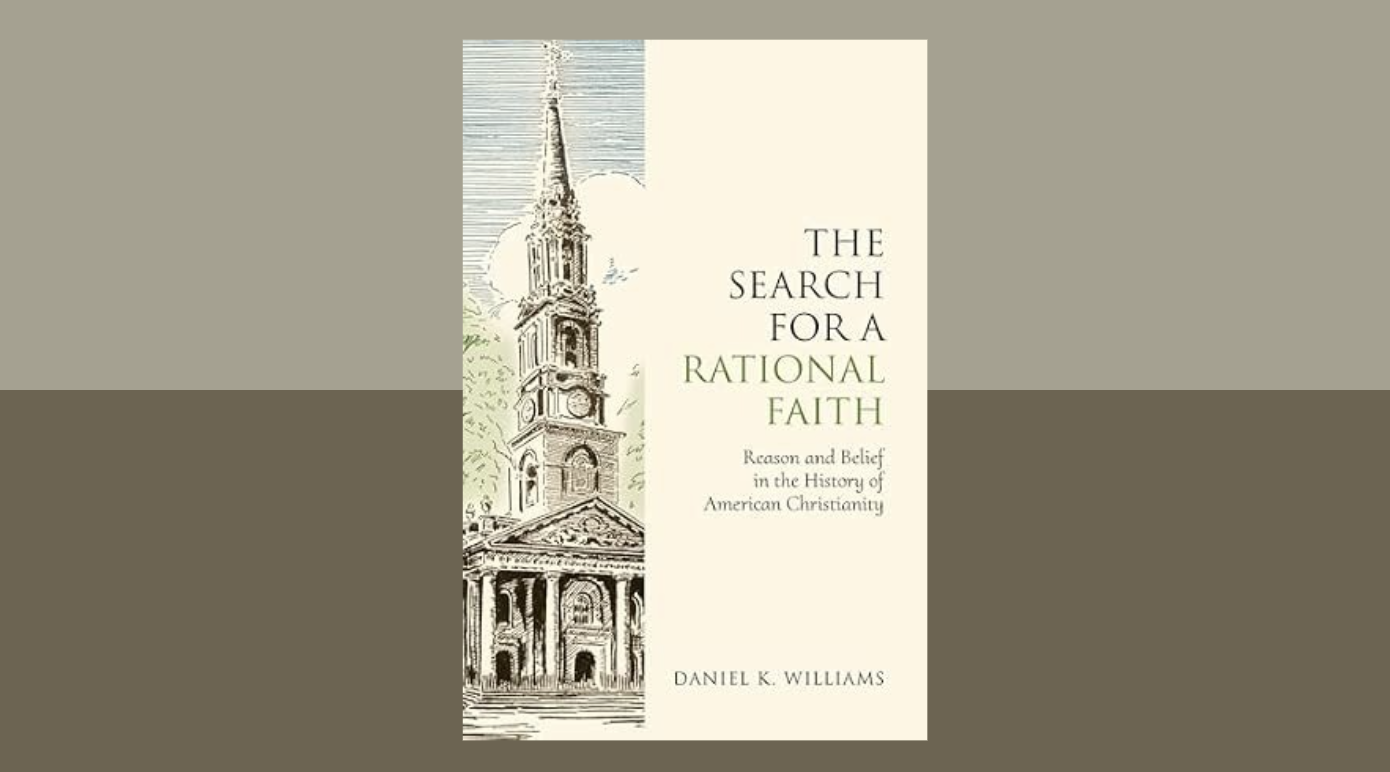
This excerpt from The Search for a Rational Faith: Reason and Belief in the History of American Christianity (2026) is published with permission from Oxford University Press.
Any Londoner who visited Chew’s Coffeehouse on a Monday evening in the 1720s or 1730s and made his way through the haze of smoke coming from clay pipes and the excited chattering of small groups of men passionately debating the latest news would have encountered, among other gatherings at the scattered tables, a meeting of a local literary club.
Coffeehouse intellectual clubs were common in the early eighteenth century, when Enlightenment would-be philosophers, gadflies, and local wags from the middle and upper classes gathered in a caffeine-fueled environment to discuss the latest ideas and test them with the standard of reason. The gathering at Chew’s Coffeehouse was, like others of its type, a venue for the intellectually curious. Each Monday evening, the chairman of the club proposed two questions for debate, and each member of the club presented an essay for discussion.
These clubs were sometimes a magnet for deists and skeptics, but at this particular society, one of the members, Nathaniel Lardner, was a London minister—but one who was just as committed to reason as any deist. He was already in his forties at this point and so hard of hearing that he had trouble figuring out when the choir at his church had stopped singing, but he still loved to discuss ideas with people who held contrary opinions. He was also intellectually flexible enough to change his mind when presented with new evidence.
As a lifelong Dissenter, he was used to being a nonconformist theologically and intellectually, and as a result, he enjoyed corresponding with deists, even though he thought they were entirely wrong. He was certainly no stranger to skepticism, because his pursuit of graduate training in theology had taken him to such leading centers of skeptical opinion as Utrecht, Leiden, and finally back to London. While participating in the literary club, he was in the process of rethinking his view of the Trinity. At first, he ardently defended the orthodox position, but after a few years of study, he became convinced by Unitarian arguments that the Son was not eternally preexistent, as orthodox Christians claimed ever since the Council of Nicaea.
In some respects, Lardner was a bit of an oddball. He never married, he lived with his father until he was in his mid-fifties, and, despite his graduate education at some of Europe’s best universities, he found it impossible to secure a permanent ministerial post until he was forty- five—and even then, he served in pulpit ministry for only a short time.
The chief obstacle that he faced in finding ministerial employment was probably not his passion for argument or his propensity to change his mind on such key points of Christian doctrine as the Trinity—the latter of which might have alienated him from some of the more theologically conservative Presbyterian churches of his youth, but which was no obstacle for the increasing number of Unitarian-minded congregations among the English Dissenters. Rather, one of his biographers speculated, his greatest barrier to parish ministry was probably his near-deafness, which prevented his friends from communicating with him except by passing him written notes.
Lardner’s coffeehouse friends were apparently willing to tolerate the inconvenience, but he seems to have felt self-conscious about imposing his disability on a congregation. When a leading Dissenting church invited him to serve as co-pastor, he turned down the offer. Though he did preach frequently, he would primarily make his mark on Christian apologetics through his writings. And it would be through the written word that he would remain devoted to the life of the mind, exploring new ideas and choosing to accept or reject them on the basis of reason.
Changes in intellectual conviction, when presented with sufficient evidence, were common for Lardner, because he believed in freedom of thought. In the late 1720s, when the London deist Thomas Woolston was arrested and imprisoned for repeatedly publishing material denying Jesus’s miracles, Lardner argued that the deist had the right to hold his own religious opinions without coercion, even if they might be erroneous. “Nothing is so voluntary as Religion,” he wrote, quoting the Dominican friar Raymond Martini. “Faith is to be wrought by persuasion, not by compulsion.”
In the interest of producing this “persuasion” by rational means, Lardner published a book explaining why it was “rational, consistent, and credible” to interpret the accounts of three of Jesus’s most spectacular miracles—the raising of three people from the dead—as “literal histories.” He accomplished this task by carefully comparing each of the gospels with the others in order to show that the gospel writers were not prone to distortions and exaggerations when recounting the same events, but instead demonstrated the qualities of careful, trustworthy reporters. The deists therefore had no grounds to dismiss the accounts of Jesus’s miracles.
Lardner’s A Vindication of Three of Our Blessed Savior’s Miracles, as he titled this refutation of the deists’ arguments, was only the beginning of his career as a Christian apologist. After spending his Monday evenings each week at the coffeeshop conversing with the literati, he spent his Tuesday evenings among ministers whom he hoped to turn into apologists.
The young Dissenting ministers who gathered with Lardner each Tuesday at a meetinghouse in the heart of London’s financial district were an eclectic bunch theologically, because “Dissenter” in early eighteenth-century England was a broad category that encompassed nearly every Protestant outside the Church of England—which meant everyone from Puritans to Unitarians. Besides Lardner, the group included two Baptists, three Presbyterians, and one Congregationalist whose views on scripture were suspected of being somewhat liberal.
Perhaps they could have spent their time bickering over their divergent interpretations of Christian doctrine if they had wanted, but they decided instead to focus on a more constructive project: the defense of the Christian faith against deism. Each minister in the group, they decided, would deliver a short series of sermons on some aspect of the “the evidences of natural and revealed religion”—in other words, natural theology and a reasoned defense of the divine origin of scripture.
For his own set of three lectures, Lardner chose to focus specifically on refuting historical criticisms that deists made of the four gospels. The topic quickly became a life focus for Lardner. His three lectures expanded into a two-volume book, published in 1730, but this was only the beginning: he continued working on the project throughout his life, until it eventually reached seventeen volumes.
Lardner’s work functioned as the first comprehensive encyclopedia of historical criticism of the gospels, organized around a list of problematic passages. For each passage whose historical accuracy skeptics had questioned, Lardner engaged in a detailed, exhaustive analysis of every classical reference or piece of historical evidence that might have bearing on the question. He left no stone unturned. His discussion of Luke’s one-verse reference to the census of Quirinius, for instance, continued for eighty-six pages. In each case, Lardner attempted to show that historical evidence vindicated the gospel accounts. The census of Quirinius, he argued, was historically plausible, despite what the deists had said. And so was every other gospel passage that the deists had questioned.
Lardner especially focused on the question of whether information that was mentioned in only one of the four gospels—or that was never mentioned in Josephus or any classical histories—could be trusted. For instance, was it reasonable to believe John’s account of the raising of Lazarus when that miracle—as spectacular as it was—did not appear in any of the Synoptic gospels? Was it reasonable to believe that the Roman emperor Augustus had ordered an empire-wide census, as Luke suggested, even though this was never mentioned in any classical source?
Lardner treated these skeptical questions seriously and respectfully, and unlike many previous Christian apologists, he never resorted to invective or denigration when debating his skeptical opponents. Instead, he treated their criticisms of the biblical text as an opportunity for serious intellectual investigation, and at each point, he thought that an exhaustive study of all relevant ancient sources and all possible objections would show that, in the end, the biblical account was credible. His work became a massive compendium of all possible confirmations of the historical narrative of the four gospels from the nonbiblical sources of classical antiquity.
Lardner believed in the historical accuracy of the Bible, but he was hardly an adamantine reactionary; he was open to novel interpretations, as long as they sustained the Bible’s historicity. In the case of the census of Quirinius, for instance, he argued for a very limited imperial order that applied only to Judea—which explained its absence from classical sources. This meant that the Authorized Version’s rendering of Luke 2:1 as “all the world should be taxed” was incorrect; a more accurate translation, Lardner argued from the Greek, was “all the land should be taxed”— thus making it possible that the census could apply only to Judea.
Lardner’s methodology and presuppositions were in keeping with Enlightenment rationalism, but his end goal was conservative: he wanted to defend the historical integrity and authenticity of the original Greek biblical text, because he believed, as John Locke had, that if he could prove that the gospel narrative was historically trustworthy, its divine origins and authority would be confirmed as well. Jesus’s miracles and resurrection, he believed, could have occurred only through the power of God, so if he could prove that these miracles really happened—that is, that the reports about them were historically credible—he had essentially proved the truth of Christianity and subverted the deists. This was such an important goal that it was worth becoming the project of a lifetime.
Three decades after embarking on his project, Lardner, now seventy years old, reflected on the purpose of his undertaking as he picked up his pen to begin the fourteenth volume of his ever- expanding work. “The design of this work, from the beginning, and all along,” he wrote, “has been to shew the truth of the evangelical historie, and thereby the truth of the Christian Religion. For if the facts related in the Gospels, and confirmed by the Epistles of the New Testament, may be relied upon, the Christian Religion is from heaven.”
In 1757, thirty-three years after he had begun the project—and after battling several severe fevers that nearly killed him—Lardner finally finished the seventeenth volume and put down his pen. But even though he wanted to write more, the multivolume analysis that he did produce was so comprehensive that it was not repeated for more than a century.
Lardner taught orthodox Christians that they did not have to be afraid of skeptical objections; exhaustive historical study, he showed, would refute the critics’ charges and uphold the historicity of the biblical text.
The Weekly Digest
Premier Thought Every Thursday.
All of our recent essays and podcasts, delivered to you. Free.
Free. Delivered Thursday mornings.