
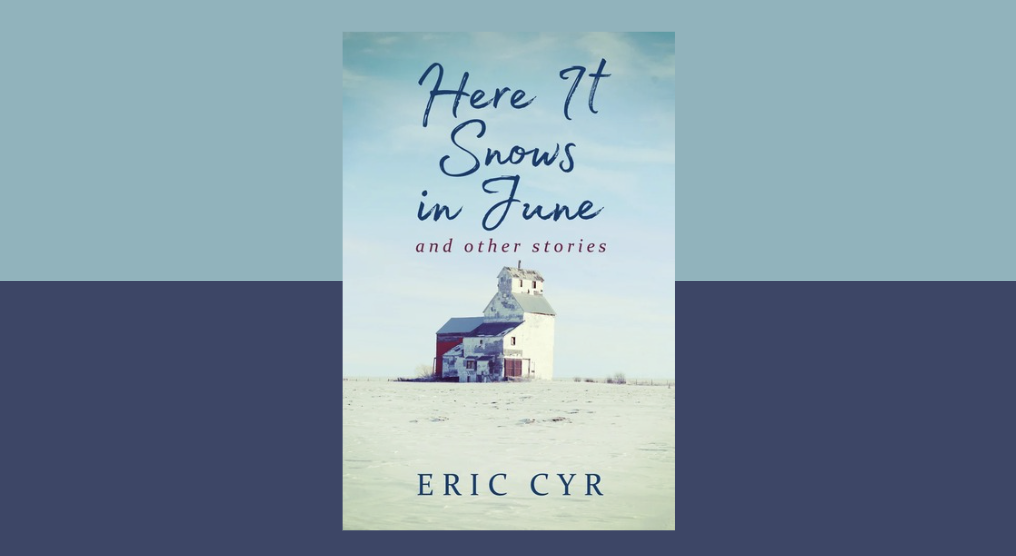
Eric Cyr. Here It Snows in June & Other Stories. Wiseblood Books: 2026. 156pp, $16.00.
In the search for perennial satisfactions of the ever-growing, never-ceasing hunger for authenticity, in which people and communities seem like the “real deal,” fiction would likely not be a typical choice. How could fiction, a deliberate fabrication, cultivate authenticity? How could souls weary of false experience find their hunger satisfied in made up stories? Would they not rather serve us better as comfortable escapes from uncomfortable (un)reality, as the overwhelming popularity of sci-fi and romantasy books seems to suggest?
Though the problem is fresh, it is not new. In his Poetics, Aristotle argues that people enjoy fiction fundamentally because of its innate capacity to depict—or imitate—the real, and the more successful the imitation, the greater our delight: “We take pleasure in contemplating the most precisely made images of things.” Fiction further attracts us because we “do our first learning by imitation” and so come to know the real through our experience of that representation: “They are pleased in seeing images because in their contemplating there is a coincidence of learning and figuring out what each thing is.”
Fictional realism creates a potent sense of authenticity, and often in a visceral manner, because of its precisely rendered imitations of human experience. Regional fiction takes realism one step further by grounding such imitations in a local setting, literally rendering stories and characters as real as your next-door neighbors. Eric Cyr’s new collection of short stories, Here It Snows in June, offers an example of fiction that is abundantly authentic to American Midwestern people.
Hailing from Duluth, Minnesota, Cyr sets the action lakeside and adorns his stories with the culture and customs of the Midwest. His use of meme-worthy Midwestern eccentricities to construct characters and plot movements renders them endearing and narratively effective. Passages like the following from “The Key” pull the curtain back on Cyr’s thorough familiarity with and affection for his home:
A summer night in Duluth is about as perfect a natural event as you can ask for, especially because the long cold of winter is always playing against it in the back of your mind. . . Even in the light, the lake looks like it goes on forever, and in the darkness it’s hard to believe it ever ends.
The same family names and siblings of characters occur frequently, enhancing the integrated structure. The Dinkels, for example, appear in “Fruit of Knowledge” and “Sacrifice Hit” and “Stuck.” Cyr is, however, very careful not to overpopulate the stories with the same people, avoiding the impression of one loose, underpinning narrative.
With few exceptions, Cyr’s protagonists are boys and men. Exhaustively, he narrates the male experience, often at critical inflection points. “Ars Moriendi” contemplates a young boy with cancer. “The Key” observes a seminarian in his twenties who realizes, despairingly, that the path is not for him. “Fruit of Knowledge” follows a boy in puberty who is starting to intuit the importance of his father in his desire for manhood. “The Old Scout” listens to two elderly men who, in conversation, discover the possibility that their nostalgia for the old days might be misguided. “Each the Size of a Child’s Heart” studies a married man in midlife who needs distance from his wife to grasp the deep unhappiness in his marriage. “Stuck” gazes on a young husband and father who only begins to grasp the sacrificial demands of family life. “Stealthy as the Night” considers an older man who has fallen out with his son and is aggressively obsessed with his property line. “Primogeniture” surveys the capacity for fathers to pass on their immaturity to their sons. “Jack” tells of a father who realizes his basic incapacity to obstruct his son’s ultimate free will. “A Scout Is Reverent” discerns how groups of boys function and how the dynamics within them drive boys either to belonging or to isolation (and perhaps to both at once). “Cold Is a State of Mind” satirizes men finding meaning in a fundamentally backseat approach to life, both through conditioning and conscious aspiration.
Cyr is clearly aware of the ongoing cultural discourse surrounding men, but he makes no commentary or reference to it. His stories rather demonstrate extensive reflection on the male experience in his own life, the flesh-and-blood characters who surround him, and his perception rings refreshingly true.
The flash fiction that punctuates the collection is a particular jewel. The first story in Here It Snows in June, “Ars Moriendi,” serves almost as a preface that lays out the predominant themes of the volume in the span of a single page. A boy with cancer sneaks out into the woods, happens upon a deer skull, and returns home to add it to his trinket collection. With a few strokes, Cyr navigates naturalism, masculine loneliness, and the constant nearness of death. His marvelous description of the deer skull in the boy’s hands channels nature’s indifference to creatures who die before maturity:
The mice and porcupines had been at them—a concave hollow was chewed out of the left antler, a long smooth depression that could hold a tablespoon of hot chocolate or the thick red cough syrup he took in the morning and at night before bed. He ran his fingers over the bumps at the base of each antler, not worn down but sharp and hard. The deer had died when the horns were new, before it had had time to rub them smooth.
Later on in the volume, “Jack” follows a single action: A boy climbs a barn and jumps off while his parents look on in fear and trembling. The story is not so much concerned with what happens to Jack but with the fact that his parents realize their son’s individual, ultimately independent personhood. “You know,” the dad says at the beginning, “in the old days only a quarter of kids even make it to adolescence.” In curt lines of dialogue, ably positioned alongside Jack’s step-by-step ascent, the parents recognize, chafe against, and submit to the boy’s discovery of self and exercise of free will.
“Can’t we help him?” she asked. I didn’t answer, because she knew it already. “But we don’t live in the old days,” she said, like she was pleading with me. Like I could do something about it.
A father himself, Cyr shows with sympathy the fundamental powerlessness of parents to determine a child’s life; they can guide and direct only so much before a child must take over, and the course of surrendering that control is itself a rite of passage.
Cyr’s fiction has been described as “Midwestern Gothic.” Flannery O’Connor, the queen of Gothic, famously argued for shouting to the hard of hearing and drawing large and startling figures for the blind. Certainly, elements of Gothic fiction figure into the stories of Here It Snows in June, such as deer skulls and severed fingers and bears that smell like lavender, to evoke a supernatural cosmic reality that is often unconcerned with the concerns of characters.
On the whole, however, Cyr’s depiction of large and startling figures is less direct. The characters themselves are not extraordinary at all but are the most average people in America. They are high school athletes nervous about asking girls to prom; old men estranged from their children and furious about their neighbors’ untrimmed trees; diehard football fans who would give anything to have their team win the Super Bowl just once in their life (perhaps Cyr is showing a little too much of himself here?). Common resentments, inherited desires, and typical anxieties, which so often intertwine in a complicated web, prove, if we’re honest, to be much larger and more significant than we often admit.
At the same time, however, Cyr also emphasizes the tendency to conjure up large and startling figures for ourselves, mostly to debilitating effect. For Bob in “Stealthy As the Night,” decades of bitterness with his wife, shame over his son’s disavowal of him, and indignation over his neighbor’s neglect of trees on the property line all morph into one baggy beast that ultimately steers him astray:
A shuddering tree branch scraped across the window. Bob pushed himself up and looked around the dark bedroom. He held himself still, his ears alert. His eyes could barely make out the familiar forms of the room. And Chris—she blamed Bob for Chris leaving, for Chris never coming around, but it wasn’t just him. The rustle of the wind in the trees outside. Nothing else. Then a stronger gust swept through the boughs again and the scrape came back, repeated its refrain. If she was really so good as she thought, she could have kept Chris around on her own. But he’s gone. And good riddance. Long oak branches tapped against the window next to their bed. Pointed tips screeched and dragged across the dry glass. Damn him. Damn her. Damn Tom and his trees.
Three stories, “Sacrifice Hit,” “Castor and Pollux,” and the title story, center on a high school athlete, Kyle Sorengaard (the last name is maybe a little on the nose). The “Kyle” stories are a kind of suburban domestic Divine Comedy. “Sacrifice Hit” imagines the baseball field for a church rec league as an Inferno, and Kyle is a sore loser. His parish priest, the pitcher for the other team whom Kyle admires very highly, has been striking Kyle out and talking smack, which pricks his pride. Kyle’s actions show his insecurity, and the replacement of description with suggestion creates a distinct intensity:
“Nice contact, Thor,” Father called. “One of these times you’re gonna get it to the outfield.”
Kyle kept his head down as he jogged back to the dugout.
“Sounded painful, though. You must be sore after that one. Right, Sorengaard? Sore?”
Kyle hung up his bat without looking back.
“Don’t you have a sense of humor?”
Kyle took his place on the bench, trying to shake the stingers out of his hands.
In the final inning, when he’s at bat with two outs and a chance to win, he relishes the chance of getting one over on the priest, but when he catches the priest in the shin with his hit, Kyle trips on the way to the bag and gets tagged out. The story yields immediate contrapasso, not so much a didactic story of wrath but a scrutiny of its internal movements.
In “Castor and Pollux,” Kyle’s aspirations for art school chafe against his dad’s disapproval, and it stirs his self-pity, which manifests in a debilitating habit of imagining himself conducting witty takedowns. Cyr’s entry into teenage thought patterns produces some of his finest passages, in turn hilarious and cringey.
In the end, his immaturity is purged, literally beaten, out of him. Kyle, anxious to realize one of his imagined conquests, throws a rock through the windshield of a passing car, and the driver chases him down. Kyle then becomes postured, violently, like Dante, who ends each poem in the Comedy looking up at the stars: “Through the slits of his eyes Kyle looked beyond the boy’s face and saw the red burn of Mars, the spark of Castor and Pollux sliding through the night sky. He gave himself up to the beating, to the blows of the boy’s fists against his face, to the night.”
In “Here It Snows in June,” three different shades of Beatrice present themselves, almost certainly signifying Kierkegaard’s three stages of life: the aesthetic, the ethical, and the religious. The first girl, Greta, is Kyle’s first crush, her beauty compelling him, among other things, to behave stupidly in front of her and attempt audacious prom proposals: “Her arm was long and shapely and smooth. Every muscle of her body was perfect, moved perfectly, entranced without effort.” She turns him down for prom, and begrudgingly, he brings his best friend’s pretty younger sister, Sophie, who surprises him with her charm and kindness and makes him sensitive to his conduct. “He knew he should dance with Sophie again. Needed to—wanted to, even.” The third Beatrice appears silently and without apparent effect; after the prom, the narrative jumps forward a decade, and Kyle is already a husband and a father, performing ordinary household duties. Kyle is not a saint; past insecurities and regrets still weigh heavy. But now given over to serving his wife and baby, he has been inwardly turned toward a selfless life, “glad for the request and the task to fulfill,” in tune with Kierkegaard’s remark from his Journals that “the highest of all is not to understand the highest but to act upon it.”
Despite his evident mastery of many fictional approaches, Cyr’s voice remains obscure. It is difficult to tell what makes an Eric Cyr story an Eric Cyr story, beyond the distinctive Midwestern mood. In time, it may only depend on how Cyr follows up on his debut. His formation of adolescent characters, particularly teenagers, is truly exceptional, and it would not be too much to expect that to become a signature element in his fiction.
Short stories of the variety given in Here It Snows in June have a marked potential to convince people to pick up literature again. The familiar suburban subject matter combined with the measured length of the stories and the earned simplicity of the prose produces accessible, realist fiction that can truly rekindle a love of stories and reading through its effective authenticity. We can only hope that popular fiction, fiction of the people, takes the same turn Cyr has modeled here.
The Weekly Digest
Premier Thought Every Thursday.
All of our recent essays and podcasts, delivered to you. Free.
Free. Delivered Thursday mornings.