

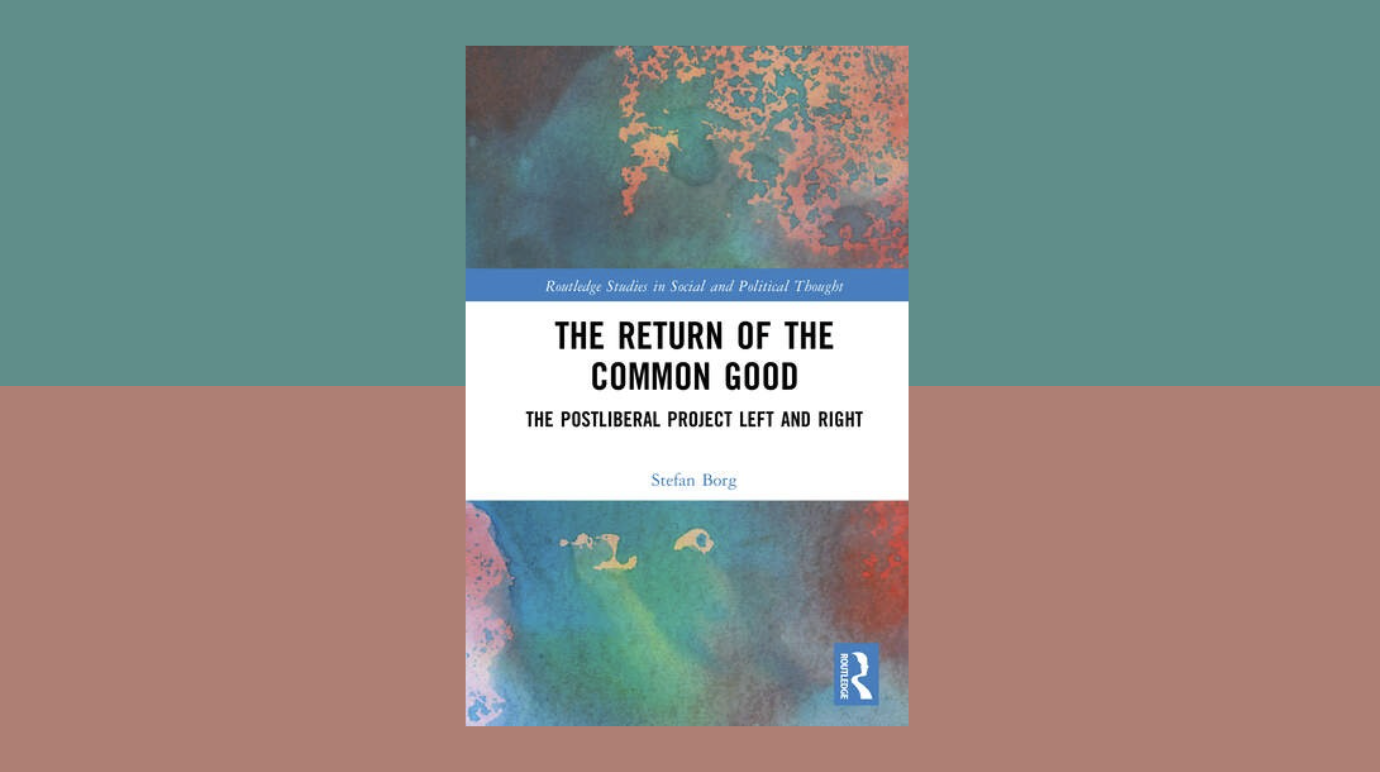
Stefan Borg, The Return of the Common Good: The Postliberal Project Left and Right. Routledge, 2026. $200.00, 162 pp.
As someone who has been a self-identified postliberal since around 2010, I have been waiting for a book like this for years. Postliberal political theory has recently become a focal point of intense—and often hostile—attention. Critics routinely accuse postliberals of misrepresenting liberalism, failing to offer constructive alternatives, or advancing proposals that amount to thinly veiled authoritarianism. At the same time, confusion persists about what postliberalism actually is, where it came from, and whether it constitutes anything more than a fleeting reaction to recent political developments.
For several years now, I have frequently been asked whether there exists a single work that could orient readers wholly uninitiated into postliberal political theory. Until now, I have had no monograph-length treatment to recommend—no book that offers a charitable, synoptic account of postliberalism’s intellectual genealogy, internal diversity, and shared concerns. Most existing works either fixate on one recent American faction or engage in sweeping denunciations that obscure the deeper continuities and substantive agreements animating postliberal critiques of the liberal order. In such accounts, opposition to liberalism functions less as an argument worth engaging than as a prelude to warnings about the dangers supposedly lurking beyond it.
This confusion has only been exacerbated by the way postliberalism is frequently narrated through the lens of the Trumpist moment. Too often, postliberal political theory is treated as little more than an opportunistic response to American populism or an attempt to capitalize on the ascent of President Trump. Meanwhile, postliberal discourse in the United States has taken on a more statist, tribalistic, and narrowly particularistic tone, intensifying uncertainty about its relationship to nationalism. Is Christian nationalism properly postliberal? Is postliberalism simply the political theology on display at National Conservatism conferences? In the absence of careful distinctions, critics—especially in academic and media contexts—have been quick to dismiss the entire discourse as intellectually reckless or socially dangerous for daring to challenge liberalism at a fundamental level.
Against this backdrop, Stefan Borg’s The Return of the Common Good: The Postliberal Project Left and Right arrives as a welcome—and much-needed—intervention. Borg’s aim is not to defend every postliberal proposal, but to clarify what postliberalism is, where it comes from, and why it deserves serious consideration. As he puts it in the introduction, the book seeks “to remedy this confusion and present postliberalism as a fully-fledged tradition of thought.” While acknowledging significant internal differences, Borg argues that postliberalism constitutes a coherent—if still underdeveloped and often misunderstood—critique of liberalism, one that has been ignored in part because of liberalism’s own hegemonic status. That critique, he insists, “ought to be taken seriously.”
Borg’s central claim is that postliberalism is unified by what he calls a shared “common project,” a claim signaled in the book’s subtitle. Despite their disagreements, major postliberal thinkers “mobilize a set of similar arguments about the historical trajectory of liberalism and share an understanding of, as well as having similar misgivings about, the liberal order.” They diverge over what should replace liberalism, but they are united in rejecting liberalism’s “one-sided preoccupation with maximizing individual autonomy” at the expense of goods that sustain political and social life. In Borg’s formulation, “the postliberal project may in part be defined as an attempt to resurrect the common good tradition.”
Accordingly, the appeal to the common good functions as postliberalism’s central normative standard. At its most basic level, postliberalism insists that claims of individual autonomy must be ordered toward, and constrained by, the flourishing of the political community as a whole. Politics should not be oriented primarily toward autonomy-maximization, but toward sustaining the conditions of shared life.
In its most ambitious form, Borg argues, postliberalism seeks to retrieve a more ancient and Christian conception of politics—one oriented toward virtue and genuine human flourishing—over against the liberal tendency to construe politics as a mechanism for securing individual freedom alone.
Importantly, Borg is careful to stress that this “common project” does not imply uniformity. He distinguishes between two broad branches of postliberalism: a British strand and an American one. While there is sufficient overlap to justify speaking of a single project, the differences between these branches—particularly their historical origins—are analytically illuminating. One of Borg’s most valuable contributions is to demonstrate that British postliberalism long predates both Donald Trump’s election and Patrick Deneen’s Why Liberalism Failed. On Borg’s account, postliberalism emerges in the 1990s and develops across theology, political theory, jurisprudence, international relations, and cultural criticism.
The term “postliberalism” itself (with reference to politics) was first deployed in the early 1990s by the British political theorist John Gray to name his growing disillusionment with liberal assumptions and liberal social orders. Yet Borg traces the deeper roots of British postliberalism to Radical Orthodoxy, the theological movement associated above all with John Milbank. Radical Orthodoxy mounted a far-reaching critique of secular modernity and “what is perceived as its chief ideological expression, namely liberalism.” Its foundational text is Milbank’s Theology and Social Theory (1990), which argued that liberalism rests on a secular ontology that displaces theology as the interpretive framework for social life.
Postliberalism assumed a more overtly political form in the aftermath of Labour’s defeat in the 2010 British election. Maurice Glasman founded Blue Labour, while Philip Blond—a student of Milbank’s and a contributor to Radical Orthodoxy: A New Theology—advanced related ideas under the banner of Red Toryism through the think tank ResPublica. Around the same time, the term “postliberalism” entered wider public discourse through figures such as David Goodhart, who popularized postliberal critiques of market society and social fragmentation. Across these expressions, British postliberalism combined a rejection of radical individualism and market atomization with an equally strong resistance to collectivism, emphasizing virtue, intermediary institutions, and local forms of belonging.
At the intellectual core of this tradition stands Radical Orthodoxy. Beginning with Theology and Social Theory and culminating, in Borg’s telling, with Milbank and Adrian Pabst’s The Politics of Virtue: Post-Liberalism and the Human Future (2016)—which Borg describes as “the most theoretically elaborate articulation of postliberalism” and “the most comprehensive statement of postliberalism currently on offer”—Radical Orthodoxy advances a comprehensive critique of liberalism as the ideology of the secular. Liberalism, on this account, insists on carving out a supposedly neutral public sphere free from theological commitments, reducing politics to procedural coordination among competing conceptions of the good. Radical Orthodoxy rejects this neutrality as illusory. Liberalism, Milbank argues, advances its own substantive moral vision, grounded in what he famously calls an “ontology of violence”—a vision of social reality that presupposes primordial conflict and self-interest rather than participation in the divine good. As Borg summarizes, Milbank’s project seeks to reinstate theology as a governing meta-discourse by which secular modernity itself may be judged, and to recover a Christian social vision as a genuine alternative to the liberal order.
Much of Borg’s account resonated deeply with my own intellectual trajectory. My engagement with postliberalism predates the Trump moment and developed independently of the American cohort associated with The Postliberal Order. Like many others, I was first prepared for postliberal arguments through engagement with communitarian thinkers such as Alasdair MacIntyre and Michael Sandel, as well as figures who bridge communitarianism and postliberal theology, notably Stanley Hauerwas.
Borg is especially helpful in making explicit the overlap between communitarianism and postliberalism. Postliberals share with communitarians a relational anthropology, a rejection of autonomous individualism, skepticism toward claims of neutrality, and a critique of negative liberty as liberalism’s core value. Yet Borg rightly resists collapsing the two traditions. Communitarianism emerged in a different historical moment and often exhibited a greater reluctance toward state action, and tended toward preservation of inherited social forms—which can drift in a more relativistic direction. Postliberalism—especially in its Radical Orthodox variant—is more overtly political and more explicitly theological, advancing a thicker normative account of political order and the common good.
The American branch of postliberalism, Borg argues, coalesces later, beginning with Trump’s election in 2016 and crystallizing with Patrick Deneen’s Why Liberalism Failed (2018), which Borg calls “the first defining work of U.S. postliberalism.” Deneen’s critique bears a clear communitarian imprint, hardly surprising given his exposure to the communitarian political theorist Wilson Carey McWilliams during his undergraduate years at Rutgers. Liberalism, Deneen argues, rests on an anthropology of voluntaristic individualism, a conception of liberty as autonomy-expansion, and a severing of the human person from nature. Far from limiting state power, this individualism generates statism: as social bonds erode, the state expands to manage the resulting disorder. Market capitalism intensifies this dynamic by commodifying desire while relying on regulatory expansion. Why Liberalism Failed is primarily diagnostic; Deneen’s later Regime Change (2023) advances more constructive proposals centered on the recovery of the common good. Borg situates these developments within the consolidation of American postliberalism around Deneen, Adrian Vermeule, Gladden Pappin, and Chad Pecknold in the early 2020s.
Despite these differences, Borg identifies three elements that unify postliberalism as a common project: a genealogical critique of liberalism’s internal contradictions, a social analysis of the orders liberalism produces, and a normative commitment to the common good.
First, postliberals broadly agree that liberalism is internally self-undermining. Its commitment to atomistic individualism proves corrosive not only to social life but also to the natural world. Liberalism systematically privileges the political and economic spheres over the civic and social, and this imbalance ultimately erodes the latter. Moreover, while liberalism presents itself as neutral with respect to substantive visions of the good, postliberals argue that it in fact enforces this purported neutrality as a comprehensive moral framework, often acting illiberally toward those whose substantive commitments conflict with it.
Postliberals identify liberalism as a decisive break with classical and Christian accounts of political order, and this is why Thomas Hobbes figures so centrally in their genealogy. Leviathan is commonly understood as “the most forceful articulation of the break with the ancients,” radically undercutting the foundations of common-good political theory. As Borg explains, “modernity is often understood as the process by which Hobbesian assumptions of the world slowly but steadily won out.” Hobbes’s conception of order as an artificial imposition of power designed to manage primordial hostility generates a pervasive suspicion toward social authority and inherited forms of life—one that, over time, functions as an acid on the social fabric. Contractarian models weaken the intermediary institutions that once mediated between the individual and the state, while liberalism’s commitment to negative liberty fosters mistrust toward the traditions, habits, and norms that sustain common life. In a market society these dynamics are further exacerbated, as social relations themselves are increasingly commodified. The result is a mutually reinforcing logic in which the abstract individual, the expanding state, and the market together erode the very sources of social cohesion and shared flourishing on which liberal order ultimately depends.
Second, postliberals analyze the social orders liberalism produces, with particular attention to the rise of a managerial elite. Drawing on James Burnham, Christopher Lasch, and Michael Lind, postliberals narrate the emergence of a professional class that governs institutions while remaining detached from the communities they administer. This elite combines technocratic power with cultural liberalism, advancing norms that corrode social solidarity while entrenching its own privileges.
Before turning to the third element, Borg clarifies a frequent misunderstanding. Critics object that postliberals offer an overly narrow, one-sided account of liberalism. Borg concedes that postliberal critiques are not primarily exercises in textual reconstruction. But this, he argues, is precisely the point. Postliberals treat liberalism not merely as a theory but as a sociopolitical project whose consequences matter more than its internal nuances. The question is whether liberal societies can sustain the goods they require to function.
This leads to the third element: the recovery of the common good. Drawing on Helen Rosenblatt’s authoritative history of liberalism, Borg acknowledges that earlier liberals often affirmed the common good, but he argues that contemporary liberalism—exemplified by John Rawls—treats it as politically inaccessible. Under conditions of pluralism, Rawls contends, the state must remain neutral and secure fair procedures which allow individuals to pursue their disparate ends rather than promote substantive goods. Postliberalism rejects this premise, seeking to recover a politics ordered toward virtue rather than autonomy.
Borg identifies three postliberal approaches to the common good: pluralist, common good conservatism, and integralism. The pluralist approach, associated with British postliberalism and Michael Lind, emphasizes an open-ended pursuit of the common good through dispersed power, corporatist institutions, relational economies, and strong civil society. Deneen’s common good conservatism places greater emphasis on tradition, social stability, and popular wisdom, articulated through his concept of “aristopopulism.” Integralism, associated with Vermeule, offers the most programmatic and state-centered approach, insisting that political authority should actively promote substantive goods.
Borg’s typology usefully dispels the claim that postliberalism lacks constructive proposals. Yet the book’s greatest strength lies in re-centering the common good itself—an emphasis increasingly eclipsed by the association of postliberalism with nationalism.
Echoing his earlier point about communitarianism, Borg argues that postliberals are opposed to radical conservatism in that they are not primarily motivated by the preservation of a given social order—a posture that can easily slide into relativism. And, as Oliver O’Donovan demonstrates in Ways of Judgment, nationalism often functions as a species of identity politics, which postliberals recognize as an expression of liberalism. Postliberals can concede that nationalist critiques of liberal universalism have real force, particularly insofar as liberalism tends to universalize late-modern Western norms. Yet nationalism, Borg suggests, frequently replicates liberalism’s own pathologies. It retreats to a Hobbesian state of nature at the international level and reduces political judgment to collective self-interest—merely scaling liberal individualism and liberalism’s “ontology of violence” up to the level of nations.
By contrast, Borg shows that postliberals insist on the irreducible universality of the Christian faith, even while affirming the necessity of historical and cultural particularity. As he puts it, “[U]niversals must always find expression in historically instantiated particulars …. Universals are never fully disclosed outside of their (always imperfect) instantiations in particulars.” Where strands of the dissident right radicalize particularity and lapse into an ontology of violence—now transposed to relations between nations—postliberals such as Pabst and Milbank advance a form of Christian internationalism. We should understand nations as neighbors—each seeking in its own way to instantiate the good, with the common good itself requiring forms of international cooperation. On this view, postliberalism decisively rejects frameworks such as Samuel Huntington’s “clash of civilizations” thesis.
The book also draws attention to the “sex-realist feminists”—figures such as Louise Perry, Christine Emba, Erika Bachiochi, and Mary Harrington—showing how their work advances distinctly postliberal arguments. In particular, they critique contractarian accounts of sexual relations, the commodification of intimacy, the equation of libertinism with empowerment, and what Harrington terms “bio-libertarianism.” This strand of thought is rarely included in standard mappings of postliberalism, yet Borg persuasively demonstrates its family resemblance to the broader postliberal project. On this point, I am entirely in agreement: these thinkers deserve to be recognized as an integral part of the postliberal conversation.
There are, however, areas where Borg could go further. He rightly notes that not all postliberal positions are wholly or uniformly antiliberal, and he gestures toward the ways liberalism emerged by abstracting and radicalizing certain Christian principles. I would press this insight further: liberalism is best understood as a Christian heresy—or, in Oliver O’Donovan’s formulation, the “prodigal child” of Christendom. Liberalism represents, to borrow G. K. Chesterton’s phrase, a set of Christian “virtues gone mad.” Insofar as liberal orders continue to draw on moral capital they cannot themselves reproduce (à la the Böckenforde dilemma), that capital must be re-tethered to the Christian whole from which it was severed. On this view, the task is not simply to oppose liberalism but to call it home—to re-anchor its moral claims within the ecclesial and theological framework that once gave them coherence and limits.
Indeed, this points toward a deeper omission. Borg would benefit from drawing the theological thread more consistently throughout the book. Postliberalism—especially in its Radical Orthodox forms—is not merely a sociological critique but a theological one. Postliberals do not merely criticize liberalism for its deracinating social effects—for eroding the resources that sustain common life, producing increasingly atomized individuals alongside an ever-expanding state—but also for its desacralizing logic. This dimension is central to John Milbank’s argument in Theology and Social Theory, where the very category of the “secular” is exposed as a historical and conceptual invention—one that, though emerging from within the Christian tradition itself, was progressively hardened in modernity into a domain conceived as wholly autonomous from and impermeable to theological judgment. At the heart of Radical Orthodoxy, and thus of postliberalism more broadly, is the insistence that theology be recovered as a governing meta-discourse—the regina scientiarum by which other forms of knowledge are ordered and judged.
This theological critique carries an implication that Borg only partially develops: political order is never religiously neutral. Borg notes that postliberals expose liberalism’s claim to neutrality as illusory and highlight its substantive moral commitments. Yet he stops short of drawing the full implication—namely, that such commitments are always and inevitably theological. He comes close when he observes that deviations from liberal orthodoxies are often treated as a form of “secular sinning,” but he does not carry the point far enough. Every political order, liberal ones included, necessarily renders judgments about God, religion, and their relevance to social life and human flourishing. Borg rightly shows that postliberals understand the human person as socially constituted and embedded in thick networks of relationships. But the most fully Christian expressions of postliberalism press further still, insisting that human beings are situated within a theological horizon, ordered toward God. Without foregrounding this claim, postliberalism risks being reduced to institutional reform rather than a challenge to liberalism’s spiritual architecture.
Finally, Borg largely omits a crucial postliberal strand: ecclesiocentric postliberalism, represented by the Communio school and figures such as David L. and D. C. Schindler, as well as Peter Leithart and the Civitas network. Though largely North American, these thinkers stand closer to the theological and ecclesiological concerns of Milbank and Radical Orthodoxy than to the more overtly political forms of American postliberalism—complicating Borg’s neat British-American divide. What unites them is the insistence that the Church is not a voluntary association concerned exclusively with “private” and otherworldly realities, but a public body. To be sure, Borg does note that Deneen gestures in this direction, particularly in his critique of post-Westphalian nationalism, wherein the modern state sought to eliminate rival claims to sovereignty—above all those of the Catholic Church. In this settlement, the Church was progressively reduced by secular sovereigns who claimed the authority to determine the boundaries of acceptable religion within their respective realms. Yet Borg does not develop this line of analysis beyond a brief summary of Deneen’s point. Moreover, he appears to treat the Church as merely one intermediate institution among others situated between the individual and the state.
What is missing—and what the Communio and Civitas strands of postliberalism help recover—is the political significance of the Church itself. Borg rightly highlights how postliberals critique liberalism for recognizing only non-state communities formed on liberal premises: voluntary associations of contracting individuals pursuing shared interests. The Church cannot be understood in these terms. She is not simply one voluntary society within civil society, constructed by individual choice and ranked beneath the state. She is a reality that confronts all persons. She is the body of Christ on earth (Rom. 12; 1 Cor. 12; Eph. 1; Col. 1), the pillar and bulwark of the truth (1 Tim. 3:15), and the Christian’s more ultimate family (Matt. 12:48–50), nation (1 Pet. 2), and polis (Eph. 2:19; cf. Phil. 3:20; Heb. 12:22–23). The Church is the most comprehensive community, summoning all persons and, in doing so, relativizing and challenging the totalizing claims of other social bodies and purported sovereigns. Yet she does so not by withdrawing from history, but by seeking to be instantiated within every society and to receive—purified and redeemed—the fruits of each. Precisely as a multinational and transnational body, the Church also serves as a source of reconciliation and healing among the nations.
Leithart explains how liberalism systematically marginalizes the Church by reshaping its ecclesiology, focusing especially on the foundational figures of Thomas Hobbes and John Locke. Hobbes, Leithart contends, domesticated the Church by subordinating it to the civil sovereign, thereby resolving the problem of divided loyalties between temporal and spiritual authority. Locke, by contrast, domesticated the Church by spiritualizing and privatizing it, reducing it to a voluntary association concerned with inward belief rather than public truth. In both cases, liberalism strips the Church of any genuinely public status.
Leithart’s analysis here echoes the work of the sociologist of religion José Casanova, who has argued that the liberal state’s “preferred form of religion” is a privatized one. On this account, the liberal assumption is that religion is—and ought to remain—a “private affair.” The consequence is that the Church is stripped of any genuinely public status. It is no longer understood as a commonwealth (πολιτείας), no longer a society of “citizens” (συμπολῖται) gathered in the public assembly of the household of God (Eph. 2:12, 19). Instead, the modern liberal order ultimately recognizes only two actors as politically salient: the sovereign individual and the state. By marginalizing the Church as a public body, liberalism effectively eliminates any competing form of authority or allegiance.
Modern liberal orders have sought to privatize religion and to emancipate social life from ecclesial authority. The Church’s jurisdiction is thereby restricted to those who voluntarily choose her, while the state is increasingly treated as a comprehensive authority from which no one may opt out. Over time, the state comes to be viewed as the most ultimate and indispensable community, and loyalties once oriented toward the Church are gradually redirected toward political sovereignty. Liberalism’s deepest error, according to these postliberals, is its ecclesiological one: privatizing the Church while rendering the state ultimate. Any postliberalism that fails to recognize this fundamental ecclesiological heresy at the root of the liberal order—and the religious dangers it entails—remains incomplete.
Despite these omissions, Borg’s book is an indispensable primer on postliberalism. It is the clearest, most charitable map of the terrain currently available—and it will be my default recommendation … at least once it appears in paperback.
The Weekly Digest
Premier Thought Every Thursday.
All of our recent essays and podcasts, delivered to you. Free.
Free. Delivered Thursday mornings.