

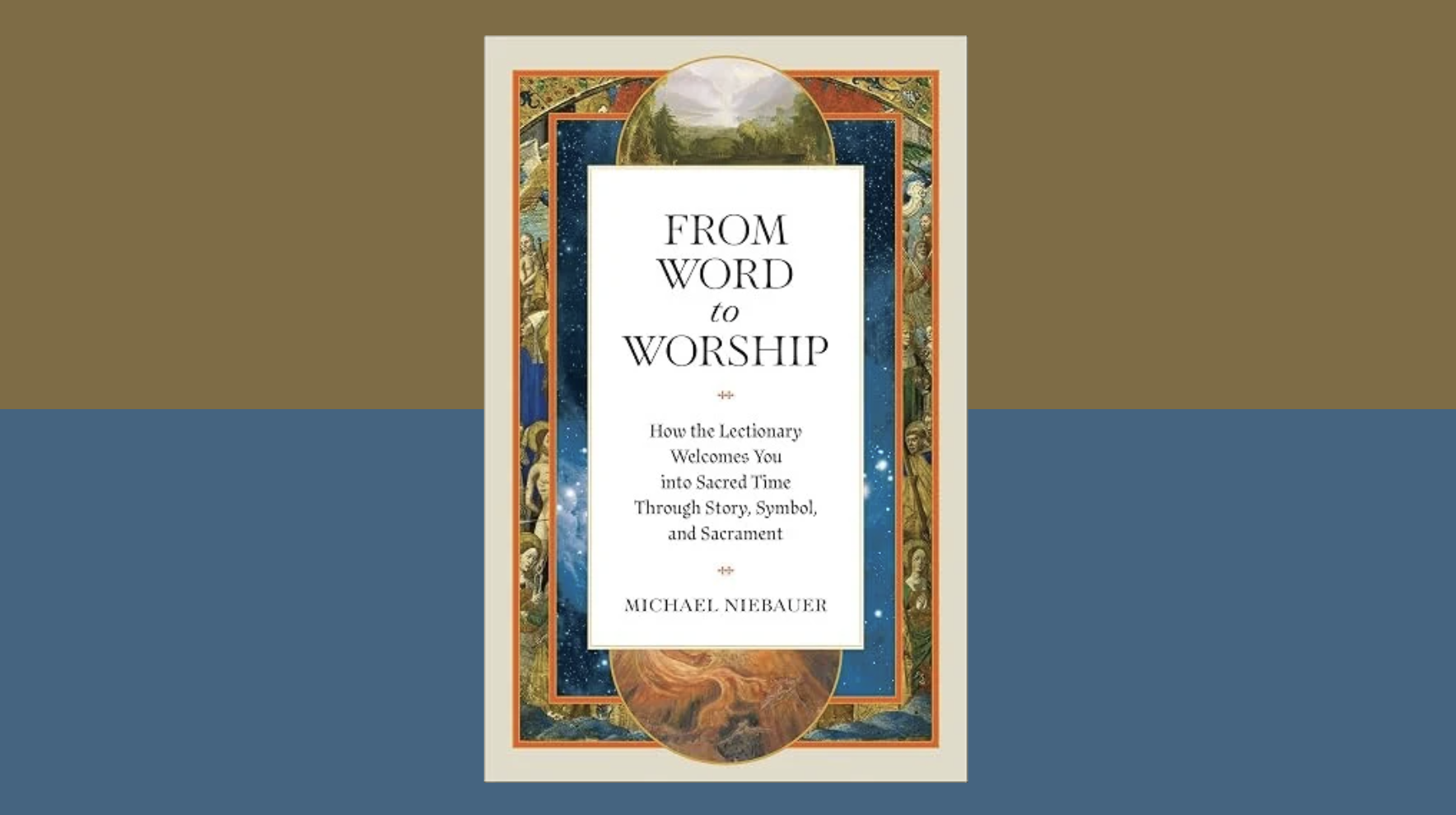
This essay is adapted from Michael Niebauer's new book From Word to Worship: How the Lectionary Welcomes You into Sacred Time Through Story, Symbol, and Sacrament.
For the past 2,000 years, most churches gathered together on Sundays to hear Scripture read aloud according to a set schedule of readings (called a lectionary) tied to the seasons of the Church. While the use of a Sunday lectionary remains the norm in Roman Catholic and Orthodox churches, it has almost entirely been lost in Protestant and Evangelical circles. Many of the Protestant churches in the West that continue to use a lectionary are in rapid decline, and the non-denominational churches that have taken their place typically prefer topical sermons or sermon series. Many contemporary Reformed and Baptist churches likewise prefer either topical sermons or expository sermon series that go through single books of the Bible.
While there are advantages to these approaches to preaching, the use of a lectionary as the principal guide for preaching enables a unique and rich encounter with God’s Word that these other approaches often lack. My new book From Word to Worship helps Christians discover the rich connections between each of the four weekly lectionary readings, as well as the relationship between these readings and the liturgy and seasons of the Church. It is meant to help any church that uses some form of three-year lectionary, and invite those that don’t use a lectionary to consider adopting one. What are some of the advantages of using a Sunday lectionary?
Disciplined Preaching
First, the lectionary disciplines the preaching of the congregation. One of the best parts of the Sunday lectionary (either its one-year or three-year vintage) is its givenness—the scripture readings for each Sunday are scheduled in perpetuity, and as a result everyone knows what passages will be read and preached upon well in advance. This disciplines the congregation to hear, and pastors to preach, from portions of the Bible they would otherwise avoid. Scripture, not the pastor, sets the preaching agenda. While this might seem restrictive for pastors, it can actually be quite freeing: it relieves them of the burden of trying to be mind-readers, or worse yet, amateur sociologists, trying to intuit the needs of the congregation and pick passages to meet those needs.
Additionally, the use of a Sunday lectionary disciplines the preaching expectations of the congregation. Church members know in advance what Scripture is going to be read, and they should come expecting the sermon to emanate out of those texts. This is particularly important in an age in which Christians have become accustomed to expecting sermons that touch on hot-button political and cultural issues. When people show up expecting to hear sermons based on the headlines, they will inevitably be disappointed, since the pastor cannot possibly satiate such varied and idiosyncratic preaching demands of every single parishioner.
I often hear this complaint from my evangelical pastor friends: “I have parishioners leaving because my preaching is too political, and I have parishioners leaving because I am not political enough.” Using the set schedule of readings in a Sunday lectionary can help to remedy this issue. Pastors can reinforce in their congregations that they should show up each Sunday expecting to hear about the scheduled Bible readings—no more and no less.
Emphasizing the Divine Authorship of Scripture
Second, the lectionary prioritizes the divine authorship of the Bible. Scripture is the Word of God written through human hands inspired by the Holy Spirit. This is often referred to as the dual authorship—human and divine—of the Bible. Much of contemporary Biblical interpretation, and the preaching which flows from it, starts first with the human authorship of Scripture. Most commentaries, for instance, begin with an analysis of the estimated date of composition and the identity of the human author of a specific Biblical book. The application of the Biblical text to the Christian life then flows out of historical, lexical, and archeological research. Expository preaching likewise typically starts with historical backgrounds and grammatical analysis before moving on to application for the church.
While there are benefits to such an approach, its weakness is the potential to diminish the interpretive range of Scripture. The meaning of any given passage is here whittled down to whatever one posits to be in the mind of the human author at the time of writing. But Scripture is the Word and words of an infinite God, and because God is the ultimate author of the Bible, there will always be a surplus of meaning behind any particular passage of Scripture—meaning that stretches well beyond the original date of composition, and well beyond what was even known to the human authors who composed it.
For instance, God intends for the crossing of the Red Sea to be an event that discloses to us part of the meaning of Christian baptism. Christians believe this to be true even if Moses had no knowledge of Christian baptism, and it is a meaning that cannot be found through an assessment of the original composition of Exodus. We can assert this truth because we believe that God, not Moses, is the ultimate author of Exodus. Prioritizing human authorship can often diminish our ability to see the many faithful interpretations embedded in Scripture.
The lectionary, in contrast, invites us to prioritize the divine authorship of the Bible. Rather than going book by book through the Bible, starting with the historical context of each book, the lectionary presents to us biblical passages (lections) that are explicitly taken out of historical context. When one attends a service of a church that uses the lectionary, one can hear a slice of the Old Testament, a Psalm, another slice of an epistle, and finally a Gospel reading.
If we think of the Bible only as a collection of individual books with discreet human authors, such a selective process would be odd at best, or even dangerous. But if the Bible truly is written by God, then reading various selections from various books written over thousands of years is quite natural. It is akin to going to a book club to discuss Pride and Prejudice, where discussion can jump seamlessly from chapter to chapter as one discusses various themes and characters. One can do so because one assumes that the book is a cohesive whole written by a single author. Likewise, if we assume Scripture is a unitive whole written by God, we should be able to move seamlessly from book to book, drawing faithful connections from text to text, and in turn growing deeper in our love and knowledge of God.
Hearing Scripture in Community
Third, the lectionary prioritizes the hearing and performing of Scripture in community. Most of us are accustomed to encountering the Bible primarily through reading it: on our own, in a Bible study, or in a classroom. We see words on a page and think about the significance of those words for our lives. While reading is a vitally important way of encountering Scripture, the Bible is also meant to be heard out loud within the gathered congregation.
It is supposed to be read out loud as part of one event—corporate worship—that also includes prayer, praise, fellowship, and the reception of the Eucharist. Within this context, the congregation is encouraged to see the connections between the Bible and the church’s worship, where it is called to enact and perform the content of the Bible. We are called not just to be readers of Scripture, but hearers and doers, and Sunday worship is the primary place we do the hearing and the doing.
The lectionary arranges Scripture so that we can easily make this connection: we hear passages about fire and judgment, we see the fire of candles, and we respond in an act of repentance. We hear passages about manna and the bread of life paired together, and we are invited to live out these passages by tasting the body of Christ at the Eucharis. I wrote From Word to Worship to draw out these connections, so that both pastor and congregation might better see the relationship between Scripture, liturgy, and the seasons of the church.
My hope is that more churches would adopt some form of either the traditional one-year or three-year Sunday lectionary to guide their weekly encounter with Scripture. Preaching out of the lectionary does not preclude the occasional topical sermon or expository series, although it should be noted that such approaches to Scripture can also be utilized outside of Sunday mornings, such as in Christian education classes or mid-week Bible studies. Those churches that choose to utilize a lectionary will discover an ancient, faithful encounter with God’s word that highlights the rich harmonic interconnectedness of Old Testament, New Testament, liturgy, and the life of the people of God.
The Weekly Digest
Premier Thought Every Thursday.
All of our recent essays and podcasts, delivered to you. Free.
Free. Delivered Thursday mornings.