


There was a time when Wendell Berry was a passionate and even amusing critic of Christianity. This is seen perhaps most explicitly in one of his earliest published essays, "The Long-Legged House."
In the essay, Berry describes the experience of repairing an old cabin built by a relative of his. That cabin would become the home that he and his soon-to-be wife would move into it after their wedding. (For long-time readers of Berry’s work, the cabin by the river that Jayber Crow moves to in his dying days is the fictional imagining of this actual cabin where Mr. and Mrs. Berry began their married life together.) Much of the essay is taken up with the meaningfulness of the work of restoring such a place, the ways in which that work tied Berry to his place and his people, and how the preparing of that place for his wife would also set something of a course for their life together.
Then Berry turns to the church, an institution about which he had virtually nothing to say up to that point. But as the wedding grew closer, it became impossible to avoid the church—which is what Berry had been doing quite happily and successfully. When you read his account of things, it is hard to blame the man for wanting to stay well clear of the church:
Our wedding reminds me a little of the Kentucky Derby. The main event, which lasted only a couple of minutes, required days of frantic prologue. During this commotion one must discontinue one’s own life and attempt to emulate everybody. Nobody can be still until convinced that this marriage will be like everybody else’s. The men insinuate. The women gloat. The church is resurrected and permitted to interfere. As at funerals, the principals cannot be decently let alone, but must be overhauled, upgraded, and messed with until they are not recognizable.
During the week up to and including the wedding I am sure I was at the center of more absurdity than I hope ever to be at the center of again. One of my unforgettable moments, as they are called, was a quaint session with the minister who having met me for the first time that moment, and being scarcely better acquainted with Tanya, undertook to instruct us in the marital intimacies. A display of preacherish cant and presumption unusual even for a preacher, and all carried out with a slogging joyless dutifulness. As we were leaving he handed us a book on marriage.
In a country less abject before “expert advice,” the effrontery of it would be incredible. Well, be damned to him and his book, too. We thrive in spite of him, and in defiance of some of his rules. We are, I like to think, his Waterloo—though I know that, like most of his kind, he had come to his Waterloo before that, and survived by his inability to recognize it.
The text is obviously Berry, though written when he was only in his early 30s: You can hear the language of his male characters in it—of Jack Beechum and Carter Keith and Nathan Coulter. The phrase "survived by his inability to recognize it" is also vintage Berry and a classic example of his ability to find simple, under-stated ways of making a devastating critique. The disdain for "experts" is there as well, as is the revulsion at ostentatious displays. It is not at all surprising to think that the man who wrote these words would, within only a few years, write The Memory of Old Jack. Indeed, we can find a similarly disdainful attitude toward the church in that book, the first of Berry's truly great novels, alongside Jayber Crow and Hannah Coulter.
In this particular case, the church manifests as villain in the final pages of the novel, as the departed old farmer Jack Beechum is fraudulently reconstructed as a dutiful son of the church by his affluent and spoiled daughter, Clara, who hasn't known her father well for at least 30 years, if she ever did at all. In a particularly pointed passage, Beechum's true heir and closest relative, Mat Feltner, instructs the preacher to simply read a few Psalms at a small graveside service. When the preacher ignores Mat's request and launches into a showy and dishonest prayer after reading the Psalms, Berry describes Mat's reaction to this fictionalized version of "preacherish cant":
And then Mat exercises for the first time his prerogative as the oldest man. He turns his back and gazes upon his fields.
The gesture is subtle, perhaps even polite in its own way, yet its meaning is unmistakable: For Berry, at this time at least, the church is merely one of the institutions of the world, seeking to make better theoretical persons in better theoretical places, without any recognition of the world as it is, of people as they are, and gratitude for all the good things we have. The church, like virtually all other institutions, is perpetually trying to improve its members, exhorting them to make something of themselves. None of them see and love the world as it is, see and love people as they are. They only love imagined, far off places and imagined, far off people who exist only in the false prayers of mendacious preachers.
There is another passage in Old Jack that names the failure Berry recognizes in the church, but not in the church alone; it is a failure of imagination, a failure of seeing. In the passage I am about to quote, Mat Feltner is reflecting on the bizarre life of a couple renting a home from him on his property. This couple, the Berlews, are travelers, thrill chasers. They avoid hard work as much as they can, seeking only to work enough to make enough to facilitate their thrill chasing.
For the privilege of such a life they end up working far harder to maintain their old car that facilitates that life than they ever would dream of working in the day for pay.
Then Berry remarks, comparing the Berlews with Beechum's extremely rich and successful daughter and son-in-law the Pettits,
It comes to Mat suddenly—so that he first grimaces and then grunts—that the Berlews and Pettits represent the two halves of the same distraction. What the Pettits are is what the Berlews dream of being. Is not the Berlews' old car the hopeless dream of a Cadillac? Is not their tireless going a persistently frustrated pilgrimage in search of Easy Street? That the Pettits live on Easy Street makes no essential difference between them and the Berlews. If the Pettits are what the Berlews would like to be, they are also what the Pettits would like to be; they have imagined nothing higher than they are.
We could put it this way: There is a way we people, perhaps especially we modern people, have of imagining nothing higher than we are. And once we have started from that point, there is some sense in which Christianity can't help us. It can only be abused and twisted and perverted by us. This is what Berry recognized: The church we find in "The Long-Legged House" and The Memory of Old Jack is a church that simply takes for granted the belief that this world has nothing worthy to offer us. These churches believe without thought or question that the only good thing in this life is to seek to save our own souls out of the world—and if that is the only thing of ultimate importance, than everything else doesn’t much matter, which perhaps explains why such radical spiritualism can often be found closely associated with rampant materialism and spiritual complacency. The ease with which a kind of fundamentalist Baptist or Methodist Christianity of the old south can be melded with a life that imagines nothing higher than we are is actually quite astonishing: Christianity simply becomes one means of serving ourselves (by giving us a sense of superiority), of exalting ourselves (by highlighting our own righteousness in the eyes of others), of protecting ourselves (by acquiring the requisite fire insurance to protect our immortal souls).
You might say that this is a Christianity that lacks both a doctrine of creation and a doctrine of resurrection; it is bloodless and disembodied and, for precisely those reasons, has very little to offer the world and very little of use to protect its members from violating themselves, their neighbors, and the world.
This is a point worth lingering over. There is a passage in the Gospels where Jesus warns the religious leaders that all their religious teaching serves only to make their followers twice the children of Hell that they themselves are. The Christianity we encounter in Berry's early work is one example of how that can happen. Only leave the great idol of the heart—the supremacy of the self—unchallenged and Christianity, of a kind at least, becomes a tool for spreading and facilitating unimaginable wickedness.
To put it another way, when Berry looked at the goodness of the world he walked about in every day and set that against what he found in the church, he found the church's account of goodness entirely inadequate. Indeed, he found the church routinely taking the side of evil while the world itself shined unnoticed. What Treebeard says to Merry and Pippin in The Lord of the Rings could just as well be said by the land and, perhaps, by Berry himself in Berry's fiction: "Side? I am on nobody's side, for nobody is altogether on my side."
It's important to understand this because this is a different sort of objection to Christianity from those familiar to most Christians. It is not claiming that Christianity’s moral norms are stuffy or antiquated. It is not an objection founded on some sort of moral relativism, or even on some sort of strong moral critique against Christianity.
The failure, as someone like Jack Beechum would see it, is that he lives "hard up against mystery" every day (to use a phrase from Jayber Crow) and when he sets what he sees in the world, both its beauties and its many evils, he simply finds the Christian account to be small and stuffy, and, as a result, deeply unconvincing. Christianity is too small for the men of Berry's novels—the gratitudes and mercies they receive every day by virtue of their life as human beings (and, particularly, as farmers) seem far more real to them than anything they ever heard in a church.
It's not that there is some negative criticism of Christianity that Berry accepts and this prevents him from believing; that framing presupposes belief as a kind of default mode which will only be deviated from if presented with some sort of sufficient obstacle. But that isn't how the early Berry regards Christianity. It's not that Christianity is necessarily immoral or corrupt or unjust. It's that when Berry encounters the given earth with its pleasures and mercies and difficulties and sets it against Christianity he finds the world far more beautiful.
That, I think, is why Christianity, though seldom treated kindly in Berry's early work is also not something he spends an immense amount of time addressing. Berry is not a misotheist, a god-hater, in the way of a Nietzsche or a Christopher Hitchens. Religion is almost wholly absent from The Memory of Old Jack and from most of Berry's short stories, for example, and most of his early essays. To the degree he considers religion at all, it is simply as one more example of an institution more concerned with its own life than the life of the world and filled with people more concerned with their own lives than the lives of others or of their place.
And yet that is not where the story ends. By the time we come to Jayber Crow, published in the early 2000s, Berry has retained many of his criticisms of certain Christian communities and even of certain Christian ideas. But the tone is measured and careful, as if he has learned to do what Frederick Douglass learned a hundred years prior: to distinguish between a sort of Americanized folk Christianity aimed at self-exaltation at the expense of all else and the "pure peaceable" Christianity of Christ. The point is not that the theological questions have evaporated for Berry, or at least for Jayber Crow. They don’t. They linger. But the experience of living in the world and finding love in it caused Jayber to reconsider his relationship to the faith—and in the Gospels, at least, he finds an account of love that anchors and deepens his own experience of it.
And so the rage we find in Berry’s older work has dissipated by the time we arrive at Jayber Crow. What remains is an ordinary man vexed by certain theological questions still, yet convinced that God's mercy can work to overcome any evil and that Christ's law of love is the pinnacle of moral wisdom. How did this change happen?
A neglected volume of essays published in the early 1980s provides an answer—and for my money this particular volume is Berry's greatest accomplishment as an essayist. The collection is called Standing by Words and in it Berry considers poetry, poetic forms, the limits inherent in language, and how all these things relate to the ways we imagine the world. Why is it the volume that is so pivotal in his reconsideration of Christianity?
I think the answer is here: What Berry knew all along is that he found the life of the world more entrancing and satisfying than the life of the church as he knew it. What becomes apparent in Standing by Words is that he needed an account of why the life of the world is marked by the beauty, abundance, and superfluity that so delighted him. The answer he comes to, through various means, is that the life of the earth is marked by forms that it did not choose for itself, so to speak, but also cannot be overwritten, erased, or remade without causing great and unnecessary harm. The good life and our capacity for good work are both largely bound up with how we are able to relate to the order, place, and people that have been given to us. When we regard these things with indifference, rage, or contempt it turns out that we can violate the fields that Mat Feltner turned toward in Old Jack just as easily as we can violate churches or universities.
What Berry is reckoning with in this collection of essays is the way in which his own callings as both a writer and a farmer have been compromised and set at odds with the givenness of things, coming under the sway of specialization and control and so being drawn out of the world, one might say. In the first essay of the volume, in which Berry laments the "specialization" of poetry he writes, "the poet is isolated and specialized and.. the old union of beauty, goodness, and truth is broken." Later he continues, writing about poets in much the same way he had previously written about bankers and professional religious people:
One of the oldest doctrines of specialist-poets is that of the primacy of language and the primacy of poetry. They have virtually made a religion of their art, a religion based not on what they have in common with other people, but on what they do that sets them apart. For poets who believe this way, a poem is not a point of clarification or connection between themselves and the world on the one hand and between themselves and their readers on the other, nor is it an adventure into any reality or mystery outside themselves. It is a seeking of self in words, the making of a word-world in which the word-self may be at home. The poets go to their poems as other people go to the world or to God—for a sense of their own reality. ...
It may be argued that this emphasis was in some sense forced upon poets by their peculiar isolation in a society dominated by specialists of more practical kinds. But this way of looking at language and at poetry also completes and enforces the isolation of poets, not just within a sort of literary ghetto or subghetto, but within themselves. Mark Strand is evidently not the only poet who would say that, 'the self in a sense is all we have left.'
There are strong echoes here of what Berry wrote of the Berlews and Pettits in The Memory of Old Jack, but whereas in Jack Berry seems to isolate that narrowed spirit, in "The Specialization of Poetry" he is suggesting that it has become ubiquitous. In Old Jack the villains are bankers and drifters and the heroes are farmers. By the time we come to Standing by Words Berry is reckoning constantly with the ways in which farmers and poets–his two vocations–can be just as complicit in the unmaking of places as the bankers and drifters. The problem, in short, can’t be concentrated or distilled down to “corrupt institutions indifferent to the health of the land smothering men like Jack Beechum.” The problem Berry wants to address strikes at the heart of what it means to steward both land and language, the two great preoccupations of Berry’s life.
What this means is that he no longer can focus his ire primarily on bankers, like the Pettits, or lazy dreamers, like the Berlews. Rather, he has had to turn this critique loose on everyone, including the people closest to him and, indeed, on himself. But then that also suggests that the contest we see at the end of Old Jack in which Mat Feltner turns away from the rude and pontificating preacher to turn toward the fields is not quite so clear as that image might suggest. The fields themselves can become a subject of "specialization" and can themselves be cut off. If you are seeking an escape from preacherish cant, it is no sure thing that you will find it in the fields. You might find the same desecration there that one can find in so many other places.
It turns out that one cannot simply pit the life of the world against the life of institutions. Rather, even the world itself can, in the twistedness and lostness of human beings, be set against the life of the world. It is a challenge to see the life of the world truly. And if it is a challenge, that suggests that aids are needed in order to do so. This is where we begin to see a reconsideration of Christianity in Berry's work.
In the essay, "Standing by Words," Berry considers the problem of language and naming in ways quite similar to what Lewis sought to address in The Abolition of Man. And he comes to quite similar answers, though he gets there via a different route. The problem, for Berry, concerns the ways in which language itself becomes divorced from any kind of external control or referent aside from power and will.
He rightly sees that the health of the world and of people and their many communities is dependent on the notion that words stand for something real; language is not simply an expression of tastes or a tool for acquiring power. Language is how we try to name what is real and true and worth living for. The trouble is that when language becomes materialized or politicized, it loses its referent. He illustrates the point with two diagrams, one of which he suggests is a model of healthy communal and natural life while the other is the industrial semblance:
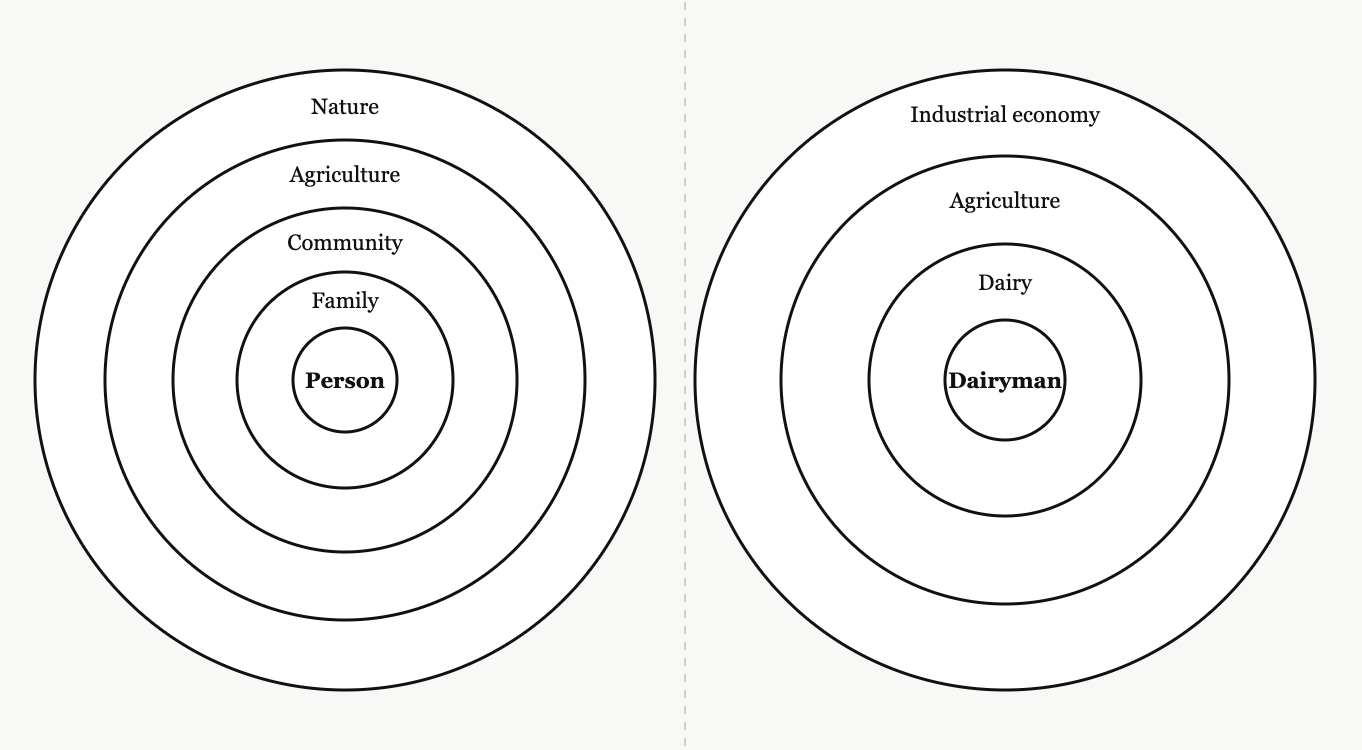
In the first diagram, everything that is part of our life in the world is encompassed in some sense. The second, by contrast, has removed anything that can’t be quantified or financialized. This is how Berry names the change that happens when you move from the economy depicted in the first diagram to the economy of the second diagram:
So long as the smaller systems are enclosed within the larger, and so long as all are connected by complex patterns of interdependency, as we know they are, then whatever affects one system will affect the others. It seems that this system of systems is safe so long as each system is controlled by the next larger one. If at any point the hierarchy is reversed, and the smaller begins to control the larger, then the destruction of the entire system of systems begins. This system of systems is perhaps an updated, ecological version of the Great Chain of Being. That is, it may bring us back to a hierarchical structure not too different from the one that underlies Paradise Lose–a theory of the form of Creation which is at the same time a moral form, and which is violated by the ‘disobedience’ or hubris of attempting to rise and take power above one’s proper place.
What does Berry propose to fix this? As is implied above, he suggests that what we need is a category above 'nature' that controls and names it, and that category, he suggests, is "religion.” The issue he sees is that his “system of systems” is fragile and easily destroyed because its only measure is truth and truth is easily ignored or suppressed. A moral witness is needed from outside Berry’s system, something to help the members of a community recognize why it is good for them to tune their lives to the lives of neighbors and the life of the world. That something, he thinks, is religion:
There is no reliable standard for behavior anywhere within the system of systems except truth. Lesser standards produce destruction–as, for example, the standards of public relations make gibberish of language. The trouble, obviously, is that we do not know much of the truth…. And so yet another term has be introduced. The system of systems has to be controlled from above and outside. There has to be a religious interest of some kind above the ecogenetic. It will be sufficient to my purpose to say simply that the system of systems is enclosed within mystery, in which some truth can be known but never all truth.
In other words, the members of the world can never know the world exhaustively. And so a certain deference to mystery and to our own creaturely ignorance is often necessary to prevent us from committing monstrous acts. You might say that this is Berry’s articulation of the famous Chesterton’s Fence aphorism in which the British writer G. K. Chesterton said that a fence should never be knocked down by someone who doesn’t know why it is there. The only time it is safe to knock a fence down is when you do know its purpose and can explain why it is no longer needed. The recognition of ignorance, in other words, should provoke us toward gentleness, caution, and care–and this provocation, Berry thinks, is what is needed to preserve healthy places, which include the land and the people living from the land.
Interestingly, Berry actually pressed the religious language even further. Earlier in the essay he had teased at this solution when he suggested that the Christian doctrine of the Incarnation would offer a way of grounding our language, such that we can claim that our language is not simply taste or power-grabbing, but can actually be an attempt to speak of reality. Specifically he argues that in the Incarnation true Word and true Flesh are found together, suggesting that not only should we try to speak of reality truly, but that we actually can.
In other words, by the time we arrive at Standing by Words Berry has become aware that the deeper evil he wants to oppose is a kind of human wilfulness that, flowing out of the idea that there is nothing higher than ourselves, reduces everything it finds to consumable goods. The battle is not, necessarily, between “the peace of wild things” and the mechanical. The evils of the machine can come to reign in the wild as easily as they can in churches, farms, and universities.
What is needed, rather, is some account that offers us a way to name the things that are higher than us, a way to love those things, and a way to tune our lives to them—and that work can happen as much in the fields as it does in the church. The way Berry learns to make this critique is through a return to Christianity, through considering the ways in which theological themes in Christian scripture help us to see and love what is higher than us, to know that Higher Good so well that we can tune ourselves to it wherever we go, whether that be the wild places, a classroom or, even, a church.
The Weekly Digest
Premier Thought Every Thursday.
All of our recent essays and podcasts, delivered to you. Free.
Free. Delivered Thursday mornings.