
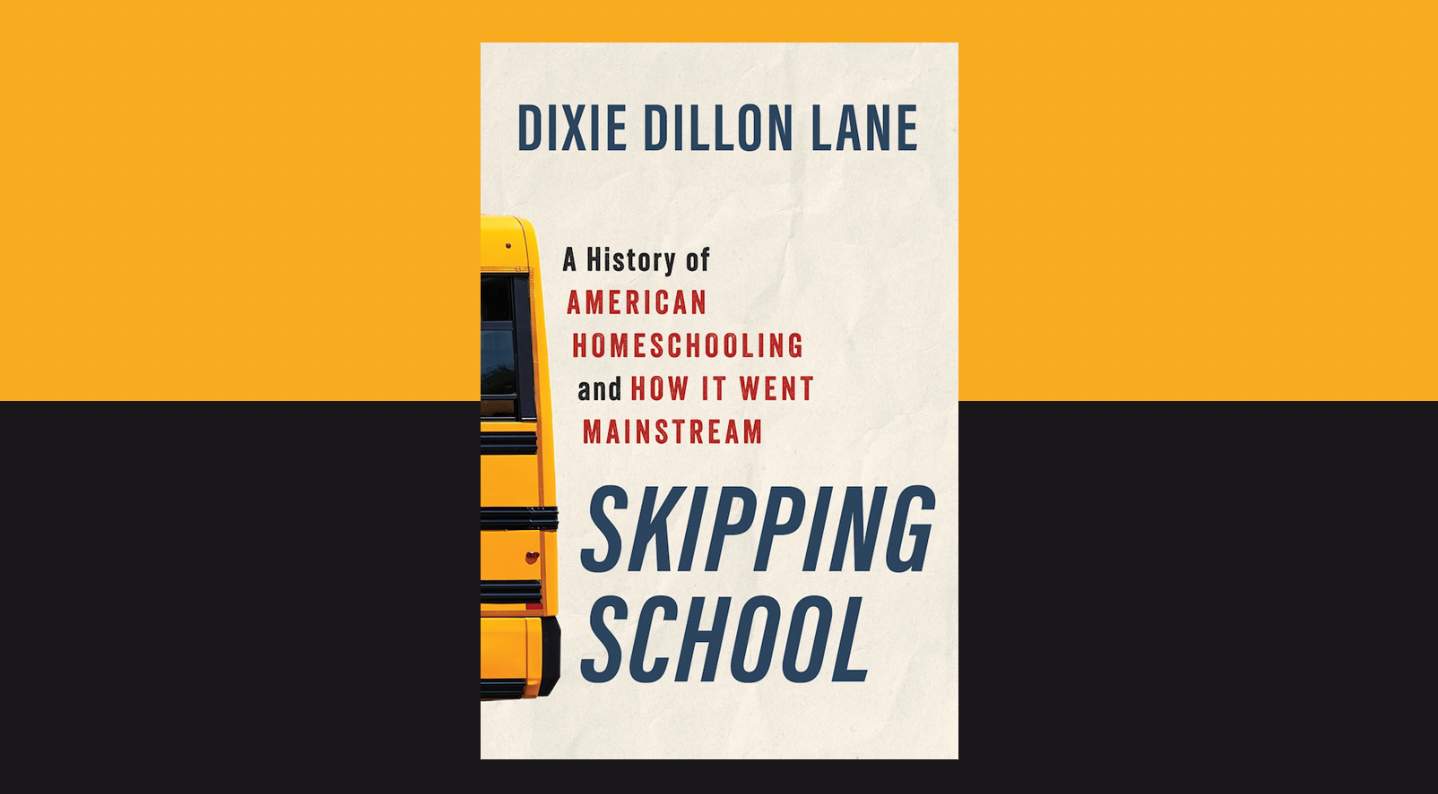
Dixie Dillon Lane. Skipping School: A History of American Homeschooling and How It Went Mainstream. Eerdmans, 2026. $28.99. 216 pp.
It was a sunny March day, nearly seventy degrees, so I packed up the four kids, ages ten months to ten years, and we drove to the state park. The older two had dressed the three-year-old and packed food and water. They noticed old nests tucked in the trees as we walked the trails. We remarked how the world was ready for spring, and that new nests would soon be built. Every once in a while, my three-year-old stopped us so that we could listen to the birds.
As energy flagged and water ran low, we recited some poems, nursery rhymes, and folk songs to keep our spirits up. Later we explored the interpretive center, where we read about the history of Machicomoco Park and happened upon three archeologists at work; they welcomed us and answered the kids’ questions. We concluded our exploration with a walk onto a dock, where we looked for oysters and other salt marsh critters and stared at the glinting river water.
It was one of those days that fill me with gratitude that we get to homeschool. None of this would have been possible had the kids jumped on the school bus that morning and spent most of the day inside. I also enjoy the game of translating the things they learn outside of formal school into educational jargon: today, for instance, we worked on environmental stewardship, problem solving and group dynamics, perseverance, hands-on historical study, research initiative, critical thinking, situational preparedness, familial bonding, local history, social and neighborly skills, immersive natural experience—you get the idea.
Modern American homeschooling has entered a new era quite different from its beginnings in 1950s America, where “living room schools” existed in a legal gray area. Compulsory universal education as we understand it today—that is, the state requirement to attend an approved school between ages five and eighteen—was still rather new in the mid-twentieth century. Still, it was sufficiently established that, by contrast, schooling at home was clearly countercultural (unlike, say, Abraham Lincoln-period homeschooling), and sometimes even illegal.
Now, in our post-Covid era, homeschooling has entered the mainstream. Homeschoolers are still a minority, but a significant one, as demonstrated by the Homeschool Days at the National Gallery in Washington, D.C., and Mount Vernon (not to mention innumerable podcasts, curriculum providers, and homeschool conventions and consultants). People no longer look askance if you take your school-age children to Costco on a weekday morning (though if you bring more than three kids, they might). Some states provide funds for homeschooled families to support their children’s education. If globe-trotting is your thing, you can even “worldschool,” spending most of your school year studying California Redwoods, Niagara Falls, or Tuscany onsite. Or you can simply travel to England with your family to visit Charles Dickens’s grave while your teenager reads A Tale of Two Cities in his online literature class (as some of my students have done).
How did this shift happen? And why should we care about the story of homeschooling and our homeschooling neighbors? American historian and homeschooling mother of four Dixie Dillon Lane answers these questions in her new book, Skipping School: A History of American Homeschooling and How It Went Mainstream. Lane’s project moves beyond sensationalist and alarmist opinion reporting on homeschooling. Instead, she soberly presents a clear narrative of homeschooling that sheds light both on American society today and, through the stories of real families, on the motivations of actual homeschoolers. Lane shows that religious motivations are only one factor. Homeschooling in America today is “the site of a flourishing range of pedagogies, curricula, and experiments in education,” reflecting the diversity of Americans.
***
This would be an important book even if it were dryly written. But thankfully, Lane writes with humor, clarity, and ease. And one great benefit to Lane’s study is that she is both scholar and practitioner. Like Catherine Ruth Pakaluk and her parents-of-five-plus-children subjects in Hannah’s Children, Lane is both scholar and insider. This allows her to gather valuable information from her subjects that an outsider (especially a hostile one!) would not be able to. This doesn’t mean that outsider perspectives are not needed; rather, insider perspectives are sorely lacking in society at large. Lane’s book fills that gap in a scholarly and winsome way. As she writes: “Surely we can examine the homeschooling phenomenon across time in a way that is analytically robust and evidence-based but is also respectful of the experiences of those who actually lived it.” “We can do better” than the run-of-the-mill clickbait takes, she adds. And she does.
Lane opens with a scene that could be the inspiration for a movie: A mother of seven is on trial in Los Angeles in 1953 for not sending her oldest children to school. She’s asked, “Are you a Communist?”
Lane notes that the 1950s and ‘60s were generally characterized by “domestic conflict and suspicion.” If you weren’t sending your kids to school, maybe you were a Communist. Or maybe you took your kids out of school because you were afraid of Communism. Or maybe you welcomed more state oversight because, well, Communism. Such ideas were in the air, all while the nation sought to strengthen its defense, both ideologically and otherwise, against the Soviet threat. Schools were a prime domain for strengthening national defense—hence the increased consolidation. Steadily and surely, local communities had less and less say in what went on in public schools, and children were more isolated from their families (a Communist dream, one might note).
Lane situates the story of homeschooling in America, then, within a broader context that brings out perhaps her greatest insight: Modern homeschooling is part of a long American tradition of parental involvement in children’s education and community that began arguably with the Massachusetts School Laws of the 1640s.
Indeed, public schooling has changed significantly, arguably with each decade, especially since the 1925 Supreme Court decision in Pierce v. the Society of Sisters that upheld the right of parents to have primary say in where their children are educated. This decision overturned an Oregon law that required parents to send children to public schools within their district; Pierce thus preserve the right of parents to send their children to private schools as well. “The child is not the mere creature of the State,” wrote Justice James McReynolds. And further: “The fundamental theory of liberty upon which all governments in this Union repose excludes any general power of the State to standardize its children by forcing them to accept instruction from public teachers only” (emphasis added).
Lane makes an argument that may seem surprising at first glance: Homeschooling is more normal than you think. That is, homeschooling is part of a continuous, though sometimes suppressed, American belief in (and desire for) “parental influence and local control of education.” In this context, homeschooling is just one aspect of an overall trend in American life: we dwell in a tension between the steady increase of state control and the continual resurgence of resistance to state overreach, and all the debates and battles and distinctions in between.
Tracing the story chronologically, Lane brings us from the Soviet scare era and the time of under-the-radar homeschooling to its legal recognition and the growth of homeschool cooperatives, to the Covid era where homeschooling gained new adherents, to today’s community-based homeschoolers, who reflect the diversity of America. Her history of American homeschooling helpfully complicates the narrative of the history of American public schooling, which is one of increased overall consolidation. Homeschooling is one thread of resistance to the expanding consolidation. It forces us to ask hard questions about what good education actually means for our children, in and out of public schools, and what the good life means for our communities. In other words, what is actually good for our kids, and not just convenient for society?
***
The stories Lane shares of first- and second-generation homeschooling families are some of the best parts of the book. For example, there’s Skylar, a high-achieving scholar who graduated college at age nineteen and is now a second-generation homeschooling parent. She found out she had severe ADHD only in her last year of college. Because of the personalized path her parents gave her, those things hadn’t become labels to keep her back from any successes. The flexibility of homeschooling (“unschooling” in Skylar’s case) had played to her strengths and strengthened her weaknesses. One can only imagine what would have happened if she had been stamped and ticketed from an early age.
This points to one larger issue that homeschooling brings to the fore: sphere sovereignty. In a well-ordered society, children are not pitted against parents; men are not pitted against women; cities do not siphon resources from rural areas; and one’s love of family, neighbor, culture, church, stranger, and nation are not in conflict. The history of American education shows what happens when spheres become disordered, and when systems become more important than persons. Skylar’s story, by contrast, shows what can happen when parents who know and love their children have the freedom to fulfill their duties by them—and do what will help their children thrive.
Lane mentions fear as a typical reason people assume homeschoolers do what they do. She notes an undercurrent of fear, for example, at a homeschooling conference, while also noting the need for homeschoolers to network in order to defend their rights from state overreach (this is how the Home School Legal Defense Association began). Her examination shows how important it is to distinguish what is feared (low academic standards? gang violence? bullying?), how proportional the fear is, and whether the response is reasonable and just. For example, public school parents today are fighting against the undermining of parental authority in California, where educators are prohibited from “sharing details about children’s gender identity with parents.” These parents have much in common with some homeschooling and private school parents. Both groups want to respect and support parental authority; they want their children to be taught in a context that respects them as persons rather than isolating and manipulating them.
This brings us to another key point Lane makes: Today’s homeschoolers are postinstitutional. I thought this an interesting term, since it’s not clear that a typical homeschooler in the pioneering days of the 1950s and 1960s could precisely be termed anti-institutional, unless institution were mainly understood as bureaucratic. Granted, the twentieth century was a time of great institutional skepticism, but there is a difference between suspicion or opposition to an institution as such and to a diseased specific instantiation. One can be supportive of the institution of marriage and support a wife who leaves an abusive husband. Similarly, many families have had clear reasons for pulling their children out of schools for a time. The family is a more fundamental institution than the school and indeed the state. Families desire a healthy village life for their children—and sometimes a healthy village has to be rebuilt.
To put it another way, if someone moves out of a crumbling house to live in a tent, one is not necessarily anti-house. Rather, one recognizes that the house is crumbling and perhaps has a bad foundation, so a new one needs to be built.
***
But to be postinstitutional is a bit more complicated than that. Once social stigma decreased for homeschoolers, families have continued to network and build their own associations—and institutions. One example of this is Catholic families who choose to homeschool instead of sending their children to parish schools, because the education at the latter is hardly different from district schools and therefore seen as not worth the money. There is a whole other story to be told about dying parish schools revived by joining the classical movement—and of homeschooled families who have banded together to start alternative schools (Chesterton Academy high schools, which are Catholic and classical, are one example). Last but not least, I suspect the increasing reliance on screens in many public and some private schools will offer an increasingly common incentive for families to opt out of screen saturation to seek true personalized attention from actual persons by homeschooling or joining alternative movements like Waldorf and traditional classical schools.
The disintegration of community in the twentieth century is a significant background factor to the story of homeschooling. It would take another study to examine how the upheavals of the twentieth-century affected the fabric of American society and of schooling choices: Not only did we see two world wars and the Soviet scare, but also unprecedented technological changes to everyday life. Consider rural electrification, radio and television, the colonization of roadways by the automobile, the rural-to-city movement, and more—and all this even before the introduction of the personal computer and the World Wide Web. The story of homeschooling and of American society cannot be understood apart from these changes.
Many homeschooling families desire to rebuild a village; in a more rooted time, this wouldn’t be such a focus. But nowadays, many homeschoolers want their children and their whole family to be part of a more organic, human culture. They want to know their neighbors, and they want their children to hang out not just with children their own age (as they would at school), but with kids of many ages and stages. One homeschooling couple I know are now grandparents. They told me how their children used to do chores for elderly neighbors. Now that these children are adults, they still count those elderly neighbors among their closest friends. Many families see public school as an obstacle to precisely the more thickened community they desire for their children, or to the proper development and personalized attention their sons and daughters need.
One of my favorite vignettes from Lane’s book is of Rodney and Renée Brooks, an African American family who chose to live in an “impoverished neighborhood” of South Central Los Angeles in order to serve their neighbors. Rodney, an Independent Baptist minister and police lieutenant, and Renée taught their children at home. They didn’t send their children to district schools because they didn’t want them to grow up with “the violent gang mind.” But they would invite the neighbor kids—many from broken homes—over to their house after school hours to give them a safe haven and the experience of a loving home. Renée would require “clean language and respectful behavior,” and she would tell the kids, if they behave, “we’re going to bake cookies.”
The drive toward total control over society and the rejection of proper levels of authority — including the family—affect us all. This culture transforms what a school and society could be. This is why both homeschooling families and people like a friend of mine in Chicago, a regenerative farming expert involved at her children’s public school, are batting for the same team. Both want to raise children who are curious and competent, who have ordered loves and respect for legitimate authority, but are not easily controlled shills for a totalitarian state.
We live in a strange time, where fundamental relational tasks like teaching, care of children, and care for the sick and the elderly are respected only when professionalized and performed by someone in a paid position. The history of homeschooling, however, shows it to be a crucial part of the timeless civilizational project of caring for our families and loving our neighbor. And so, homeschooling matters because by its very nature—in all its non-standardized, messy, unwieldy glory—it is a movement against the professionalization, standardization, and replacement of the human being.
The Weekly Digest
Premier Thought Every Thursday.
All of our recent essays and podcasts, delivered to you. Free.
Free. Delivered Thursday mornings.