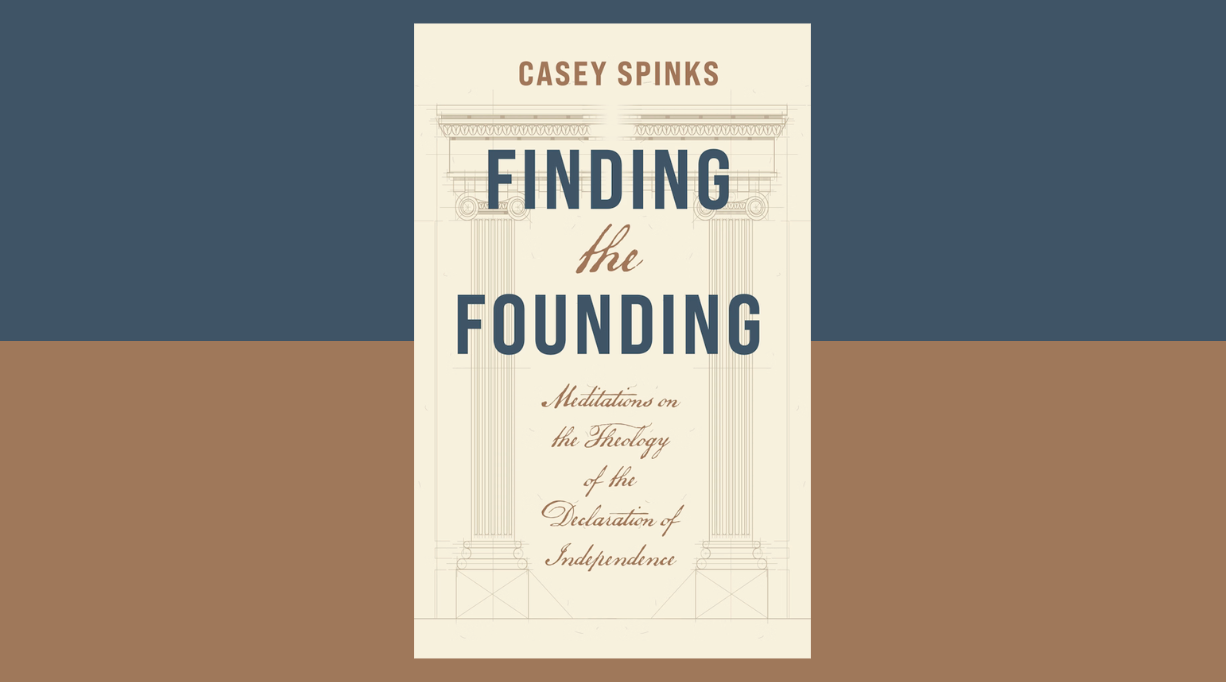
Recently, I was invited to the Jack Miller Center’s National Summit on Civic Education to give a speech about my book on the Declaration of Independence, Finding the Founding: Meditations on the Theology of the Declaration of Independence (Front Porch Republic Books, 2026). This was my first trip to Philadelphia, and having arrived a day early, I made sure to visit Independence Park. The visit didn’t disappoint, but it did cause me to tear up my speech and write a new one.
An exhibit at the American Philosophical Society featured a series of memorial engravings documenting our country’s history of the Declaration. The evolving significance of the Declaration grew clear as these engravings changed with each generation. I was struck by a pattern: In all the earliest engravings in the 19th century, each of the Declaration’s references to God (“Creator,” “Supreme Judge of the World,” “divine Providence”) was enlarged and emphasized, along with many of our now-hallowed ideas. But as the years went on, only the ideas (equal, life, liberty, etc.) remained emboldened. Finally, a 2026 artist’s annotated, “re-interpretive” engraving placed at the end of the exhibit made a striking choice: It deletes each mention of God from the Declaration, and it adds a parenthetical question mark to every ideal.
I’m not alone in worrying about this trajectory. In 1798, John Adams warned, “our Constitution was made only for a moral and religious people. It is wholly inadequate to the government of any other.” In explaining the principles of the Declaration 154 years later, Dwight Eisenhower said, “our form of Government makes no sense unless it is founded in a deeply religious faith, and I don’t care what it is.” In 1973, Elton Trueblood wrote, “the Declaration makes sense in a theological context, but fails to make sense in any other.” They would have been neither surprised nor comforted by this exhibit in Philadelphia.
We are now experiencing a renaissance of American civic education, especially in our public universities. Last summer I found myself, as a theologian, now somewhat unwittingly part of this renaissance. I didn’t understand how I belonged to this endeavor. But I did think that in this 250th anniversary year, the question of what it means to be American is alive again—thanks to debates over liberalism and postliberalism, globalization and its retrenchment.
In this year, I thought, the Declaration might have new answers to these deepest questions, if read in a certain way. So, I put pencil to paper, and over four months, I wrote a line-by-line meditative commentary of the Declaration, treating it as a theological document with its own voice—that is, as if the term “Nature’s God” mattered just as much to its integrity as the “Laws of Nature,” as if “divine Providence” was not accidental flourish, but the cornerstone which founds the declarations of this founding document and its people. If so, then the Declaration’s theology would hold a timely answer to who we are as “one people,” in this broken time.
Finding the Founding is the product of this meditation. It is a close reading of the Declaration—compacted into 126 pages and focused on the political theology that is crucial to the document. Within our renaissance of civic education, I offer this work as an invitation to a forum to meditate on the question of American faith.
What is that faith? For only a brief, apparently un-theological example, take that most beautiful and confusing clause of the Declaration: We hold these Truths to be self-evident. Now, as humanity before and since 1776 has shown, it’s hardly obvious that, say, all human beings are equal—if it were, so many wouldn’t have failed to see it. So “self-evident” can’t mean “obvious.” As many have argued, the definition of “self-evident” must be closer to something like a premise that cannot be proved but only assumed, like the claim that all triangles have three sides. But we don’t need to “hold” a geometric truth. Yet we do “hold these Truths,” the Declaration claims. Therefore, I found that the Declaration is, in fact, making a statement of mutual faith—not a claim to common sense or rational principle. We are basing our peoplehood on our holding of these Truths as our foundation. And the truths that follow are much deeper than mere propositions. The very words of the Declaration already demand something like a faith commitment, both in the founders who signed it and the “one people” the Declaration claims is America itself.
As we revive the conversation on civic education, I do not think we can repeat that aforementioned artist’s omission of God. Our ideals are worth holding without question marks, but only if we don’t erase the God of the Declaration. Therefore, we cannot ignore the fraught matter of American civic religion and theology, no matter how hard either side of the sacred and the secular may try. As Adams, Eisenhower, and Trueblood—as well as two of my personal favorites, Reinhold Niebuhr and Stewart Udall—all argued in their own ways, American self-government depends on a deeply religious sensibility.
Many fear we have lost that pre-political disposition. Perhaps we cannot revive it. But we can regain the conversation to revive it. (I should not have to mention that others are already having that conversation, and in ways less than charitable.) I know how important the works by the Niebuhr brothers have been to my own sense of faith and civic responsibility. I am jealous of how freely and deeply they could write on faith and America, with a public audience ready to read their reflections. I hope this book may do for our time, if only in small part, what these earlier writers’ works did for theirs.
I hope you will read and converse with this book. Not for the book’s sake, but for the sake of what this book is about: our common deliberation on faith, solidarity, freedom, and belonging, face-to-face with the transcendent. If we can regain this, then whatever we will make together of “divine Providence,” I believe we will become closer to pledging each other “our lives, our fortunes, and our sacred honor.”
The Weekly Digest
Premier Thought Every Thursday.
All of our recent essays and podcasts, delivered to you. Free.
Free. Delivered Thursday mornings.