Mere Orthodoxy is a reader-supported ministry. Join us in our mission to renew the Church and culture.

My Christmas Bicycle

December 9th, 2025 | 8 min read

By Jim Wildeman

My birthday is December 28th. When I tell people that, most of them feel sorry for me. They understandably think that having my birthday so close to Christmas is a problem. Either it doesn’t get celebrated at all or, if it is, I don’t get any birthday presents because people have just given me gifts. And that is true—at least partially true. Some of my relatives did not send a birthday card or a present, and they would say something to me on Christmas day like “this gift will count as your birthday present, as well as Christmas, ok?” As a young child, when I examined their gift and compared it to what my siblings and cousins received for Christmas, it didn’t seem to me that it was a bigger, better, more expensive gift. But I was not inclined to point that out, since my parents would have upbraided me for being materialistic and ungrateful. So I guess much of the time I did get cheated out of a full-blown birthday celebration. 

But on the occasion of my tenth birthday, I actually used the closeness of my birthday to Christmas to my advantage. I asked my Grandmother Wildeman and her daughter, my Aunt Helen, who lived with her, if I could combine my Christmas and birthday gifts from them into one BIG gift, a new bicycle. Grandma and Aunt Helen were the people from whom we received our nicest, most expensive gifts each year. My father was a minister to very poor churches throughout my childhood and youth, so we didn’t receive expensive gifts from him and my mother. My Grandmother and Grandfather McCombs were even poorer than we were, so I don’t remember even getting a small gift from them (although that could just be a problem with my memory). 

Each year, after Thanksgiving, my siblings and I were allowed to go through the Sears, Roebuck and Montgomery Ward catalogs to come up with a list of items we would like for Christmas.  We could choose a few items from which Grandma Wildeman and Aunt Helen would normally pick two or three for each of us. Before those lists were sent, my mother would go over them very carefully to be sure we weren’t being too greedy. Usually, she would eliminate an item or two or three, the most expensive ones. Using that procedure, we would have a fairly good idea of what we would be receiving at Christmas, but still enjoy a bit of surprise when we opened our gifts. 

But the year I was to turn ten, my lack of a bicycle began to be a real problem for me. All my friends had bicycles, and they rode them everywhere. Grove City, PA was a small enough, safe enough town so that a child could go almost anywhere on his or her own. And my friends rode their bikes to school, to Little League baseball, to Boy Scouts, to the bowling alley, to the public swimming pool in the municipal park: EVERYWHERE. I knew how to ride a bicycle, and sometimes there would be a spare one for me to use. But often I was reduced to sitting on the handlebars of a friend’s bike, running alongside the gang on our way to some enjoyable activity or just meeting them somewhere later. The lack of a bike was a serious hindrance to my full engagement in social activities; I felt like a second-class citizen. 

During our annual summer vacation to Union, NJ, where Grandma and Aunt Helen lived, I brought the issue up with them one day when my parents were away, because I had mentioned the bike to my mother and father, and they had both felt I was seriously overreaching to ask for such an expensive gift. After some consideration, Grandma and Aunt Helen agreed that I could have a bicycle IF I agreed that it would be the only present I received that Christmas. My parents, my Aunt Bea and Uncle Bill and Grandma and Aunt Helen would pool their funds and get me that one big gift. Nothing else, not so much as a candy cane or a popcorn ball in my stocking. I was overwhelmed with joy—and a bit surprised—and immediately agreed. 

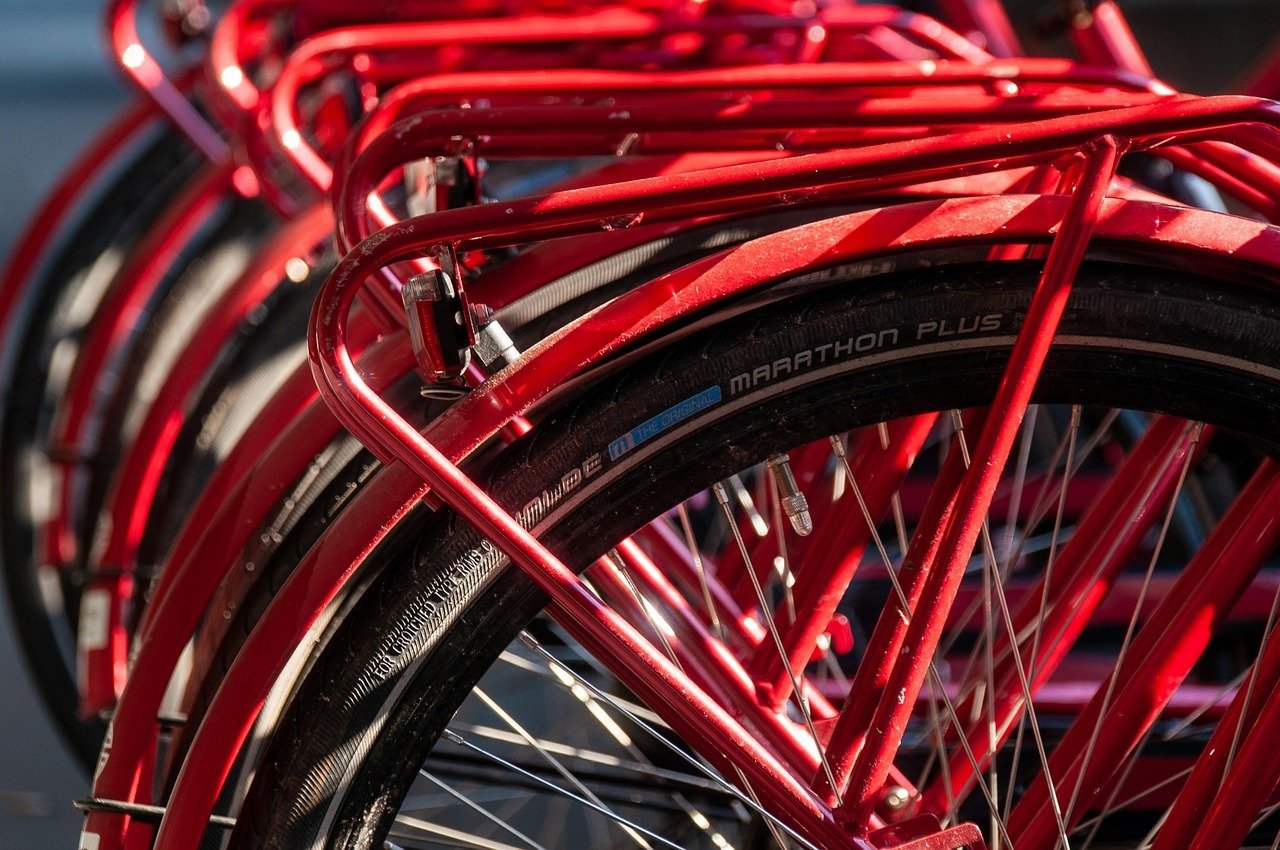
For the next five months, the search for the bicycle was on. My parents set a strict limit: it could cost no more than $35.00. That might sound ridiculous in 2022, but in 1960 it was very reasonable. There were several bikes in the Montgomery Ward catalog for less than that price. So I looked each one over carefully on paper, trying to decide which features I needed to be absolutely happy. I also went to the local bicycle shop in Grove City to look bikes over in person, to sit on both 24 inch and 26 inch models to see how they felt (I was a small child, so I couldn’t manage the 26 inch bike comfortably). At the same time, I rode my friends’ bikes, asked them what they liked about their bikes, which other models they might like more.  Finally, I had found the perfect bike: it was one of Montgomery Ward’s “better” bikes. (You remember that they offered “good,” “better,” “best” in every line they sold?) It was 24 inches, so that I could easily reach the pedals, bright red, what we call a “beach cruiser” these days: one gear with coaster brakes. PERFECTION! I copied out the page number and model number and sent it to Grandma and Aunt Helen.

I also tore out the page the bike was on from the catalog and taped it to the head board of my bed. For the four weeks between Thanksgiving and Christmas, the first thing I looked at each morning and the last thing each night was my new bicycle, which was waiting for me, I knew, at Grandma’s house.  I fantasized about me zipping through Grove City on my shiny new bike, outracing my friends to all our favorite places. Truly “visions of sugar plums.” 

Our family always celebrated Christmas in New Jersey. Our entire extended family on both father and mother’s sides lived in, or near, New Jersey. So no matter how far from Jersey we were living, my family drove to Jersey and stayed with my grandmother and Aunt Helen. All six of us would pack ourselves in with Grandma and Aunt Helen for the few days before Christmas. Then on Christmas day my Uncle Bill, Aunt Bea and their three sons would join us for a huge, delicious feast, followed by the opening of our long-anticipated gifts. It was, by far, my favorite day of the year. We were all very close with my father’s brother and his family, and his youngest son, Mike, was my best friend. Being with them all in a place I loved was about as good as it could get for me.

But my anticipation made the days between Thanksgiving and Christmas almost painful for me, as I played over and over in my imagination how delightful Christmas Day would be. Reflecting in old age, after a lifetime spent in the Church, I think I am not being hyperbolic when I compare my childish longing for Christmas with the longing for the Messiah’s coming expressed by the Old Testament prophets. Obviously, the two events are of very different magnitude—but I think the LONGING was very much the same.

I was a sneaky kid, and I liked nothing more than finding my presents before Christmas wherever they were hidden and doing my best to figure out what I was getting. Other Christmases, when I received much smaller gifts, I would sneak around the house, peaking in all the obvious places to hide gifts (under beds, in closets, on high shelves)—and most years I found them. In 1960 my search should have been ridiculously easy. My bike was by far the biggest gift any of us would receive, and Aunt Helen and Grandma’s house was very small. There were only two places to hide it: the cellar or the garage. So I was sure to find it well before Christmas day and enjoy stroking it, sitting on it, imagining my delight as I whizzed through Grove City with my friends, a second-class citizen no more.

My Aunt Helen knew me well. She was a very bright woman with a well-developed sense of humor. When we arrived in Union and I started my search, I discovered that the garage had been locked. And she warned me sternly NOT to go into the cellar. Since I didn’t know where the key was, there was no opportunity to search the garage. And I respected my aunt very much, so I stayed out of the cellar, no matter how much I itched whenever I passed the cellar door. For the three days before Christmas, I suffered in anticipation, longing to get my hands on my shiny red bike.

Normally, I thoroughly enjoyed Christmas: waking to the smell of roasting turkey, looking out the window, waiting for my uncle’s car to appear in the driveway, savoring the delicious feast while sitting next to my best friend, Mike, surrounded by the extended family I cherished. There was only one drawback to our annual celebration. We had to wait to open our presents until after my father and Uncle Bill washed, dried and put away the dishes. 

This particular day, I waited even more impatiently than usual for the men to finish the dishes. I had never had something so wonderful to wait for before. But the great moment finally arrived. All of us were sitting in the living room, staring expectantly at the pile of presents around the tree. My aunt announced that, because my present was by far the largest, that I would have to wait until all the other presents had been opened. I have never been patient—and the thirty minutes that passed while my siblings and cousins relished their gifts was sheer torture. I was only ten years old, pretty immature, and I was fighting back tears as one gift after another was opened, painfully slowly to my way of thinking.

FINALLY, all the presents were opened. My aunt told me I could go into the cellar. I threw open the door, turned on the light and raced downstairs to find my bike. NOTHING! No bright red bike was hiding anywhere. I walked back upstairs, gulping down my tears. “Oh,” Aunt Helen said, “I forgot that I moved it into the garage the day before you arrived.” She handed me the precious key that would open the garage.

Everyone followed me outside to share my delight. I was so excited I struggled to fit the key to the lock, struggled to make the stiff old lock turn. But I finally threw open the door, turned on the light. NOTHING! Only my aunt’s car. Even though I knew it was hopeless, I searched in front of the car, behind the car. I was devastated. My much-anticipated bike was nowhere to be found. There was absolutely nowhere Aunt Helen could have hidden it. What terrible joke had she played on me? I couldn’t help myself. To my chagrin, I burst into sobs in front of my siblings, my cousins and the adults. Looking back, I am certain that I never felt such desolation. No loss, no failure has ever felt so horrible as that one did.

I think my aunt was surprised by how violent my reaction was. She put her arm around me (though I struggled against her embrace in my disappointment and anger) and said, “Come with me.” She led me upstairs to the small bedroom where my brother and I had slept for the past three nights. I thought she was just getting me away, finding a quiet, private place to allow me to deal with my feelings. Instead, she went to the bed where I had been sleeping the entire vacation, pulled it away from the wall, pulled an afghan off a very large, thin box that was resting between the bed and the wall. Through my tears, I could read “Montgomery Ward. Bicycle. Some assembly required.” It was my bike! The ecstasy I experienced for the rest of the day, the rest of the holidays, was indescribable. I am now 71, and I can honestly say that that bike was the greatest present I have ever received.

I have thought about that Christmas present quite a bit over the years.  Sitting in church recently on the first Sunday of Advent, listening to readings from the Old Testament prophets, hearing their longing for the appearance of Christ, it struck me that my experience at my tenth Christmas was, in its very small way, very much like Israel’s experience at Christ’s birth.

I think one reason many Jews rejected Christ was because they were looking for the wrong thing. They were, like me, looking for a shiny red bike, rather than a humble nondescript cardboard box. They paid attention to the descriptions of Messiah as “wonderful counsellor, mighty God,” the one who would come in power to set the world right. But they failed to hear that he would come the first time as a humble, undistinguished, suffering servant.

As a 71 year old man, I struggle with my faith. I feel hope-less quite often. I fail to experience the presence of Christ in my daily life, so I go about my days joylessly. I wait—expectantly and impatiently—for Christ to appear to me dramatically, powerfully: to FEEL the Spirit of God moving in and through me. But as I reflect on my spiritual dilemma, I wonder if my problem now is much like my bicycle problem at Christmas 60 years ago: I am looking for Christ in the wrong place, in the wrong form. For didn’t Christ tell his disciples that if they gave a cup of cold water in his name to the “least of these” they gave it to HIM? Perhaps, in seeking out the poor, the displaced, the powerless, the unattractive, I might experience the presence of Christ in an unexpected way—and find a joy like that which I experienced as a child many years ago. Perhaps Christ is as near to me as my bicycle was decades ago, when my Aunt Helen hid it in full view.

Jim Wildeman

Jim Wildeman is a novelist, short story writer, essayist, and professor emeritus at Covenant College. His work has been published in various places, and he has been nominated for the annual Best American Essay collection.  He lives in Chattanooga, Tennessee.

Topics:

Formation