
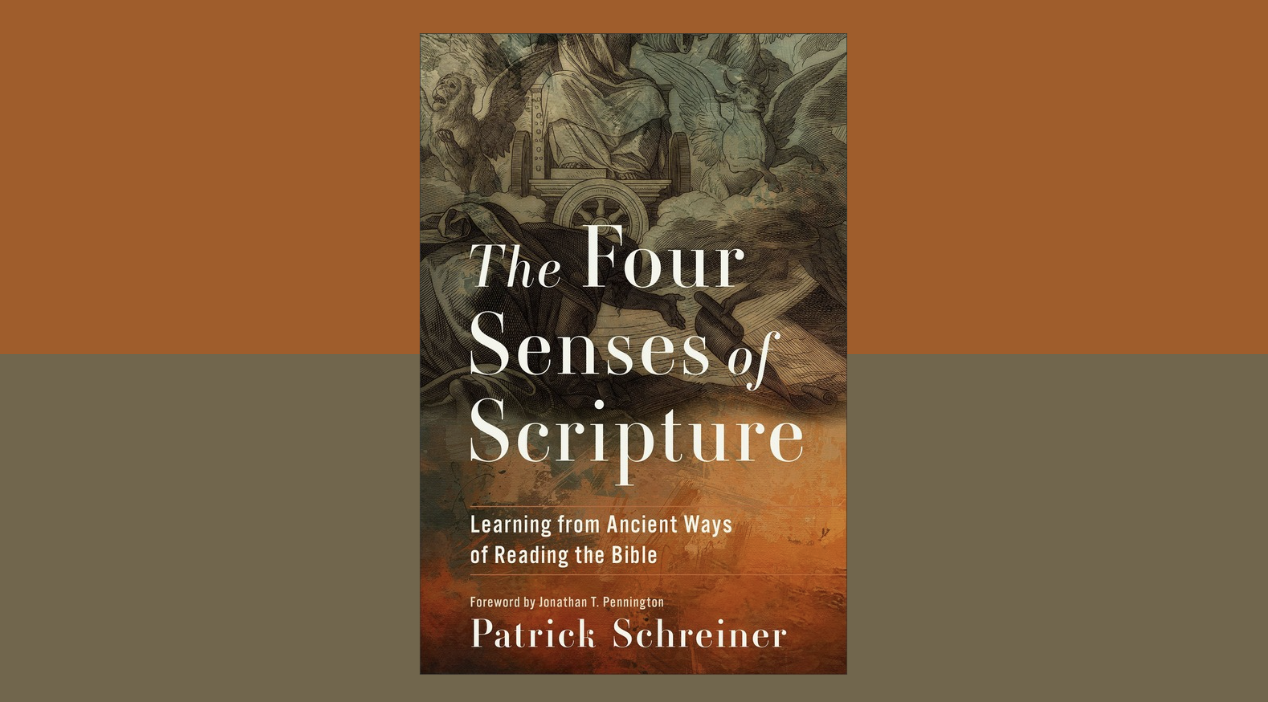
The following excerpt from The Four Senses of Scripture by Patrick Schreiner is published with permission from Baker Academic.
In recent years, evangelicals have shown renewed interest in the hermeneutics of the Church Fathers. Much has been written about how premodern Christians read Scripture, but fewer works describe the method behind their practice.
This is surprising because, despite the diversity, the fourfold sense provided the dominant framework through which many interpreted Scripture. However, there is still quite a bit of confusion about the four senses concerning what they are and what they are not.
The Senses of Scripture
Most in the early church accepted the doctrine of the “senses” of Scripture, even if they didn’t always employ this language. To speak of the senses of Scripture is to speak of a word’s “signification.” It comes from the Latin sensus or sentire, which means the ability to perceive or understand. The task of an interpreter is to articulate the significance, the sensus, of the Scriptures.
Though the “four” senses were not solidified until the medieval era, many beforehand spoke of a literal and spiritual sense. The literal sense focused on what God said through the words of Scripture, while the spiritual sense explored how those realities pointed to Christ, shaped believers, and anticipated final redemption.
The Four Senses
The four senses historically have been described as the literal (littera, historical), allegorical (allegoria, Christological), tropological (tropologia, moral), and anagogical (anagogia, futuristic). The literal sense refers to the most natural sense of the words in their grammatical and historical context, which will be discovered by sound exegesis. The allegorical sense refers to symbolic readings with Christ and the church in view. It asserts that the words point to things which point to other things. The tropological sense is another spiritual sense, but narrows the focus to the formation of the church and persons in the church. The final spiritual sense is the anagogical sense. This pertains to what is to come, what we are hoping for.

The four senses have been expressed in this little jingle.
Facts the letter teaches; what you’ll believe, the allegory;What you’ll do, the moral meaning; and where you’re bound, the anagogy.
A Linguistic Aside
The four senses might be confusing to us partially because the early church had a different understanding of how words work. In the modern era, it is believed that words refer to things, but these things can only be observed with the physical senses. Limitations are therefore put on signs. For example, the word “rock” refers to a solid mineral material. The combination of letters, and thus sounds, has the function of pointing to a thing that is found on the earth. However, there is nothing beyond the “rock” to which this thing points.
Word (Signum) Things (Res)
Rock solid mineral material
Premodern interpreters, on the other hand, believed that signs point to things which point to other things. Thomas Aquinas affirms that words point to things, but things point to other things. So, the word “rock” points to “the solid mineral material forming part of the surface of the earth” but this thing points to other things (or realities). A rock in the Scriptures can point to stability, immutability, foundation, or even Christ himself.
Word (Signum ) Thing (Res) Other Things
Rock solid mineral material stability, Christ
Here it is in Aquinas’s own words:
The author of Holy Writ is God, in whose power it is to signify His meaning, not by words only (as man can do), but also by things themselves. So, whereas in every other science things are signified by words, this science has a property, that the things signified by the words have themselves also a signification. Therefore, that first signification whereby words signify things belongs to the first sense, the historical or literal. That signification whereby things signified by words have themselves also a signification is called the spiritual sense, which is based on the literal, and presupposes it. (I.1.10)
An example, according to Thomas Aquinas, is that the word lion refers to a thing, more specifically a “beast” or even more specifically “a large tawny-colored cat.” However, the thing “a large tawny-colored cat” can also point to other things. The word lion can in the Scripture be an image of Christ (Gen 49:9; Num 23:24; 24:9; Deut 33:20; Rev 5:5). This is not because the word “lion” means “Christ” but because lions have some sort of similitude, or likeness, with Christ. This doesn’t mean that “lion” means “Christ” for that would create confusion. It is the thing that points to other things. For the devil is also called a lion (1 Pet 5:8). So the word “lion” refers to a thing “beast” which can point to other things. A lion, in the literal sense refers to a beast, but allegorically it refers to Christ.
The Exodus as an Example
This may be too theoretical for most. An example of the four senses might be helpful. Take the exodus. The literal sense tells us that Moses and Israel crossed the Red Sea to escape from Pharaoh. The historical sense relates both to the event and the narration of the event. The allegorical sense affirms the literal sense points beyond itself to Christ’s death on our behalf and his victory over the powers. This victory is then embodied in us as we are baptized and practice a new way of life (tropology). Finally, we long for the day when we make our final journey and cross from death to eternal life (anagogy). Dante puts it in this way:
For if we inspect the letter alone the departure of the children of Israel from Egypt in the time of Moses is presented to us, if the allegory, our redemption wrought by Christ; if the moral sense, the conversion of the soul from the grief and misery of sin to the state of grace presented to us; if the anagogical, the departure of the holy soul from the slavery of this corruption to the liberty of eternal glory presented to us.
What the Four Senses Are Not
Some worry that this way of reading suggests Scripture has four different meanings, a concern that can sound similar to postmodern approaches to interpretation. But that is not what the four senses claim. Rather than offering four meanings, they provide four ways of understanding a single text within the unified story of Scripture.
A common idea is that the fourfold sense rejects this grammatical-historical sense. Yet, a proper understanding of the fourfold sense views the literal sense as the key and most important aspect of interpretation. A “literal” interpretation is what we see most often in the Scriptures, and any hermeneutic that neglects it or doesn’t begin with grammar and history will be immediately unmoored.
It is not only the foundation and bedrock for the rest of the senses, but all the other senses are found in the literal sense. The literal sense contains the mystery of Christ. The literal sense often commands morality. The literal sense often speaks of our glorious future. Therefore, the literal sense is primary. The best of the premodern tradition affirmed this, including the Reformers.
The foundational nature of the literal sense implies all the four senses are ultimately integrated and must not be repugnant to one another. There is a dynamic unity, a reciprocal interiority to them. We speak of them, as we must, as diverse senses, but they are intertwined.
Some have compared the unity yet distinction of the quadriga to a house. The literal sense is like the foundation, the allegorical is the walls of the house, the tropological is like the decorations or furniture, and the anagogical is like the roof. In this way, the church fathers claimed that the four senses are a comprehensive way of reading the Scriptures. In them, the whole house is completed.
For example, when we read of God feeding Israel with manna in the wilderness, we must acknowledge the literal sense points to God’s provision for his people long ago (Exod 16:1–36; Num 11:4–9). However, Jesus teaches the allegorical sense in John 6. Jesus is the bread, the true bread. The bread pointed to him because only through him will they receive not only physical life but eternal life. Yet, when John writes these words it is hard to not imagine that he had the Eucharist in view as we continue to eat of Christ even after he ascended (1 Cor 11:23–26). Finally, we long for the day when we eat with Christ in the Messianic banquet (Rev 19:6–9). The point is that Exodus 16 signifies all these realities. The literal sense is like a seed that flowers as the biblical storyline progresses and finds its unity in Christ. This isn’t multiple meanings; it is the fulness of meaning.
Depth not Difference
The four senses do not lead to subjectivism or an affirmation of multiple meanings. The spiritual senses extend rather than efface the literal sense; they eschatologize rather than erase the literal sense. However, they also affirm Scripture is multifaceted and richer than we might expect. Words, and words that come from God, are remarkable artifacts. Scripture is not a wax nose that fits many faces, but it does contain all sorts of treasures. We rightly affirm the Scriptures’ perspicuity, but do we also affirm its fecundity? Anyone who encounters the Scriptures should not suppose that they can exhaust their meaning. This is because they come from the hand of God, the infinite one.
Conclusion
Though some, including the Reformers, have critiqued the four senses, their critiques largely stemmed from allegorical readings in which the canon ceased to guard and guide the spiritual senses. Allegorical readings that employ an extra-textual grid to view biblical persons and events as representative of abstract virtues or doctrines and thus disconnected from authorial intent ought to be rejected.
If we keep these critiques in mind, then the four senses can be a helpful way to renew a deep and multifaceted reading of Scripture. The four senses remind us that Scripture was never meant to be read merely as an ancient text to be analyzed. It is God's Word that reveals Christ, forms disciples, and directs our hope toward the coming kingdom.
The Weekly Digest
Premier Thought Every Thursday.
All of our recent essays and podcasts, delivered to you. Free.
Free. Delivered Thursday mornings.