Search for topics or resources
Enter your search below and hit enter or click the search icon.
Advent was upon us. I needed it. Advent is my favorite season of the church calendar. The readings are so encouraging. “Look up,” they seem to say, “Live in hope that Christ WILL return and will set things right.” As I just said, I really needed to hear this message. It has not been a good year. At 73, I am feeling my age: aches and pains that make movement difficult, inability to sleep through the night, lapses of memory. And things in the larger world seem more troublesome than normal: renewed conflict in the Middle East, millions of people displaced and on the verge of starvation in Africa, and Putin refusing to pull out of Ukraine. The list could go on. But those are the problems that depress me the most.
I had made a resolution at the beginning of 2024 that I would try to live more hopefully. I worked at putting a brake on my skepticism, cynicism. I began each morning praying “Thy kingdom come, Thy will be done on earth as it is in heaven.” I changed my place of worship to an Anglican church, where I felt the presence of God in a way that I did not in my Presbyterian church. As I listened to the readings from OT, Psalms, Epistle and Gospel, it felt somehow that I was hearing God’s voice speaking to my particular situation. As I recited the congregational responses in the liturgy, I felt like I was speaking to God in a meaningful way. And I was beginning to believe that, as I received the wafer and wine, I was really--in some mystical way--united with Christ. Attending church was becoming not a painful duty, but something I looked forward to: an experience where my faith would be strengthened, an experience that I would leave with renewed hope.
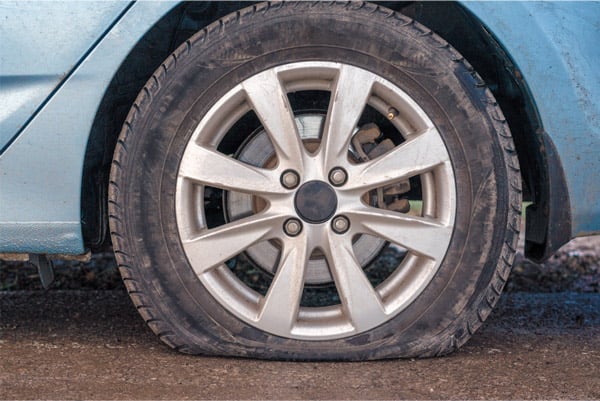
But on my way to church last Sunday, the WARNING light on my instrument panel lit up, sending the code that one or more of my tires was low. Not a big deal, really. I was only a mile from church and the car was handling fine. When I pulled into my parking space, walked around the car, checked the tires, the left rear tire did look a bit low. But I had purchased a fancy new digital pressure gauge, and I knew it would give me a reliable reading. But I was running a bit late, so I left things as they were. I could check the pressure after the service. I needed to get to church, needed to feel the presence of God. Needed to sense that he loved me and was working things out for my good. And, truthfully, in the grand scheme of things a low tire is obviously no big deal. Even in the small scheme of things, the daily makeup of my little life, NO BIG DEAL. So I turned my attention to church and put the low tire behind me
After the opening hymn, I paid careful attention to The Collect for Purity. “To you all hearts are open, all desires known, and from you no secrets are hid. Cleanse the thoughts of our hearts by the inspiration of your Holy Spirit, that we may perfectly love you, and worthily magnify your holy name.” I had repeated that prayer many times. But in the last few months, I had actually started to pay attention to it. The first sentence always makes me a bit uneasy. I really fear having anyone—even a loving God—know what I am thinking, feeling in the privacy of my own mind. It isn’t pretty much of the time. But I have started to believe the second sentence, the plea for God to “cleanse the thoughts of our hearts by the inspiration of your Holy Spirit.” That sentence always gave me hope as I went through the rest of the service. I could—with the Spirit’s help—clear my mind of distracting thoughts, even evil thoughts, and focus on the good news expressed in the liturgy: God loved me, God had provided for my salvation, God would bring all things to good in the end.
The responsive reading that day was Psalm 91, some of the most comforting words in the entire Bible: “He shall deliver you from the snare of the hunter and the deadly pestilence. . .He shall defend you under His wings. . .There shall no evil happen to you. . .I am with him in trouble.” But even as I entered into the responses, saying the words myself, in the back of my mind the thought of that low tire on the left rear made a disturbing appearance. And soon in my imagination I could see that, when I approached my car after the service, that tire would be completely flat. My lips were still repeating the comforting words of The Psalm, but my mind was completely absorbed by that tire.
The car was fairly new, a 2024 Subaru Ascent. And I tried to remember if it even had a spare tire. Many of the newer models did NOT. And if my Subaru had one, I knew it would, at best, be one of those puny “donuts,” made only to be driven a few miles at low speed to the nearest service station or tire store. And, if I had that puny tire, I knew I had never even looked at it, nor a jack. So if there was a tire and a jack, I knew I would have to consult the Owner’s Manual to figure out how to operate it. And if there was a tire, would there even be air in it—or would it also be flat? I have AAA. I knew they would come. But on a Sunday, how long would that take? And on a Sunday, would there be a tire store open that could repair the tire or supply a new one?
While my imagination tortured me with all that might be going wrong with that tire, I mindlessly repeated the words of the liturgy. Without thinking of it, I repeated “He will come again in glory to judge the living and the dead, and his kingdom will have no end.” The thought of Christ’s ultimate victory over sin and death, of my own perfect life with Christ, made zero impression. And during the Prayers of the People, when I should have concentrated on “my brothers and sisters around the world, who are suffering for their faith in you,” instead I prayed that my tire might not be flat after all, that the monitoring system on my car might be wrong.
And while I knelt at the altar rail, waiting for the priests to offer me the wafer and the wine, to remind me that Christ’s body was broken and His blood shed to preserve me, body and soul, unto eternal life, all I could think about was myself kneeling on the dirty parking lot before the flat tire, sweating as I jacked the car up, struggled to loosen the lug nuts (which had probably been tightened much too tight at the factory), lifted off the old tire and replaced it with that puny doughnut tire, getting my nice white shirt smudged with grease, maybe damaging one knee of the new pants I was wearing.
After I returned to my seat, after The Eucharist was complete, I did not really hear myself thank God for “assuring [me] in these holy mysteries that we are living members of the body of your Son, and heirs of your eternal kingdom.” I was gathering up my things, ready to make an early exit while the celebrant priest offered the blessing: “The peace of God, which passes all understanding, keep your hearts and minds in the knowledge and love of God, and of his Son Jesus Christ; and the blessing of God Almighty, the Father, the Son, and the Holy Spirit, be among you, and remain with you always.”
And I only waited for a moment, until the first notes of the recessional hymn were sung, before I almost ran out of the church into the parking lot, praying fervently—more fervently than I had prayed during any part of the Eucharist—that my left rear tire would not be flat. And when that particular prayer was answered, when I could see that it still held air, I offered a sincere “thank you” to God (especially after my digital pressure gauge assured me that the tire had 28 PSI, only five pounds less than suggested). Then as I entered the car and started the engine, I prayed again that some sort of service area would be open at that hour on Sunday, that someone would not be “remembering the Sabbath Day to keep it holy,” so that a professional could check all the tires, fill the offending one, and assure me that all was well in my little world, once again.
My prayer was answered. Only a couple miles from church an Instant Oil Change place was open, all its bays empty, with two employees standing in the parking lot chatting. I pulled in, asked if they had air. They did, and within a few minutes they had checked all the tires, inflated the left rear and made sure all the rest were at their recommended 35 PSI. No charge. But I fished in my wallet and handed them five dollars as a thank you.
The indicator light on the dashboard was off as I left the parking lot and entered the flow of traffic. But the entire way home, about 15 minutes, I kept my eye on the dashboard display, half-expecting the “low tire pressure” indicator light to reappear. It did not, thankfully. But when I got home, I pulled out the pressure gauge—once again—to confirm that the offending tire was, indeed, at the correct pressure. Later that evening, I was out once again, walking around the car, examining the tires, pulling out the pressure gauge again to find everything was fine. At around 4:00 am, I awoke from a dream about changing tires, and first thing in the morning when it was light enough to see, I tested that left rear tire once again. When 35 showed up on the digital display of the gauge, I finally believed that the crisis had passed. I was finally at peace, and offered a final, brief—but very heartfelt—prayer of thanksgiving.
But as I went about the affairs of my day, one sentence from The Prayers of the People haunted me: “For our brothers and sisters around the world who are suffering for their faith in you, we ask you to give them a keen awareness of your presence and enable them to STAND FIRM against the evils of persecution.” Comparing my situation to theirs, I worried about how I would behave, what I would think and feel, if and when I found myself in real trouble. My answers were not reassuring.
But one good thing has come out of my tire pressure crisis: I now pray several times a day for “the peace of God that passes all understanding.”
Jim Wildeman is a novelist, short story writer, essayist, and professor emeritus at Covenant College. His work has been published in various places, and he has been nominated for the annual Best American Essay collection. He lives in Chattanooga, Tennessee.
Topics: