
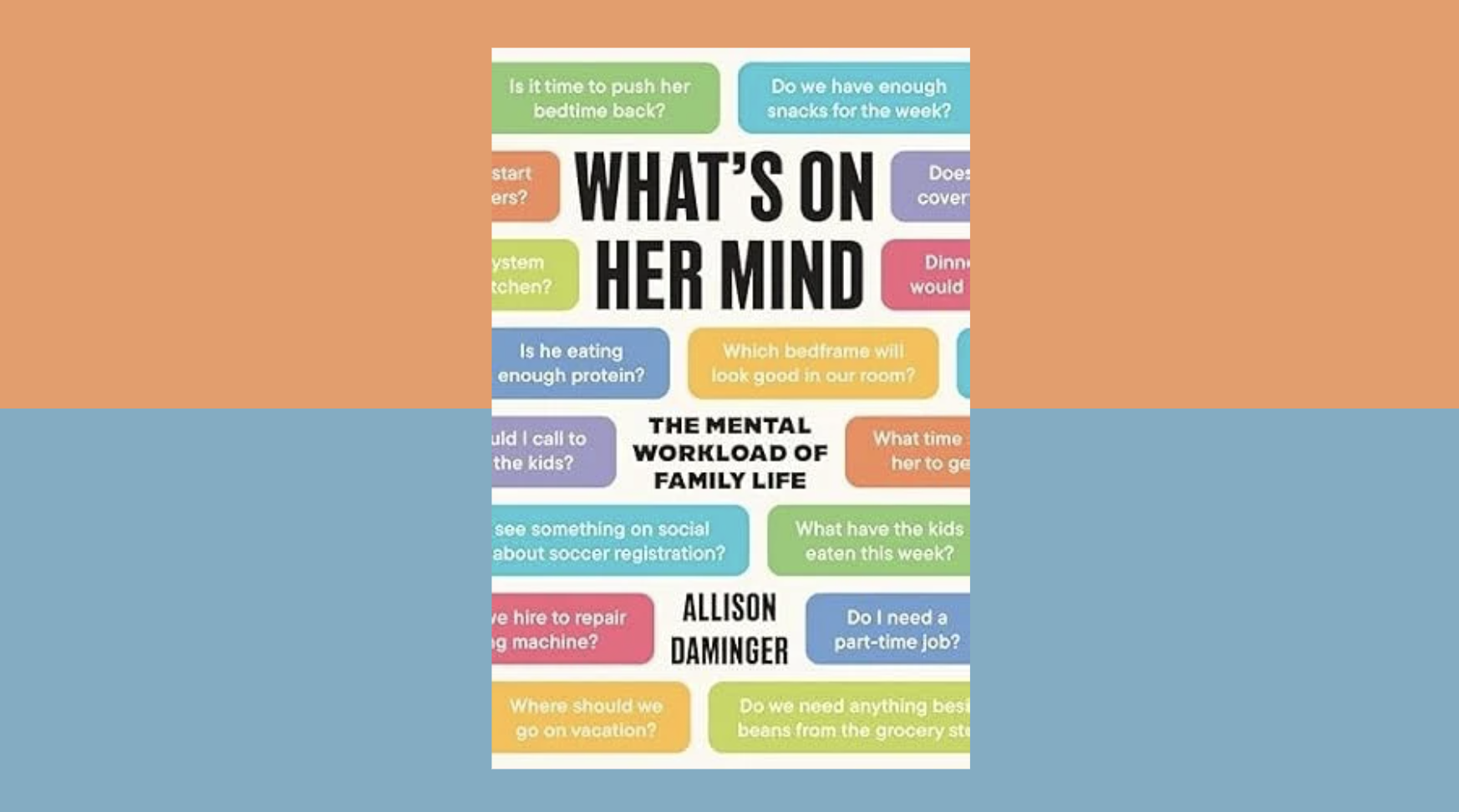
Allison Daminger. What’s on Her Mind: The Mental Workload of Family Life. Princeton University Press (2025). $29.95. 248 pp.
A woman whose kids were in the same activities as mine when young used to send a warning text to the moms’ group when she left town. She gave heads-up that the B team would be on, which meant that her husband would be showing up instead. She told us, so we would pick up the slack.
Allison Daminger’s book pokes a sore spot in domestic relations. At issue is not the easily reckoned load of practical chores, now subject to decades’ worth of gendered time-use studies. Here is a category harder to measure. Cognitive labor can be invisible, but it generates loud grievances. Women might combust with exasperation that they do so much of this and still have to explain what it is. Men might express frustration that after years of taking on more housework, they still get faulted for not doing enough.
Consider how much dads’ doings have changed in a few generations. A man now might remember that his grandfather never packed kids’ lunches, for instance, while his father might have done them occasionally when mom was out of commission (like maybe in the hospital). This contemporary man might insist: I fill the lunchboxes three times every week. Can’t you see I’m doing a lot, he might demand, while a spouse who plans meals, buys groceries, monitors school allergy protocols, remembers her kids’ tastes, and keeps track of brown-bag field-trip days, might ask why he wants praise and gratitude for sticking a sandwich in a bag.
If readers confronting Daminger’s title wonder, what do American moms think about when they let their minds wander, the answer is not a beach cabin on Bora Bora. The book fills in the blanks. Its clever cover is composed of color-coded thought bubbles asking things like: Should we switch her pediatrician? What have the kids eaten this week? See something on social media about swimming registration? It is true that some of these items seem urgent but are trifles. But raising kids in a society that pins identity to employment status and makes family a kind of side hustle raises stakes of this stuff. America does not bless the household as a little church or a little commonwealth. Amid atomized individualism, parents’ cognitive labor may come as close as anything to constructing a common good.
Daminger, a sociologist, addresses her book to academics who study American families and to political figures who can help them. But in the process, she speaks just as much to men and women like the ones she interviews. Like time-use studies, her investigations into cognitive-labor patterns confirm that many couples do not have a balance. In heterosexual pairs, women still do a greater share. Same-sex couples also demonstrate imbalance although she finds them more flexible.
The author lays out the problem neatly. A "cognitive labor episode” entails four components: anticipate, identify options, decide, and monitor. Action comes in ten “domains,” including food, childcare, children’s engagement, logistics, cleaning, finances, social relationships, shopping, home maintenance, and leisure. Changing sheets is an example of cleaning. Tracking report cards is an example of children’s engagement. These lists not only clarify her terms but function inadvertently for readers as a diagnostic tool. For readers who recognize this stuff because they do it all the time, the lists provide satisfying recognition of the invisible parts of American childcare. Those who register surprise at these items are hoisted by their own petard.
Just as some physical chores are harder or nicer than other kinds, Daminger names the burdens and benefits of cognitive ones. Overseeing home renovation is high-burden/high-benefit; taking out trash is low-burden/low-benefit; managing family calendars is high-burden but “usually only moderately beneficial” and “extremely abstract.” Moms often manage family calendars. Couples might conform to stereotypes to explain themselves, so women sometimes appear as “Superhuman” control freaks, men sometimes “Bumblers.”
Daminger is generous with the couples she interviews, giving benefit of the doubt even to dysfunctional ones. Her charitable assessment of her interviewees accentuates the book’s central puzzle. Why do otherwise considerate men and women with pretty up-to-date notions about gender stick with patterns that are so clearly unfair? She argues that cognitive labor is tilted sharply because society still stresses traditional characteristics for men and women. While interviewees mostly shun gender essentialism, many uphold a personal essentialism that yields basically the same result. So, a mom might say she handles birthday parties or meal planning just from preference. The author is not persuaded. What interviewees might claim as merely a “me thing” is reinforced by social and institutional norms. Humans invest in skills and deploy them. That means that mom does not have to be the one to maintain the family calendar. The author uses the example of a middle-school principal to call the bluff in this case. Can it really be true that the reason he lets his wife handle family schedules is that he, who plans the schedules of a school full of adolescents, is not good at organization?
The book’s assessment of patterns around cognitive labor is perceptive. But the analysis shies away from first-principle arguments about why this matters. The real problem around mental load is not just the size of it but the shape.
Why is there so much? Some of what American parents do for their kids arises from physical need. Kids have bodies that change rapidly, get dirty, need food and shelter. But consumer-culture childhood bundles inanities together with necessities. Much gets added to mental load by individualism and the imperatives of intensive parenting—the reigning style of American childrearing. In this system, adults define themselves by their paid work and support kids who define themselves by attributes with economic futures. In its late-twentieth-century heyday, scholars like Viviana Zelizer, Annette Lareau, and Sharon Hays traced intensive parenting to economic insecurity: Because parents do not know what job kids will need to keep a middle-class standard of living, they have to prepare for everything.
Nineteenth-century industrialization inscribed men and women in separate spheres, the former at work and the latter presiding angelically in the home, at least in middle-class families. Women going to work in high percentages since the 1970s shattered those spheres. Weirdly, the residuum of separate-spheres ideology that persists does not mostly divide men and women, whose spheres now overlap, but parents and children. Parents work. Parents work for pay in an office, for pay from home, and in home for maintenance and hygiene. Children do not work. Middle-class parents are supposed to use all meritocratic levers to elevate offspring, who are to compose a self out of hobbies, preferences, diagnoses, and quirks. The sports, activities, lessons, and enrichments that middle-class children have come to take as normal are pleasant in the present and aimed at the future, at least at the pie-in-the-sky of college admission. Childhood leisure often is protected as contrast to the future work it enables. As a friend of mine advised her teen, she’d do better spending summer on standardized-test prep than a part-time job because potential scholarships that may result would cash out for more than a paycheck.
Cultural standards of childhood dictate the terms of parenthood. These standards made parenthood a bigger job, handed down when mothers were presumed to be the ones doing it. Its parameters not only reflect standards of a bygone decade (1950s? 1980s?), but also the ever-shifting requirements of American middle-class childhood.
Why do women do this stuff? Cultivating children’s aspiring individuality is the work middle-class women were assigned and told to get good at. Part of mothers’ job is keeping up with what the job is, which means that part of their job is keeping up with all of its attendant tasks in order to delegate some. All this means that, as parental roles currently stand, it is the mother’s job to supervise the mental load of family life, even in order to offload some.
Why don’t men do this stuff? For sure, some do. Still, the disparity in cognitive labor that Daminger finds is potent provocation. It’s a bitter joke among women that dads get praise for doing basic kid stuff that moms do all the time unsung: Isn’t it great that he took the kiddos to the playground and brought a snack?! Some men, involved in children’s lives in ways their own fathers never would have dreamed, resent being impugned for underperformance. But conflicts around this load also might arise because one party feels pressured to assume a greater share of a job whose terms he never would have agreed to. The same system that multiplied mothers’ tasks erased the value of some older fatherhood duties.
Older models may have called for fathers’ active investment in equipping children, especially sons, with skills for future work or public roles. In some religious traditions fathers held more responsibility for children’s moral formation and for enforcing social expectations. An economy inviting middle-class youngsters to invent themselves by buying things and watching screens has less use for a dad’s plodding instruction on, say, how to sell a house or change a tire, let alone how to develop courage or equanimity. Once those offerings are spurned, some fathers, when offered a share of what remains in childrearing, like reminding kids to floss or monitoring parental-control software, might not want to lean in. They may lean the other way instead, armed with classic strategies of workplace resistance like feigning ignorance or breaking tools. So doing, they would resemble what Daminger calls a Bumbler.
The couples Daminger studies are admirable. They want to do well for their households, their children, their spouses. Wisely, solutions she presents in their service do not start with to-do lists for them. She bids first for broad legal and political fixes. Work should be made less totalizing and more flexible so parents don’t need to worry about families while on the clock. Parental leave and paperwork reduction acts would help. An economy marked by less dramatic inequality would mean less cultural competition. Daminger has the blessed temerity to bid child-serving institutions like schools and camps to support this revolution by limiting extra junk they assign parents to do. When Daminger turns reform back homeward, she de-escalates conflict, advising men and women who “identify a mismatch between your ideal and actual allocation,” to “develop a plan for bringing them into alignment.”
I have seen versions of alignment among couples who enforce on each other a kind of rigid equality, each task split down the middle. There are some good reasons why housekeeping and childrearing get configured as a slate of tasks to divvy up. Treating domestic duties like this reflects effort to rationalize and respect them, to neutralize gendered categories of drudgery and “real” work, to name tasks according to services they provide children rather than by particular relationships so that either parent is eligible to provide these services now generically labeled “parenting” or even just “caregiving.”
But what is wrong with parents’ cognitive labor imbalance is not just the way it is divided but the compulsion to divide. The foundational problem with disproportionate mental load is failure to envision a common life. This problem afflicts American habits around courtship and coupling as well as parenthood, enshrining an ideal of two working spouses who affirm each other’s careers and compartmentalize the other parts of life, leaving the home as a staging area for stuff and kids. Sorting out the shares evenly is only the best goal when work is a mere series of components, discrete items on a checklist, interchangeably performed.
Except, a family does not work that way. Life together is not an array of separate tasks that can be flipped into one basket or another but the coordination of them in toto. Cognitive labor has been left to carry so much weight because it is through little details of the everyday that common life is constituted, often outside recognition that such a thing exists. Thinking about due dates and expiration dates, clothing sizes and homeroom assignments, get-well cards and appliance repair, becomes the thread holding together discrete tasks. In some couples Daminger examines, women manage cognitive labor because with it they call into being the closest thing to a common life a household may have. The welter of little details is proof that somebody is thinking about the big picture.
There is no sense in romanticizing old-fashioned farm families or the time when fathers ruled. For sure, a common life could emerge from willingness of wife, children, and other dependents to fall in line with dictates from the head of the household, or with what economic pressures dictate to all through him. The remedy now is not best sought by teasing apart breadwinning and caregiving to fit an old model, whether one lapsed or actually mythical.
The key change necessary for righting cognitive labor is for people in households to understand that they are in this together, that they know what the “this” is, and they know whom “they” includes. Cognitive labor of the kind Daminger measures is the big human work of care, of seeing and knowing each other as particular people. It is what families need to do to make home the place where we are, from which bridges extend out to the world and back in.
The other necessary step is to reimagine kids not as only objects of parental labor but as participants in the common life. This is the boast of big families—that parents worry less and kids do more because they have to. The remedy to parents’ maldistribution of work is to reduce and not just redistribute it, to have less work and also to allocate it in more than two baskets, mom’s and dad’s. Reduction can come with children’s management of more of their own stuff plus collaboration in the work that is left over. Obviously, I am not ordering babies to chop firewood. But children at fairly tender ages can be trusted, and honored, with shared responsibilities.
Believe in it? I’ve seen it done. I know some twenty- and thirty-somethings raising young children, managing households collaboratively in ways tempting to envy but so beautiful that even that sin is cast out. There’s the couple who shift an infant from one’s sling to the other’s front-carrier at an academic conference. There’s the couple whose children flourish after a big move of house, job, and school, stabilized by the strong good that both parents built at home. There’s the pair with a child needing hands-on medical assistance, where both parents are adept with equipment and confident of the other’s competence to meet the child’s needs. I love Daminger’s suggestions, especially the institutional ones. My confidence about families in the future is fueled not so much by political reform or the normalizing of gender-neutral chore spreadsheets, but because I have seen so many astonishing young people who understand themselves as making together the life they value together. The men in these couples seem to think that children are good, that they like their particular family, and that they are willing to do what is needed to keep it all going.
I am not putting burdens on these lovely people to solve the problem Daminger names. I know their family dynamics only from a little peephole I breathed on the window, and do not know how effortful or hashed-out these arrangements are. I conclude on a note inspired by Daminger’s clever title. To ask what’s on her mind is to hint that something else should be on his. Men may be key to bringing change, although I think not strictly in the scheme of chore-distributing fairness. Men might push back against the dumb things competitiveness and consumer culture impose on the workload of being responsible for young humans in a home. American childrearing systems, built decades ago for stay-at-home mothers without asking their say, burden both parents. Fathers might advocate for their families by cheerfully refusing.
The Weekly Digest
Premier Thought Every Thursday.
All of our recent essays and podcasts, delivered to you. Free.
Free. Delivered Thursday mornings.