
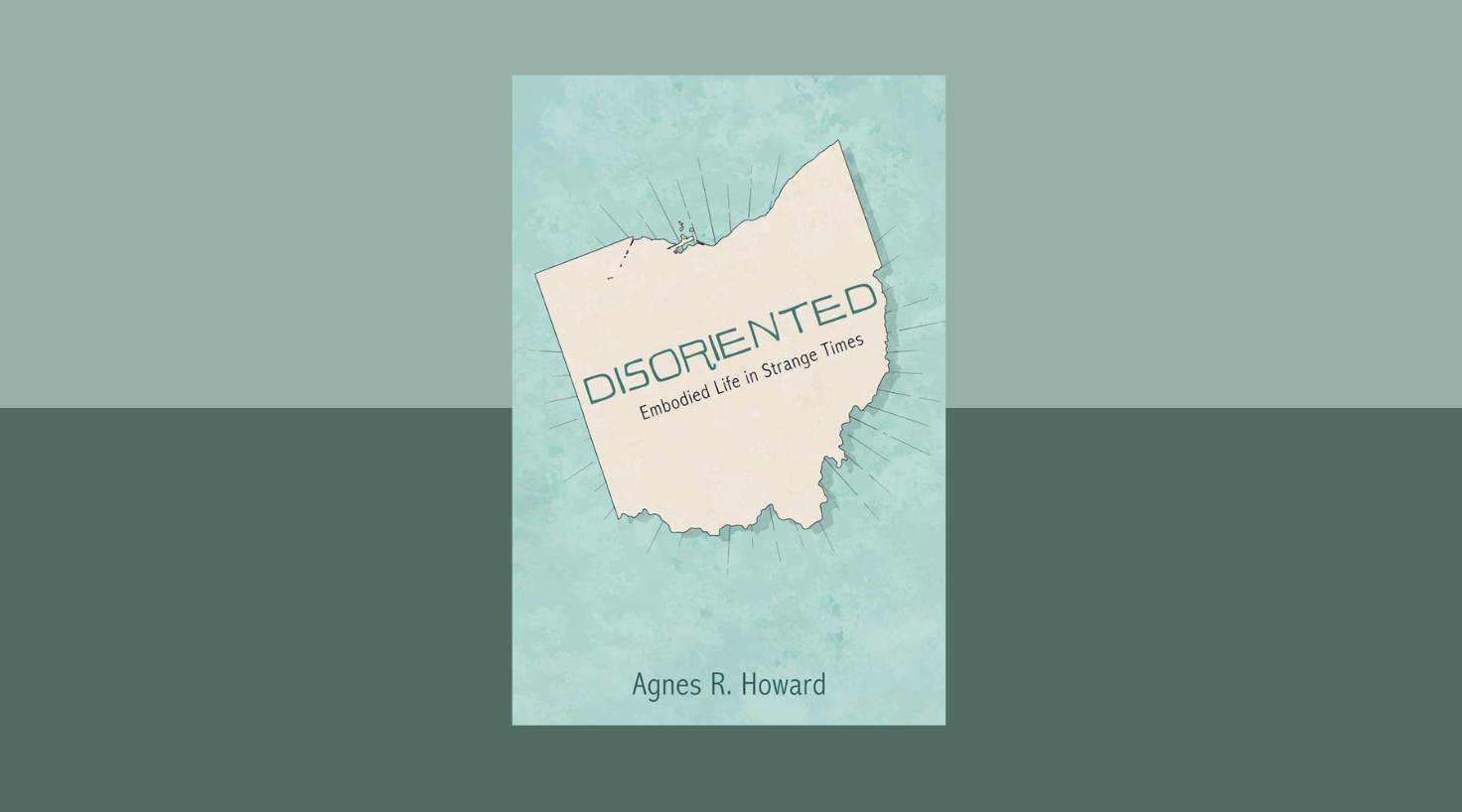
The following excerpt from Disoriented: Embodied Life in Strange Times is published with permission from Cascade Press and Wipf and Stock Publishers, www.wipfandstock.com.
The rule for pick-up at my children’s kindergarten was for parents to come on foot. Parents, that is, moms, parked in nearby lots and stood outside the release doors at the appointed hour. Standing around outside the doors of this north-of-Boston school, moms sorted themselves into tight social knots with their backs to me as they traded intel about what their kids would and wouldn’t eat, about deals on kids’ jeans at the mall, or about vacation plans for Columbus Day leaf-peeping in New Hampshire, the family off to Story Land.
I am tempted to tell the story of how I got out of ever taking my kids to Story Land, but it’s only a good story if you feel the bind. On my kids’ behalf, I regret that many features of their childhood got sorted into categories of fun things I refused. There was the category of things we wouldn’t do because we couldn’t afford them, and the category of things that were actually evil, but also the category of things so foreign to my sense of the way things should be that kids’ efforts at translation failed. I can see how my children could misread those as all the same category though I maintain that those were separate baskets.
On children’s behalf mothers often have to follow rules foreign to their own childhood. Some women manage easily but others flounder because expectations shift fast in national norms and regional variations, plus whatever sprouts from the individualism pressing kids’ conformity. Becoming a mother can feel like arriving in a country whose language you speak but discover locals only use an incomprehensible dialect, when your kids’ survival depends on your fluency.
In each cultural shift in parenting styles, mothers were punished by the new fad’s authorities for obeying the dictates of the last era. Mothers were accused in turn of screwing up their children by being both too attentive and too distant. All the playground insults heaped on American mothers by the time I took my turn—viper mother, helicopter mother, tiger mother, free-range mother—suggest that there is no such thing as a good one.
Was my grandmother a good mother to mine? I don’t think it would have occurred to either of them to pose that question.
Before I had kids I didn’t worry whether I would be a good mom. You were a good mom if you passed along tradition, if you taught children requisite skills, and if you loved them. That first part has proven a stumbling block. Mothers come up short because kids may no longer inhabit tradition or live where mothers grew up, literally or metaphorically. So mothers must not only figure out how to do the new things but learn to act as though those things are natural.
A mother wants to be able to do what her kids need her to do. Sometimes she can’t because she figures out too late what they need or she does not have the right skills. I know how to do laundry and cook dinner and pack a beach bag and write research papers and thank-you notes. For my kids’ sake I should have learned other skills, but I didn’t know which ones in advance.
Baby #1 knocked the wind out of me. Wow, she was beautiful and could not exhaust fascination. The new-baby sleep tax is brutal, but there was a short span between her colicky phase and sleep-training phase where she would slumber into morning past 8:00 or so, during which time I could have pretended to be a normal person and have breakfast and read the newspaper. Instead, what I actually did was lurk by her room hoping she would wake up so I could be with her again. Afternoons at rest I propped her on the slope made by my knees and she stared at me, receptive and amazed, like the way we are supposed to look at God. I paid more attention to her than maybe was strictly necessary. I paid attention because she was so beautiful but also because I was trying to do the right thing, what guidebooks told me, to respond to different cries for food or a diaper change or stimulation.
The experience of new motherhood leaves little original to say. But having the usual response doesn’t mean that it’s not a revelation. I held her whole being in the world on the weight of one arm while she nursed and I started down at her face, a face I came to know better thanI know any other face at the time, even my own. I started seeing people differently in line at the grocery store, wondering how much more honor they deserved from me than I usually gave them since someone some time had looked so long at them like that when they were new and milk-fed. And what if no one ever had looked at them that way? Then they deserved even more. All faces deserve that delight in being beheld, but most beholders cannot see what should be seen. One gift of being mother or father is awareness, through practice, of how good that face is.
The effort expended in meeting the bodily needs of a small human is not the same as effort called forth in enjoying their company. Children require so much physical care: cleaning, diapering, nose-wiping, sliding their arms into sleeves and their sleeves into coats, tying shoes, cutting fruit, squeezing toothpaste, lifting in and out of beds and seats and cars, opening doors, opening boxes, picking up toys. They get hungry and need food. Whether in affluence or poverty, providing food is a task mothers manage almost round the clock—getting it, anticipating kids’ want of it, preparing it, the fiddling of sippy-cup valves and filling the cup and closing the cup, and then cleaning up after the event of eating, disorder generated all out of proportion with quantities of food eaten.
Clothes too demand effort out of proportion with size, fixing each snap, button, tooth of zipper track, pressing limbs into pants, pressing thumbs into mittens, heels into boots, jimmying swimsuits onto and wet off of impatient bodies. Bathing and brushing teeth and brushing hair and helping into highchair and car seat and bed, and then out, and then in again. Then parents teach them how to do all these things on their own, which is more work than doing it for them. Play means scattering things on the floor.
It’s tempting to see the problem with American childrearing as a problem of affluence, that we just have so much stuff that we have to spend lots of time cleaning it and putting it away. We do make things harder. But wealth doesn’t create the mess. The mess comes from embodiment. The mother’s body gives birth to a body that no longer gets warmth, food, or shelter automatically without requesting it but still wants all those and has to feel the need before getting it met. Felt needs hurt more and get said louder. Of course, someone else can do this physical care work for money rather than love. Parents can express love also by paying others to provide care. We hope love stays in it somewhere, though that is a lot to try to buy through an hourly wage.
There are lots of other ways of raising children than the twenty-first-century American one. But there aren’t many plausible ways as long as you raise them here. You aren’t really bringing up bébé if you aren’t in France. When American parents covet somebody else’s childrearing manners, whether the Parisian rule that no toddlers interfere with cocktail hour or Almanzo Wilder, in the Little House on the Prairie series, waiting patiently to be served last at breakfast, no genius hack can be imported to solve our problems. For many of us, parenting problems are a function of social mobility, egalitarian manners, and democracy. American rags-to-riches stories presuppose parents still in rags or dead. Otherwise what would it mean for characters to grow up to be something special and different?
A friend with a happy childhood and nice parents once told me that as a kid, she loved to read books about orphaned children who made clever homes for themselves in cozy places like old train cars, except that she wanted the parents not to be dead. She liked the idea of playing make-believe in a boxcar but would rather head home when dinnertime rolled around. That hybrid resembles the regnant ideal in my kids’ middle-class comfortable childhood: be whatever you want to be while your parents support the make-believe. American children are supposed to move in circles their parents never entered. We love it that way, the American dream. What that means is that mothers may find themselves almost constantly swimming up streams on children’s behalf that they never crossed themselves.
That thing that virtue ethicists and grandmothers say, that you don’t know what you’re made of until challenge comes, mothers discover that at 2 a.m. feedings after 10 p.m. crying jags, at everything soaked through, the diaper and the onesie and the pajamas and the blanket and the crib sheet. They discover it at breakfast the next morning with the other kids, or in the car on the way to school with other mothers watching. A mother-to-be can work on herself beforehand but the actual job that her motherhood will be does not exist until it is hers.
The problem of motherhood is not just how much a mother has to teach kids, how to preheat the oven for baking cookies, how to quit a job or file taxes, how to fasten a bra, how to use a semicolon. The problem is that the person showing up for them is you. The hard thing about motherhood was that I had to be the one showing up for it, sack that I am of anxieties and selfishness and flubbed ambitions of magnanimity. Part of motherhood is trying to move oneself around the great suffering of one’s beloved, taking into one’s body the sufferings of one who came out of one’s body. When the world inflicts injuries on children, mothers feel the hurts too. Motherhood sticks in our faces the incommensurateness of us all, our insufficiency for each other, our desire for others’ good, our causing harm by trying to help.
Mothers should be free to affirm that both extremes can be true about raising even average children: that you should glory in the miraculous presence of small humans who bloom like sunflowers under your gaze and make you actually feel more like the sun, and also admit the tedium and pain of caring for beloved embodied creatures.
The Weekly Digest
Premier Thought Every Thursday.
All of our recent essays and podcasts, delivered to you. Free.
Free. Delivered Thursday mornings.