

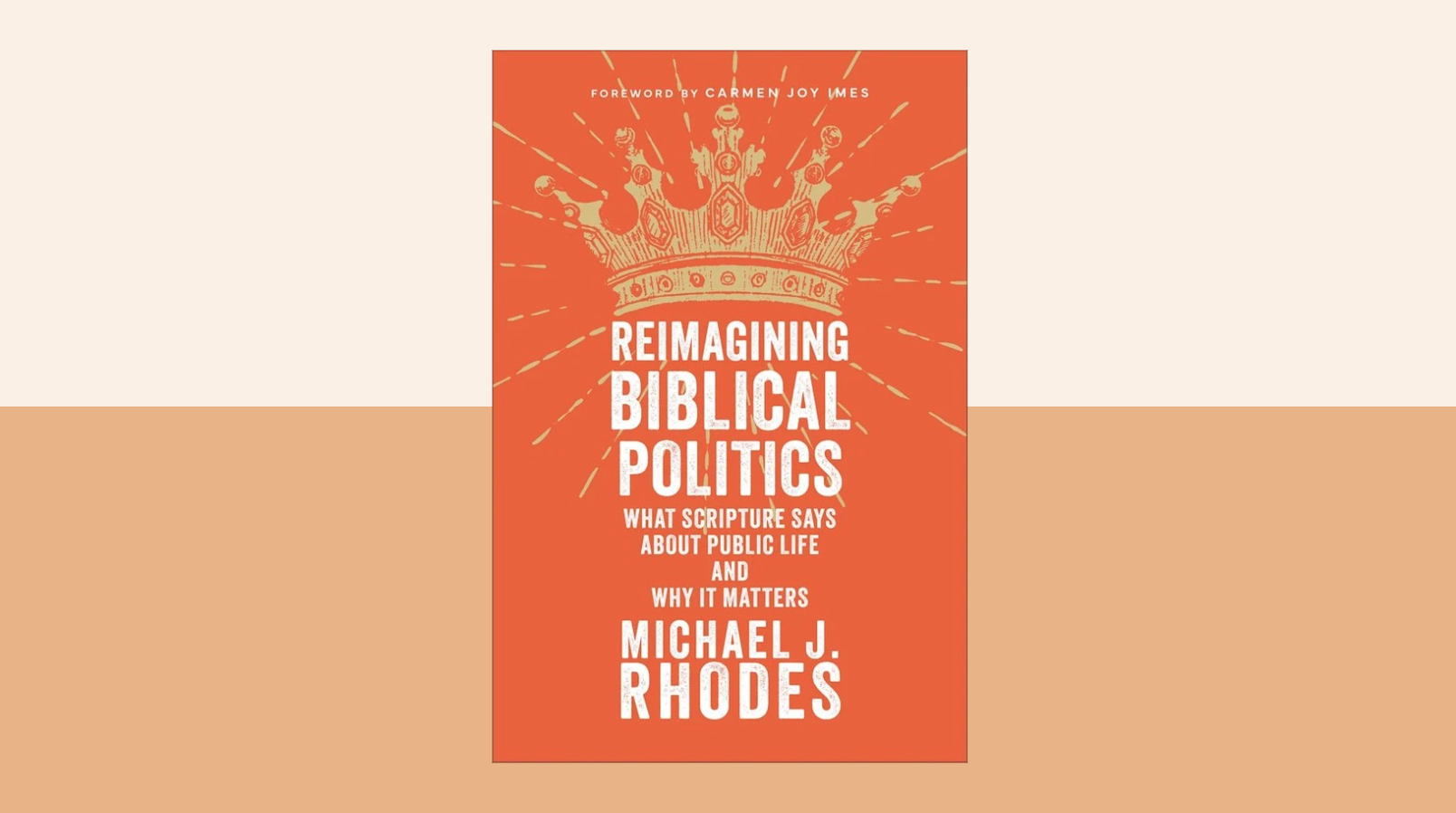
Michael J. Rhodes. Reimagining Biblical Politics: What Scripture Says about Public Life and Why It Matters. Baker Academic, 2026. $26.99. 248 pp.
A few pages into Reimagining Biblical Politics, Old Testament scholar Michael J. Rhodes remarks candidly that “the recent political witness of God’s people in the West has often been abysmal.” Many American churches have dramatically failed to provide the kind of well-reasoned biblical instruction that could equip their laity with an appropriate framework for thoughtful Christian political engagement. Some congregations, seeking to avoid the sort of polarized, hyper-partisan politics of our day, have reverted to simply sidestepping the whole subject. They’ve opted to maintain a deafening silence on any topic that might be perceived as political. While profound political differences may divide those seated in the same pew, a kind of stilted silence is politely maintained.
Given the emotionally charged political exchanges that erupt constantly online, this quietist approach has a certain appeal. But, as Rhodes rightly asks in this valuable book: “How do our political lives get discipled if we never talk about this stuff with our fellow congregants?” Further, he contends that avoiding the subject altogether isn’t a valid option for pastors who seek to teach the whole counsel of God. The political realm is, he insists, an integral part of the gospel message.
Into this fraught situation, Rhodes argues that Scripture actually has good news to deliver. The simple, ancient Christian affirmation that “Jesus is Lord” has profound implications for human politics. Christians should begin exploring this subject not by clutching a set of particular policies or ideological shibboleths close to their hearts, but with the fundamental recognition and declaration that God reigns. Thankfully, the Bible provides a wide variety of instructive examples of faithful political engagement. Christians can benefit from studying these diverse stories while taking care to consider how they hang together, like so many puzzle pieces, to create a coherent portrait.
Rhodes begins by considering how Torah conceives of God’s kingdom and the character of His rule. Old Testament books like Deuteronomy describe how God reclaims His creation “by calling together a community that will live out his kingdom way together.” These scriptures lay out the model for a society that can serve as an example to the world around it, demonstrating the way God’s people do politics. Indeed, this model should be attractive to those living outside their unique community. Rhodes labels this approach “the outpost politics of Moses.”
Because the Lord is a holy God of justice, both transformed individuals and transformed social structures must reflect His justice and generosity. Still, Rhodes takes care to exclude Christians adopting a theocratic approach since the church is a multinational community. Christians’ primary loyalty is to Jesus, and they are often called to live “in political communities that include many that do not recognize his authority.”
Among the book’s most insightful chapters is one focused on the Psalms. Christians often fail to grasp that the Psalms contain subversive political teaching—something slave owners in the nineteenth century recognized when they sought to produce a Bible suitably edited for slaves. The Psalms praise God as the universe’s creator and ruler, they stress his rule over human nations and highlight the Lord's reign over man-made idols, the so-called “gods.” Thus, “singing the psalms is an act of political rebellion, a conscious, calculated rejection of the forces, human and spiritual, that claim to run the universe.” Understood correctly, the book can help believers become faithful and effective outpost communities. Similarly, Jesus in the Gospels gathers a transformed people to Himself. Those who encountered Jesus, established communities whose “outpost politics drew people in to meet” their Savior and Lord. In Matthew 5, Jesus uses the metaphor of the city upon a hill where those who have personally experienced healing radiate it to the surrounding world.
Rhodes’ creative reading of the opening chapters of Exodus focuses on the courageous actions of obscure Hebrew women who were instrumental in saving and protecting the baby Moses, behavior he aptly describes as nonviolent resistance to evil arbitrary authority. Persons in these biblical accounts often act without explicit divine guidance or direct divine intervention. In an equally innovative comparison of the political themes contained in Jeremiah 29 and 1 Peter, Rhodes demonstrates how these two messages to different sets of exiles can provide the faithful today with useful guidance.
In both books, God’s people are called to seek the peace and well-being (i.e., shalom) of the city in which they reside. In seeking this shalom, one must keep one’s focus on this particular place and time while also being “fixed on the long-term fuller shalom” that will only be brought about directly by God himself. Both groups of exiles are called to seek common ground with non-believing neighbors while still retaining their “distinctive identities.”
Pursuing what Rhodes terms “polite resistance” in exile definitely represents a lofty and difficult calling. The peaceful protests and innocent suffering of participants in the American Civil Rights movement provides an inspirational example of this approach from more recent history. Christians today must make appropriate adjustments since many live in western liberal democracies where they enjoy far more rights and political influence than did believers during biblical times.
Although Rhodes concedes that Jesus’ focus is not primarily on social structures per se, he notes that His teachings do tackle subjects with political implications. Unlike the egotistical rulers of this world, Jesus is the selfless, sacrificial ruler that many long for in their hearts. His deft handling of challenging questions about paying tribute to Caesar in the Gospels can help Christians navigate complex political questions. As Rhodes puts it, by drawing his audience’s attention to Caesar’s image on the currency, Jesus “opens the space for disciples to creatively engage political authorities, while also calling us to reject the idolatrous claims those political authorities often make.”
The Apostle Paul also wrestles with the relationship between Christians and political authorities—and not only in the commonly cited verses of Romans 13. For Paul, spiritual and political realities were deeply interconnected. Drawing upon his Hebrew Bible, Paul teaches that ultimately all authority is derived from God. But the Apostle is careful not to write a “blank check for political authorities.” They are granted such authority only in order to enforce justice and promote good behavior. The accounts of Paul’s activities in Acts emphasize this point and portray his main posture to imperial authorities as that of a faithful witness.
In his closing chapter, Rhodes pulls together these disparate threads. Encouraging congregations to tackle thorny political questions, he warns that this sort of biblically-informed “political discernment will get messy.” Christians will inevitably disagree over which of these different scriptural cases constitute the best fit for the present particular predicament. Christians will disagree about “whether and how God’s people should address a societal problem” but Rhodes contends that such debates, if conducted properly, can be fruitful.
There is much to commend in Rhodes’s careful and thorough study. It contains many practical helps that can aid congregations at this difficult time. He eschews simplistic answers and does justice to the complex variety of perspectives in the biblical text. Although Rhodes is usually careful to qualify his statements, his contention that “your God reigns [Isa., 52:7]… is perhaps the clearest shorthand summary of the gospel itself” (italics in the original) may strike some as problematic. Such an approach could serve to redirect the central focus from Christ’s atoning death and resurrection (cf. 1 Cor 15:3-4). A fuller theological discussion of the distinction between the gospel as promise and the Kingdom as fulfillment would have been helpful. Some interaction with Oliver O’Donovan’s understanding of the relationship between human government and the proclamation of the gospel might have been illuminating too, including more on how Christ’s resurrection and ascension displaces the nation’s claims to ultimate authority. Finally, the book could have benefited from a more extensive consideration of how to grapple with political differences that extend well beyond particular programs or policies. How do we engage our brethren who reject the whole notion of a pluralist democratic system?
Reimagining Biblical Politics remains, nevertheless, an invaluable resource that provides the sort of insightful and practical Bible-based reflection that has been so conspicuously absent from many American churches.
The Weekly Digest
Premier Thought Every Thursday.
All of our recent essays and podcasts, delivered to you. Free.
Free. Delivered Thursday mornings.