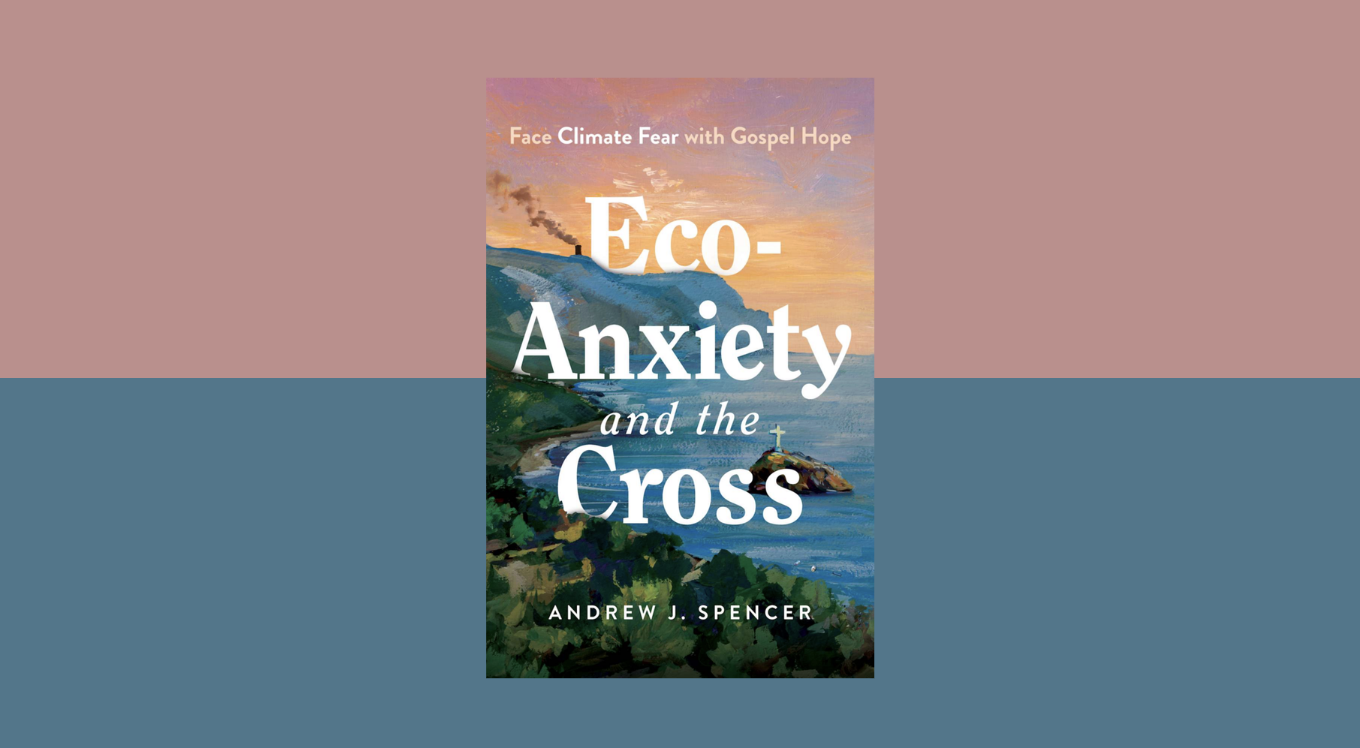
The following excerpt from Eco-Anxiety and the Cross: Face Climate Fear with Gospel Hope (September 2026) is published with permission from B&H Academic.
Debates about climate action usually begin with the stated goal of saving the planet, the ecosystem, or some enormous, complex entity that is the biological explanation for life on earth. But we’re really not trying to save the planet; we’re trying to preserve our way of life.
As climate scientist Katharine Hayhoe writes,
The planet is going to survive—it has, after all, been warmer before on geologic timescales. It is our human systems that are at risk, our cities and economies and buildings and food system and, at the end of it all, our civilization.”
She’s right.
The idea that we humans can destroy or save the world makes us anxious. We want certainty that we’re in control and that the future will be predictable. Again, Hayhoe says it well:
Modern civilization is built on the assumption that have a straight road and a stable climate, and that therefore the conditions we’ve experienced in the past, that we can still see in our rearview mirror, are accurate predictors of the future.
But that’s never been the case, and it never will be.
The illusion of control has led to some crazy proposals for changing the climate. For example, the introduction to a nuclear engineering textbook claimed that it was possible “to alter unfavorable weather patterns in many parts of the world by removing mountain ranges which obstruct the flow of air” through peaceful nuclear explosions. Another activist claims that replacing meat in our diets with lab-grown bacterial sludge can save the planet. And, of course, some people claim that the world would be a better place if humans just went extinct.
Some of these proposals might help the environment, but it would be nearly impossible to convince enough people to go along without force. There are likely unpredictable and undesirable side effects to such massive proposals, even if well-intentioned. The truth is that we humans don’t have as much control over creation as we sometimes think.
Is Control of Creation Possible?
The illusion of control produces anxiety when people claim that the world can be saved if and only if their proposals to radically change the world are widely adopted immediately. As the executive secretary of UN Climate Change argued in 2024, “We have two years to change the world.” In other words, unless the world economy was radically overhauled by the time this book was released, an environmental disaster was unavoidable.
This mentality gives us too much credit. It assumed that, like a video game, if we adjust a few slider settings in the user controls, we can make the story play out the way we think it should.
In Michael Crichton’s novel, Jurassic Park, the curmudgeonly mathematician Ian Malcolm (played by Jeff Goldblum in the movie), is critical of the dinosaur-themed park from the beginning because of chaos theory: The idea that the number of variables (no matter how minor) in a system prevents accurate predictions beyond short periods of time. As the movie version of Malcolm states, “Life finds a way.” Of course, events in the novel work out exactly as Malcolm predicted: The dinosaurs kill a bunch of people, then escape. The result is a series of best-selling books and a movie franchise that continues to make money.
There is something that rings true in Crichton’s concern about being too confident in our predictions. Scientists are much more cautious in their appeals to climate models than journalists and other activists are, precisely because of the complexity. That’s why climate scientist Katharine Hayhoe, who is one of the authors of the United Nations Intergovernmental Panel on Climate Change report, has had to publicly debunk the often-repeated statement that the world is going to end after some specific time period, like twelve years.
Climate change is real. I’m confident humans are contributing to it, given our excess greenhouse gas emissions. However, the solution isn’t as simple as imposing socialism, outlawing air travel, or eating bacteria-based protein. In fact, there is much uncertainty about the way climate change will work itself out, which is one reason for the shift in language from “global warming” to “climate change” to what Hayhoe calls “global weirding.”
We just don’t have as much control of the planet and the people who live on it as we think. To paraphrase Princess Leia from Star Wars: A New Hope, “The more we tighten our grip, the more the environment will slip through our fingers.” Rather than trying to control the climate ourselves, we should lean into trusting God’s sovereignty.
Is God Really in Control?
As Christians, one way to respond to eco-anxiety is by remembering that God is in control. The first step in overcoming this anxiety is recognizing that God directs history.
James warns against trying to control the future:
You do not know what tomorrow will bring—what your life will be! For you are like vapor that appears for a little while, then vanishes. Instead, you should say, ‘If the Lord wills, we will live and do this or that.’ But as it is, you boast in your arrogance. All such boasting is evil (James 4:14-16).
James is not encouraging passivity. He adds, “It is sin to know the good and yet not to do it” (4:17), echoing his call to “be doers of the word and not hearers only” (1:22). We don’t control the future, but that doesn’t mean we just sit on our hands. God tasked humanity with caring for creation (Gen. 2:5, 15), but always under his authority.
The book of Job is a vivid reminder of God’s sovereignty. Job lost everything—his possessions, his children, and his health. Eventually, he complained to God that he’d been unfairly treated. He wished he had never been born.
God, however, doesn’t apologize to Job or strike him dead. Instead. God offers a reminder that he’s in control. He created everything. He knows when animals give birth in the wild (Job 39:1-4). After hearing all this, Job response, “I know that you can do anything and no plan of yours can be thwarted” (42:2). God is in control of everything, including nature.
God’s control doesn’t excuse us from responsibility. Scripture shows that sin—including mistreating creation—has consequences. Israel’s exile, for example, was partially due to their failure to give the land its Sabbath rest (2 Chron. 36:20-21). Human actions matter.
And yet, God’s sovereignty is never in question. Jesus said not even a sparrow “falls to the ground without your Father’s consent” (Matt. 10:29). He rules over even the smallest details in creation.
Ultimately, eco-anxiety often stems from trying to carry burdens we were never meant to bear. We aren’t in control. God is. That truth doesn’t lead to apathy; it leads to hope. Trusting in God leaves us free to live faithfully and steward the earth well, knowing the outcome is in his hands.
The Weekly Digest
Premier Thought Every Thursday.
All of our recent essays and podcasts, delivered to you. Free.
Free. Delivered Thursday mornings.