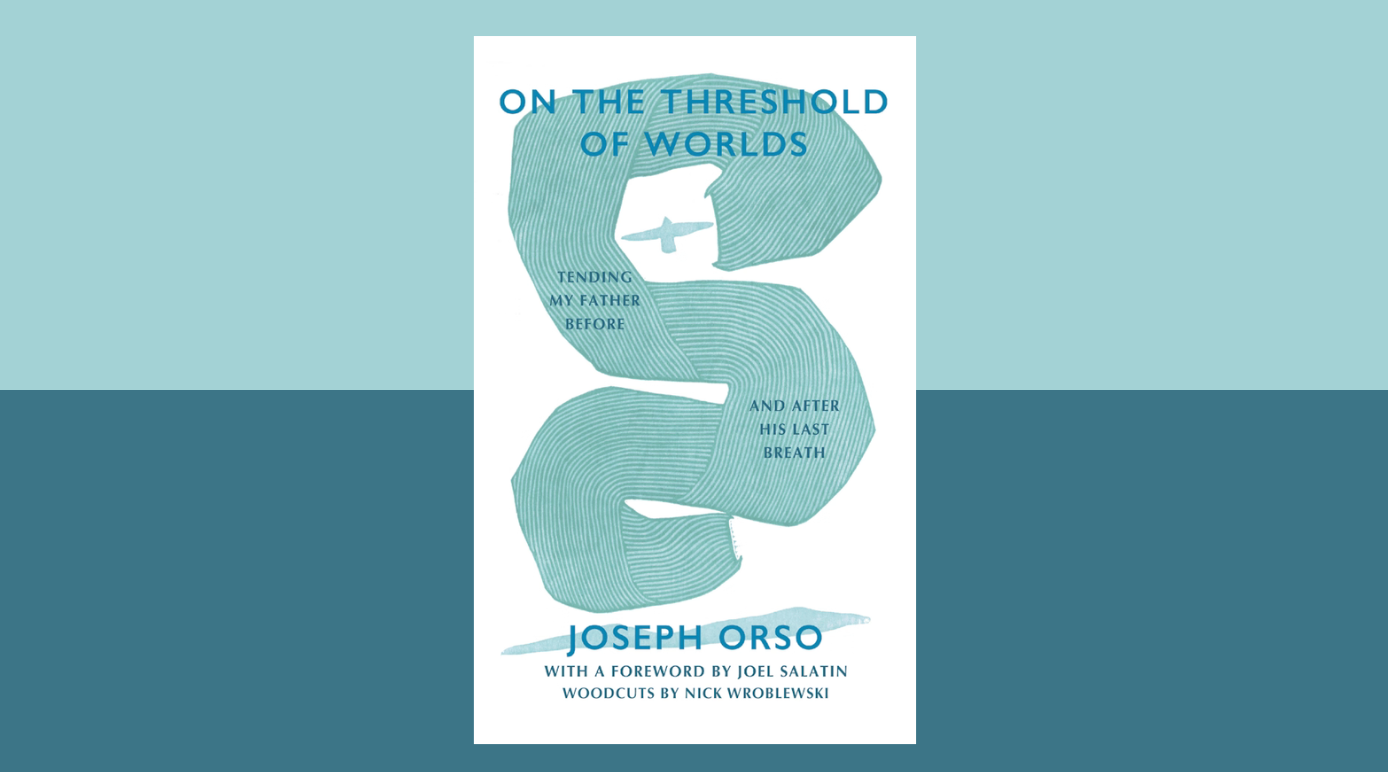
Joseph Orso. On the Threshold of Worlds: Tending My Father Before and After His Last Breath. Front Porch Republic Books, 2026. $20.00. 156 pp.
The shelves in our libraries and bookstores groan under the weight of all the tomes that have been published lately purporting to teach us this or guide us on a path to that. Whether step-by-step guides or collections of anecdotes, such books aim to pass on a skillset or serve as a guidepost for setting out on a brave new path.
In his book On the Threshold of Worlds: Tending My Father Before and After His Last Breath, Joseph Orso explores what it's like to reclaim the work and ritual of caring for our own dead, rather than turning those very important tasks over to an industry that replaces intimacy with efficiency. But the book does not clearly mark out a journey on a map or provide detailed instructions. Orso has written a call to a return to old practices we once knew, not a listicle or "For Dummies" manual.
The book is nearer to a Viking sun stone—if you turn it this way and that until the light shines brightly through its shaft, it will point out the position of the markers that will allow us to take a bearing and determine which direction to take.
Orso sets out to share his experience with the death of his father and the choice to bring his body home to hold a vigil and then bury him on his family’s own land, in their own way. It is not a simple temporal narrative, although there are narrative elements. Likewise, he does not delineate all the steps that were involved to navigate the legal, biological, and practical considerations, although he does not shy away from a frank discussion of some of them. He does not solely concern himself in this book with the philosophical, sociological, and theological questions that we must grapple with in our decisions about death, mourning, and funerary culture.
Instead, Orso asks what we might gain, should we choose to take the work of caring for the bodies of our dead back from the funeral industry and rebuild the ritual around such work at home. What do we owe the soul of our departed, and how do we honor the body that once housed it? Then he shows us.
The book reads as if you are sitting in that room with Orso and his father. Sometimes, it is filled with family and friends. Other times, it is dim and quiet, and a window opens into the past, allowing us to see Orso and his father, both before Alzheimer’s altered their relationship, and after. Then the window slides shut, and you are sitting alone with Orso as he ponders our creatureliness and the things we owe one another. As death moves closer, memories, faith, and discernment begin to blur together, before he moves back into a more traditional account of vigil and burial.
It is the experience of losing his father twice—first to Alzheimer’s, and then to death. Orso and his family have chosen to live with great intentionality and without indoor plumbing or electricity. But the very act of having chosen that type of hard for themselves in order to reap its blessings makes caring for an aging parent who is rapidly losing both mental and physical function a near impossibility. Honoring father and mother sometimes means making difficult decisions.
Still, the choice to lead a profoundly local life leads almost inevitably to the decision to care for his father's body at home and then to bury him in that place that they have chosen to call their own.
Orso's prose ranges from simple confessions and explanations of the procedures necessary to accomplish this into vivid recollection of the man being honored by his household and community. It then climbs another register in a near-poetic contemplation of the nature of grief and ritual. Ripples of Job shimmer underneath questions about holiness, Creation, and veneration.
It should be noted that Orso is Eastern Orthodox, his parents Catholic, and he sometimes uses language about ritual that can be a bit discomfiting to those of us of a more staid, Protestant background. It's worth it to ride that out, however, and absorb the experience as Orso draws the reader in.
Orso paints a picture rich with meaning and deep appeal, plucking at something that is almost a memory we all share. While he does acknowledge that not everyone has the capability to follow the path he marks out, I am not sure he has truly reckoned with all of the difficulties.
It's obvious that only someone who owns a sufficient piece of land—and lives in a jurisdiction that allows such burials—can inter their loved ones themselves. This presumes the intention of lifetime ownership of that property as well. After all, how could you sell Grandma's grave? But beyond that is an aspect that Orso does not acknowledge fully.
However radically locally we may choose to live, that decision only lasts as long as we do. Or until we, like Orso's father, lose our ability to participate in these very same decisions. It does not follow that our descendants can, or will, retain that same place or a relationship to it. What then?
As the de facto family historian, I have had cause to wrestle with this issue. My third-great-grandmother, Aaltje Sprik, and five of her children were laid to rest on the farm where they died. A marker was placed a century and a half ago, and a new granite monument was added in the late 1990s. But since then, the old homestead has been sold for development. The house is gone, although the silo and some outbuildings remain on the edges of the subdivision that now occupies the site. The markers have seemingly vanished into the ether. No one seems to know what has become of them. Were Aaltje and her children moved to another local cemetery? There is no record of it. Was the marker simply tidied away by the developer so the new residents wouldn't be bothered by their proximity to the graves?
When another century and a half has gone by, will Orso's great-great-grandchildren be able to find his father's grave?
I can walk down the lines of Atwood Cemetery and greet six generations of my ancestors as I move from north to south. That ground is, for me, thick with the known dead.
Which way truly ties us more tightly to our places? Orso does not ask. He borrows Paul Kingsnorth's Machine language to elucidate the industrialization of modern funerary practices. He is certainly correct that it is more common historically for us to care for our own dead, even if it is a largely forgotten practice in the modern West. Graveyards, however, are as ancient as human culture itself. There may be space between abdicating our responsibilities to our loved ones in death, and taking all those things on ourselves, up to and including interring them on our own lands. A middle ground of caring for our loved ones at home, while still burying our dead in cemeteries, is more accessible to most people. This would also be more aligned with historical and cultural practice, not less.
Minor quibbles about practicalities aside, this book about caring for our dead and reclaiming old rituals and practices that once made up the fabric of community is really asking a deeper question: What stitches us to our places?
In "Anne's House of Dreams," Marilla remarks to Mrs. Lynde, on the eve of Anne's wedding, "When I was a child I heard an old minister say that a house was not a real home until it had been consecrated by a birth, a wedding and a death." We have, bit by bit, turned all three into businesses rather than sacraments. And in so doing, allow the fabric of our places to become so frayed and moth-eaten that it seems it cannot hold us anymore. It falls to us to rewarp the loom, so that we can reweave the "underneath," until our places can hold the weight of our creatureliness again.
What Orso is really asking: is caring for our dead with our own hands and burying them in our own places one of the warp threads? Perhaps it is. His book makes a case for it, at least, without stridently insisting that everyone follow where he leads. It is entirely worthwhile to read On the Threshold of Worlds while keeping in mind not just what Orso says about caring for our dead but also what he doesn't.
The Weekly Digest
Premier Thought Every Thursday.
All of our recent essays and podcasts, delivered to you. Free.
Free. Delivered Thursday mornings.