

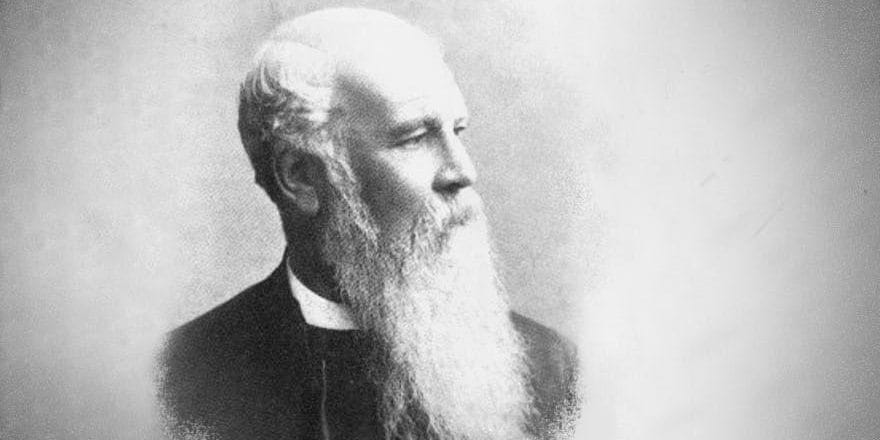
Andrew Atherstone. Ryle on the Christian Life. Crossway, 2025. $21.99. 208 pp.
Over the past few decades, Crossway’s Theologians on the Christian Life Series has been a wonderful gift to the church. The books in this series are neither biographies nor bare expositions of the theology of the figures treated therein. Rather, the series considers how the life and theology of key figures from Christian history can inform in our own time and place the practical challenges of the Christian life. The series has included entries on such universally known titans as Augustine, Calvin, Luther, and Bonhoeffer alongside more specifically Reformed luminaries such as J.I. Packer, John Owen, Herman Bavinck, and B.B. Warfield. The latest entry in this series, Andrew Atherstone’s Ryle on the Christian Life, offers a compelling introduction to the vision of the Christian life advocated by the first bishop of the Anglican diocese of Liverpool, J.C. Ryle, who lived from 1816—1900.
But who was J.C. Ryle? Ryle is most widely known today as the author of the book Holiness: Its Nature, Hindrances, Difficulties, and Roots. In this book he centrally argued that “real practical holiness does not receive the attention it deserves”—as much a problem in the twenty-first century as it was in the nineteenth. A numerically small but extremely devoted segment of the Christian reading population is aware of Ryle’s other writings, since the puritan-promoting publisher Banner of Truth Trust has kept many of Ryle’s most notable works not only in print but in handsome editions. However, I will assume throughout this review that the majority of readers have little to no familiarity with J.C. Ryle.
What Can We Learn from J.C. Ryle about the Christian Life?
Ryle on Suffering
Ryle is arguably at his very best on the topic of suffering in the Christian life. Far from a detached academic in his ivory tower, nor an apathetic Stoic pontificating about the virtues of suffering, Ryle knew firsthand what it was like to barely survive heart-rending, unbearable suffering. He endured numerous periods of serious illness. His first wife Matilda suffered postpartum psychosis, then died a year later after prolonged illness and coughing up blood. Their daughter Georgina suffered from mental illness and was confined to an asylum. Ryle and his second wife Jessy had further children, but one of them (an unnamed daughter) died at birth in 1853. Jessy died of kidney disease after ten years of marriage, leaving Ryle a widower for the second time at age thirty-eight, “with five children between the ages of two and thirteen, and ‘altogether more disconsolate and helpless than ever.’” Ryle then married Henrietta and their marriage lasted twenty-seven years, before Ryle had to bury his third wife, in 1889. Ryle buried an eight-year-old grandson in 1897.
Each of these afflictions is sufficient in itself to devastate even the most fortitudinous men. Over and against atheistic nihilism, Ryle preached “that only biblical Christianity could satisfactorily explain the prevalence of pain and disease in an otherwise remarkable world.” Pastorally, Ryle wrote that “suffering is a part of the process by which the sons of God are sanctified… A suffering Savior generally has suffering disciples.”
Though God is not to be blamed for any instance of evil, God can use hardships in powerful ways; “prosperity is a great mercy; but adversity is a greater one, if it brings us to Christ.” Far from shirking from the doctrine of divine sovereignty, “Ryle’s appreciation of suffering was closely linked to his understanding of divine providence… there is no such thing as luck, chance, or accident, in the journey of our life… the very hairs on [our] heads are all numbered. Sorrow, and sickness, and poverty, and persecution, can never touch [us] unless God sees fit…. They are immortal, till their work is done.”
A Champion of the Reformation
J. C. Ryle championed the foremost theological insights of the Protestant Reformation for a context in Victorian England which had either largely forgotten or turned against the puritans. After the advent of industrialism, post-Enlightenment philosophy, rising secularism, and not a few social crises, the theological foundations which the Church of England had stood upon for centuries began to seem either unintelligible, or perhaps no longer good and beautiful. Atherstone’s opening half-dozen chapters treat some of the foremost emphases of evangelicals across the centuries, such as Scripture, sin, salvation, the transformation of the heart, sovereign grace, conversion, obedience, and more.
One reason that J.C. Ryle is instructive today is because many of the theological emphases in catholic Christianity in all centuries, and especially for churches descending from the Protestant Reformation, are all too rare in mainstream Christian preaching and teaching. Atherstone summarizes that “foundational to Ryle’s understanding of the Christian life was not just the existence of sin but its enormous depth and awful consequences, from which humanity could be rescued only by a great Savior.” Crucially, however, Ryle was not a mere proponent of individual salvation, though it was an emphasis of his. Ryle had a robust ecclesiology and urged his listeners to attend to the means of grace. He was also captivated with the person and work of the Holy Spirit and led a union of daily prayer for the outpouring of the Spirit worldwide.
The Practicality of Ryle
Since Ryle is best-known for his book Holiness, I will not devote too much attention to it in the present review only for the sake of brevity. But Atherstone capable summarizes this monumentally significant pillar of the Christian life, and notes how “military metaphors were one of Ryle’s favorite ways to illustrate the nature of the Christian life,” particularly as a struggle against sin as we strive for holiness (Heb 12:14). As Sinclair Ferguson once commented about Ryle, “you need to understand something really well in order to explain it simply, and that is true of Ryle.” Ryle was not afraid to give people very practical advice about how to cultivate virtue, confiding “tell me how a man spends his evenings and I can generally tell what his character is.”
Ryle the Preacher
Though I knew beforehand that Ryle was a powerful preacher, Atherstone taught me just how helpful Ryle could be not only as a preacher himself but also a critic of bad preaching and an instructor of preachers. Ryle did not hold back on his sense of the state of preaching in his day: “It is my firm believe that if five out of six of our Church clergy would burn all their sermons tomorrow, and resolve to preach in a new style, it would be an immense blessing to the Church of England.” In saying this, Ryle was not seeking the advent of modernistic or anti-traditionalist preaching. Rather, his constant concern was that biblical, orthodox Christianity must be proclaimed—and proclaimed in an intelligible and engaging way that drove people to seek Christ. Hence, Ryle did not hold back when he heard preaching that was “another gospel” (Gal 1:6), devoid of scriptural truth, so academic no one could understand it, or so boring no one wanted to listen.
In 1876 Ryle delivered lectures at St. Paul’s Cathedral entitled “Simplicity in Preaching,” about which Atherstone observes:
By then he had been preaching for thirty-four years to agricultural laborers in Hampshire and Suffolk, so he knew from personal experience the ‘enormous difficulty’ of communicating the gospel in that context. He reckoned it easier in many ways to preach before undergraduates and professors at the Universities of Oxford and Cambridge, or barristers at the Temple Church and Lincoln’s Inn, or members of Parliament, than before an ‘agricultural congregation on a fine hot afternoon in the month of August.’ According to one laborer, Sunday was the most enjoyable day of the week: ‘I sit comfortably in church, put up my legs, have nothing to think about, and just go to sleep.’ Simplicity was essential if the preacher wanted to be understood.
Ryle was aware Latimer’s sermons would not suit modern taste, but Ryle chided the typical modern sermon as “too often a dull, tame, pointless, religious essay, full of measured round sentences, Johnsonian English, bald platitudes, timid statements, and elaborately concocted milk and water.” Ryle was no abstract theoretician; he had practical tips such as “beware of colons and semi-colons. Stick to commas and full stops, and take care to write as if you were asthmatical or short of breath.” When he was a young curate, his intellectual manner was “miles over the heads” of local farmers and their families, before “I crucified my style, and became plain John Ryle.”
I am foregoing that advice in this review, but it is truly helpful advice for crafting sermons: As many monosyllabic words as possible, and short sentences that both little children and elderly people can follow, but filled with content from the depths of Scripture on the inexhaustible glories of the God of the gospel, driving us all to perceive our need for Christ and his all-sufficient glory and grace.
Ryle's Devotion to the Formularies
Atherstone throughout the book repeatedly highlights Ryle’s commitment to the Anglican formularies: the 1662 Book of Common Prayer, the Thirty-Nine Articles of Religion, and the Two Books of Homilies. For instance,
Ryle was primarily a popularizer who aimed to distill biblical wisdom from the Puritans and repackage it in pithy form to attract busy Victorians. His gift was for succinct summary and memorable illustration. He was also at pains to show that these were not novel ideas but mainstream Church of England teaching as expressed in the Book of Common Prayer and the Thirty-Nine Articles of Religion.
Amidst controversy about the exclusivity of Christ for Salvation, Ryle noted that texts such as Acts 4:12 are “directly quoted in Article 18 of the Thirty Nine Articles… Ryle therefore insisted that it was the obligation of every Church of England minister to teach this doctrine.” Or, when some dismissed any notion of election whatsoever, Ryle argued from Scripture and “simply quoted Article 17 of the Thirty-Nine Articles—one of the official formularies of the Church of England—which teaches that the doctrine of predestination, or election in Christ, is ‘full of sweet, pleasant, and unspeakable comfort’ to Christian believers. He rejoiced in Article 17 as the best statement of the doctrine outside the Bible.”
In terms of churchmanship, “as an Anglican clergyman, bound by his subscription to the Thirty-Nine Articles, Ryle deemed it his public duty to uphold this teaching. As a pastor concerned for the spiritual health of his Suffolk parishioners, he also emphasized that final perseverance was a matter of great practical importance.” Or, perhaps most significantly:
The Thirty-Nine Articles of Religion, the Church of England’s confessional statement, provided a crucial framework for Ryle’s understanding of the Christian life. He first studied them as a schoolboy when competing for the Newcastle Scholarship at Eton College in the early 1830s. They ‘insensibly prepared my mind to receive Evangelical principles, when my heart first began to turn to think of religion,’ he recalled. The Articles distilled Reformation doctrine into very succinct form and deeply shaped Ryle’s theological world. He celebrated that they offered an incomparable combination of theological ‘fullness, boldness, clearness, brevity, moderation, and wisdom.’
Sadly, today there is often confusion about what Anglicans believe, or if Anglicans even have a discernible theological tradition. Ryle exemplifies someone who not merely assented to the Anglican formularies but demonstrated how our confessional heritage as Anglicans and historic observances of the classic Prayer Book tradition can not only be intelligible, but is actually compelling and profound resource for curing what ails us in late modern society.
Ryle the Tract Writer
Ryle was adept at communication. Though Ryle’s Anglo-Catholic rivals became known as “the tractarians” for the Tracts for the Times wherein they advocated their ideas, in his own time Ryle was called “the prince of tract writers,” since “the tract, second only to the sermon, was widely utilized by Victorian Christians of all stripes to campaign and communicate.”
However, as Atherstone notes, “it was a popular and powerful but inherently transient form of literature. Some of Ryle’s original tracts are now extremely rare, even from print runs of tens of thousands, and others have disappeared altogether.” This is probably a point worth reflecting upon for contemporary evangelicals who are eager to adopt digital technology or create digital content in order to reach as many people as possible. That may well be worth doing and may even seem unavoidable in many cases. But it is worth contemplating the afterlife such massive efforts of time and money will have, and discerning how we can build enduring institutions, traditions, practices, and literature that will outlast ephemeral tracts and even more ephemeral digital content.
Ryle the Shepherd
Ryle helped prepare people for death and to stand before God in eternity, especially since “death was ubiquitous in Victorian society.” In Ryle’s “Expository Thoughts on the Gospels he observed that the gravestones in every English churchyard indicated that only a small proportion of the population lived to be fifty years old, and many never reached adulthood at all.” Ryle noted that people extremely prone to distract ourselves from death and away from soberly thinking about eternity, because “we live in an age when the multitude are increasingly absorbed in earthly things, in railways, and docks, and commerce, and trade, and banks, and shops, and cotton, and corn, and iron, and gold.” How much worse is the potential for self-distraction since the advent of digital technology? Crucially, Ryle was unashamed to declare to modern people the scriptural teaching about hell that the church catholic has historically confessed:
At Exeter Hall, Ryle announced, ‘I am one of those old-fashioned ministers, who believe the whole Bible—and everything that it contains.’ He condemned the new doctrines as ‘smooth-spoken theology’ and affirmed, ‘I believe that there is a real hell.’ Rather than keep silent, Ryle insisted that it was an act of Christian compassion, and also his ministerial duty, to speak about hell. ‘I see danger ahead, and I would fain warn every man to flee from the wrath to come. I see peril of shipwreck, and I would light a beacon and entreat every man to see the harbour of safety.’
But alongside preaching about the sinfulness of sin and the terrors of hell, Ryle was most keen to impress upon his hearers the hope of heaven extended to us in Jesus Christ, especially as a consolation for those bereaved of loved ones who followed Christ:
Some of us know by bitter experience, Ryle lamented, that the days after the death of a loved one ‘are the slowest, saddest, heaviest weeks in all our lives. But blessed be God, the souls of departed saints are free from the very moment their last breath is drawn. While we are weeping, and the coffin preparing, and the mourning being provided, and the last painful arrangement being made, the spirits of our beloved ones are enjoying the presence of Christ.
Similarly, in 1868 he wrote to give hope to the bereaved who found Christmastime particularly sorrowful:
Do tears rise unbidden in your eyes, when you mark the empty places round the fireside? Do grave thoughts come sweeping over your mind, even in the midst of your children’s mirth, when you recollect the dear old faces and much loved voices of some that sleep in the churchyard… Do you feel lonely and desolate as every December comes round? …those whom you laid in the grave with many tears are in good keeping. You will yet see them again with joy… the lonely time will soon be past and over. You will have company by and by.
Perhaps thinking of his own daughter who died at birth in 1853, Ryle wrote that “the youngest babe that ever drew breath shall not be overlooked or forgotten… we shall once more see our beloved friends and relatives who fell asleep in Christ, and left us in sorrow and tears—better, brighter, more beautiful, more pleasant than ever we found them on earth.” Finally, when his own death loomed, Ryle declared “nothing can break my union with Christ… doctors may have given over their labours. Friends may be unable to minister they wants. Sight may depart. Hearing may depart. Memory may be almost gone. But the loving-kindness of God shall not depart. Once in Christ thou shalt never be forsaken…. Reader, may this be your portion in life and death! And may it be mine!”
Three Critical Questions About Ryle’s Approach to the Christian Life
And yet, there are at least three critical questions worth asking about Ryle’s approach to the Christian life.
Ryle on Conversion
Ryle’s approach to conversion is both salutary but also can easily become distorted and unhelpful. Ryle, rightly so, routinely made direct evangelistic summons to faith and repentance to enormous crowds. He taught that conversion was absolutely necessary, because “no one, however wise, wealthy, noble, or beautiful, will ever get to heaven without conversion.” For instance, Ryle’s description of an unconverted congregation hits uncomfortably close to our own context today:
Observe how listless, and apathetic, and indifferent, they evidently are about the whole affair. It is clear their hearts are not there! They are thinking of something else, and not of religion. They are thinking of business, or money, or pleasure, or worldly plans, or bonnets, or gowns, or new dresses, or amusements. Their bodies are there, but not their hearts. And what is the reason? What it is they all need? They need conversion.
In a Victorian society where most people were either baptized or at least extremely familiar with Christianity, it was indeed true that there were regularly people at church who were unconverted. That is still the case in twenty-first century America, as it is in every age. However, it is important to recognize that we inhabit a significantly different context from Ryle.
Non-believers today are far less familiar with the Bible or church or Christianity than they were in Ryle’s context, and without compulsory church attendance, people are far less likely to attend church for social advantage or entertainment than they might have been in Ryle’s day. Today, we simply cannot take for granted that unconverted people believe that God exists, that Christian morality is helpful, that they will face judgment after death, etc. Far more work needs to be done to make the gospel intelligible to a not only non- but also post-Christian context today.
Differently, and perhaps more significantly, hearers incessantly are summoned to be converted, those who are already converted can sometimes succumb to unhelpful scrupulosity or excessive introspection. For instance, Ryle declared “repent, and be converted. Rest not, rest not, rest not, till you know and feel that you are a converted man.”
Of course, we should urge everyone to personally appropriate the Christian faith! Ryle was correct to summon nominal Christians to actually repent and believe the gospel. However, conversion is not necessarily a feeling, and even those who are converted will at times feel a closeness to our Lord in Gethsemane or his cry of dereliction from the cross. There is a time and place in the Christian life to cry out like Martin Luther Baptizatus sum! [“I have been baptized!”] in the face of temptation and struggle and attack from our spiritual enemies, appealing not to inward subjective feelings but to the outward and ordinary means of grace whereby Christ himself promised to unite us with himself.
Ryle the Polemicist
Though at the end of the day I have more in common with J.C. Ryle than his Anglo-Catholic sparring mates, some of his intra-Anglican polemics are baffling to me. Within the Church of England, Ryle’s puritan-adjacent theology and trenchant opposition to the Oxford Movement won him few admirers among High Church Anglicans. Yet his free church and non-conformist critics hardly appreciated his nineteenth-century Low Church Anglicanism.
For instance, Ryle lamented the return of altar rails. However, “the black rubric” in the 1662 Prayer Book had long before clarified that kneeling to receive the Eucharist as a posture of humble reception and does not necessarily imply pre-Reformation eucharistic beliefs and practices. Differently, on vestments, Ryle affirmed their continued use. A puritan-inclined critic once lambasted Ryle in a magazine for preaching in a surplice, to which Ryle responded in a letter to the editor that “if I were a hearer, I would far rather listen to a lively, searching, ringing Gospel sermon from a man in a surplice than to a dull, dreary, mumbling stupid homily from a man in a black gown.” Simultaneously, the Anglican diocese in Liverpool was at one point reaching less than 7 percent of its urban mission field. Ryle commendably promoted more lay ministers but said “they must not be like the clergyman who ‘never feels at ease unless he has Prayer-book in his hand and a surplice on his back.’”
I happen to wear a surplice at all of the services our church performs, and routinely have my Prayer-book near me pretty much wherever I go. Far from a hindrance, I see both things as profound aids to evangelism and pastoral care in the secularizing, disembodied culture of liquid modernity that is desperate to connect with something transcendent and historic. The goal posts have moved several times since Ryle once replaced a stained-glass window depicting Christ out of concerns about idolatry. Ryle derided that before the Reformation there was a “conspicuous absence of all knowledge of true Christianity,” and “gross darkness overspread the land.”
Ryle the Generalizer
How does that sweeping generalization hold up under the scrutiny of historical research such as Eamon Duffy’s The Stripping of the Altars? One does not have to be John Henry Newman to recognize the need for further nuance to precisely characterize what exactly the Reformation did, and did not, remedy. The dividing lines between more Evangelical/Low Church vs. Anglo-Catholic/High Church parties no longer fall precisely where they once did. I do not regard those conversations as settled, or not worth pursuing.
But too often in history they have involved more heat than light. Given the tremendous, massive amount of things that Ryle and the tractarians tried to respond to as each sought to renew the seriously decrepit state of the Anglican church in the nineteenth century, one cannot help but wonder if they could have accomplished even more as co-belligerents against their primary and common foes rather than routinely clashing over interminable questions about Anglican identity.
Conclusion
Yet, for those intent upon renewing Christian worship and witness, Andrew Atherstone’s Ryle on the Christian Life is a well-written introduction to the foremost and generative contributions of J.C. Ryle that we would do well to recover today.
The Weekly Digest
Premier Thought Every Thursday.
All of our recent essays and podcasts, delivered to you. Free.
Free. Delivered Thursday mornings.

