

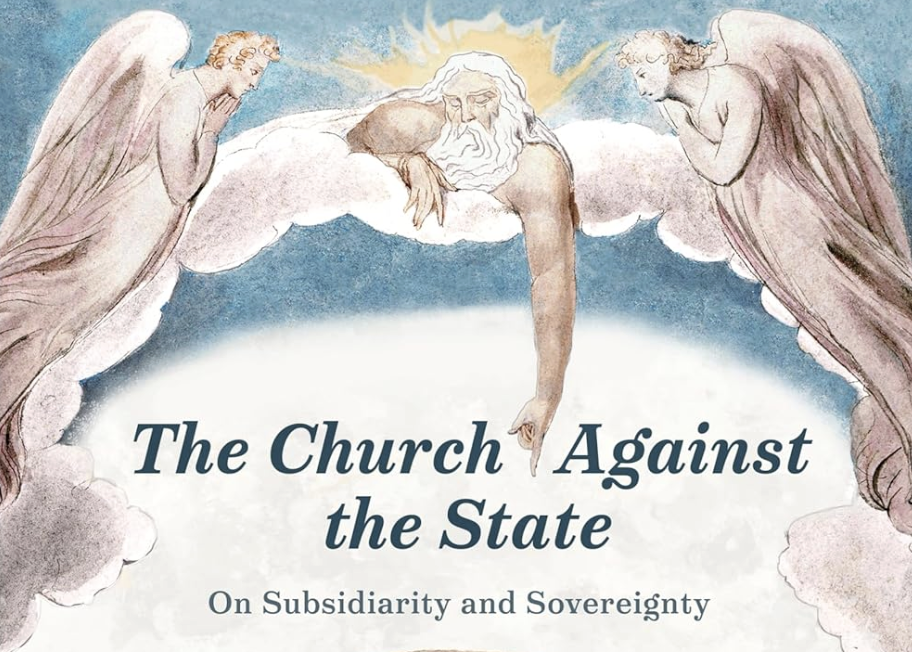
Andrew Willard Jones. The Church Against the State: On Subsidiarity and Sovereignty. New Polity Press, 2025. $34.95. 321 pp.
Christians who feel the oppression of a secular government that is hostile to their values might be attracted to the vision of Christendom that Andrew Willard Jones presents in The Church Against the State.
Jones, a professor of history and political theory at the College of St. Joseph the Worker in Steubenville, Ohio, and the founding editor of New Polity: The Journal of Postliberal Thought, does not merely want to limit the state’s power or Christianize it. Instead, he wants a revived Christendom—that is, a society in which every facet of society, including the state, derives its meaning from its relationship to God and works harmoniously with all other entities in society to further God’s ends.
Jones arrives at this vision partly because he thinks of society as an organic unit. Just as the hand is part of the body and functions effectively only when it works harmoniously with all other components of the body, so each component of society is organically connected to the others.
The individual is part of the family, which is part of the community, which is part of the state, which ultimately has meaning only in its relationship to God. The relationship between each of these entities is hierarchical, but these hierarchies are based on mutual obligations—an arrangement that Jones, using the language of Catholic theology, calls “subsidiarity.”
In an ideal political order, the local community would assist the family’s effort to bring children into the world and raise them up, and the family would find their happiness and larger identity in the larger local community. The state would exist to help the local community assist the family, while the local community would find meaning in its larger relationship to the state. A common relationship to God and to moral virtue would bind everything together. And the church would infuse all of these relationships by mediating grace and teaching virtue.
A postliberal who disagrees with the liberal commitment to individualism, Jones also believes that too many of his fellow postliberals have been antagonists against the state or have sought to appropriate the state to their own ends. Some postliberals have advocated the confessional state—that is a state that is explicitly Catholic or Christian. But a confessional state can easily use religion simply to acquire power, which is not what Jones wants at all. Instead, he wants something larger than merely a nominal Christian confessionalism. He wants an organic unit encompassing all of humanity, which is possible only if all human societies are organically connected to their Christian purpose.
Jones believes that all political systems other than Christendom—including liberalism, socialism, fascism, or the various confessional states of early modern Europe—ultimately degenerate into some form of authoritarian state. This includes the modern American liberal order, he argues. And modern American conservatives have no real solution to this. They imagine that by promoting individual rights, they can limit the state, but a society of atomistic individuals who have no larger external grounding for their freedom-seeking will have no defense against the growth of the state. Competition, which is the basis for classical liberalism, cannot lead to virtue or to a just society; it will instead lead to a society in which state power supersedes everything else, because the state, as the largest player in the competition, will inevitably overcome its rivals.
The only solution, Jones thinks, is a return to the Christendom that Europe enjoyed before the Reformation, when every monarch’s power was limited by the state’s relationship to a larger Christian order that was ultimately grounded in God.
As a Protestant who supports many of the principles of classical liberalism, I finished the book asking myself why I don’t find Jones’s argument for Christendom and subsidiarity compelling. After all, many of his observations are grounded in Christian principles to which I also subscribe. His argument that competition and atomistic individualism are incompatible with Christian virtue is hard to disagree with. His argument that in a struggle for power, the state will always win also seems empirically true much (if not all) of the time. And his depiction of the beauties of a state committed to virtue and grounded in its relationship to God certainly sounds compelling.
The problem, I think, is that that type of state has never existed and will not exist until the second coming of Jesus. Jones’s book includes a great deal of political theory, but no discussion of the actual workings of the medieval societies that he seems to long for. He quotes Thomas Aquinas at great length, but does not discuss the political and social history of thirteenth-century Europe. If he had, I suspect that Christendom would have seemed a lot less virtuous. Emmanuel Le Roy Ladurie’s Montaillou, a classic work of microhistory that reconstructs the social relations of a French village at the beginning of the fourteenth history, reveals a society in which extramarital affairs were rampant, even the most basic theological knowledge seemed to be lacking, the local priest was corrupt, and the Cathar heresy was winning a lot of converts. Le Roy Ladurie’s analysis focuses on the local level, but if he had extended his narrative to examine the French Capetian kings or the politics of the papacy, he would have found plenty of other examples of corruption and blatant power-plays.
Jones doesn’t deal with the argument that classical liberalism was not the invention of utopian idealists who imagined that individualistic competition would produce a perfect society but was instead the creation of realists who understood the depravity of human nature and believed that a diffusion of power was the best way to deal with it.
James Madison, for instance, wrote at length about the question that interests Jones—how can we avoid a corrupt, authoritarian state?—but he gave a different answer to the question, because he was cognizant of the evil propensities of human nature. “It may be a reflection on human nature, that such devices should be necessary to control the abuses of government,” Madison wrote in Federalist 51. “If men were angels, no government would be necessary. If angels were to govern men, neither external nor internal controls on government would be necessary. In framing a government which is to be administered by men over men, the great difficulty lies in this: you must first enable the government to control the governed; and in the next place oblige it to control itself.”
Madison thought that the best way to control the government was to make it directly accountable to the people and at the same time divide its power internally, so that through separation of powers, each branch of government would keep the other in check—a form of competition that reflects the liberal model that Jones finds so problematic.
“This policy of supplying, by opposite and rival interests, the defect of better motives, might be traced through the whole system of human affairs, private as well as public,” Madison wrote. “We see it particularly displayed in all the subordinate distributions of power, where the constant aim is to divide and arrange the several offices in such a manner as that each may be a check on the other that the private interest of every individual may be a sentinel over the public rights.”
Classical liberalism is also based on a realistic understanding of religious pluralism. Jones never explains how non-Christians will fare in a restored Christendom, but we know that in medieval Christendom, the rights of Jews, Muslims, and Christian heretics were severely constricted and some (especially those whom the church declared to be heretics) faced direct persecution. That makes sense, because if all of society has meaning only in its relationship to God, as mediated by the church, there is no place for religious diversity or for those who don’t imagine that they are related to God.
After the Reformation, the various Christian confessional states of Europe fought a series of religious wars for decades, but when neither the Protestants nor the Catholics could gain full control of Europe, the next generation of European political thinkers began to imagine an alternative that would allow people of diverse religious views to coexist in the same political community. The result was a liberal order committed to religious pluralism.
Evangelical Protestants of the late eighteenth and early nineteenth centuries largely accepted the idea of a religiously pluralistic, classically liberal society that was committed to religious freedom because they recognized that the kingdom of God could thrive even in the midst of religious competition and a state that was not aligned with the church. Many evangelicals (especially Baptists) welcomed the demise of Christendom because of their belief that the kingdom of God grew only through individual regeneration, which state power could never effect. The kingdom of God could thrive under a liberal political order, they thought, because individual conversions could continue to multiply. State support for a particular church or version of Christianity was not only unnecessary for true conversions but would likely only hinder them.
We’re still testing the limits of our liberal political order today. It’s certainly not a perfect system—as the flaws that Jones points out make clear. Whenever the state acts to limit the rights of the church, it’s easy for some post-liberals to imagine that the solution might be something like a restored medieval political order or something even more radical.
But perhaps the real issue that Jones has is not with the political order we have but with the individuals who make up the political community. The government we have in the United States and the laws we live under reflect the reality of our community. Catholics who attend church every week make up only about 6 percent of the American population today, and even that group includes at least a few people who disagree with Catholic teaching on even the most fundamental moral issues, such as abortion. Evangelical Protestants who attend church at least once a week make up about 12 percent of the American population, and of that group, the overwhelming majority are opposed to abortion and same-sex marriage. Another 2 percent of Americans are evangelicals who attend church once a month. But even when the totals of all of those churchgoing groups, both Catholic and Protestant, are added together, that still leaves about 80 percent of the population who are not in those camps. And while some of the non-churchgoers do support pro-life legislation or other moral causes, most do not. It shouldn’t surprise us, therefore, if some of our laws or cultural trends do not reflect Christian moral beliefs.
We could react to these demographic realities by longing for a restored Christendom, as Jones does. Or, we could instead react by realizing that the kingdom of God is not made up of states or societies but of individuals—and that the growth of the kingdom therefore requires the regeneration of individual people, not the remaking of a political order. The free religious marketplace that a classically liberal political order produces will include some Christians preaching the true gospel—which means that even in the midst of error and heresy, God’s kingdom will continue to grow.
There will come a day when society will look very much like the ideal that Jones imagines. The state will be completely subsumed in God, as Jones wants. But as a Protestant, I believe that that day will come only with the arrival of the new heavens and new earth. Until then, the corruption of human nature will prevent the full realization of that vision, and both the state and individuals will require limitations to curb the evils that unbridled power fosters. The classical liberalism that Jones objects to offers a promising way to restrain those evils, I think. But even if it doesn’t, the individual regeneration that will grow the kingdom of God can continue, and the church will flourish, regardless of what happens with the state.
The Weekly Digest
Premier Thought Every Thursday.
All of our recent essays and podcasts, delivered to you. Free.
Free. Delivered Thursday mornings.

