Mere Orthodoxy is a reader-supported ministry. Join us in our mission to renew the Church and culture.

The Annunciation: An Excerpt from the Incarnation Poems of Martha Marchina

December 11th, 2025 | 3 min read

By Elspeth Currie

To Marvel More: Holy Attention in the Incarnation Poems of Martha Marchina presents the Advent, Christmas, and Epiphany poems of a seventeenth century neo-Latin poet, Martha Marchina, with English translations and devotional commentary.

Marchina was a Catholic lay woman who specialized in epigrams. She used the short, witty form to highlight the wonderful mystery of Christ's birth, to shake us out of a blase attitude towards the incarnation and into a spirit of holy attention. These are the first printed translations of her work in English. The following excerpt is published with permission from Trinity Books.

***

De Annunciatione Beatae Virginis.

Ardens Virgineo Phoebus velatus amictu,
Mitius ardentes dirigit inde faces.
Sic Deus intactae nivea modo Virginis alvo
Velatus, fundit mitis in Orbe faces.

The Annunciation

The blazing Son is veiled within a maid,
And from her sends a flaming, mild fire.
So God in an untouched womb is laid,
And warms the earth by this more gentle pyre.

***

We know the scene: the room,
variously furnished,
almost always a lectern, a book;
always the tall lily.

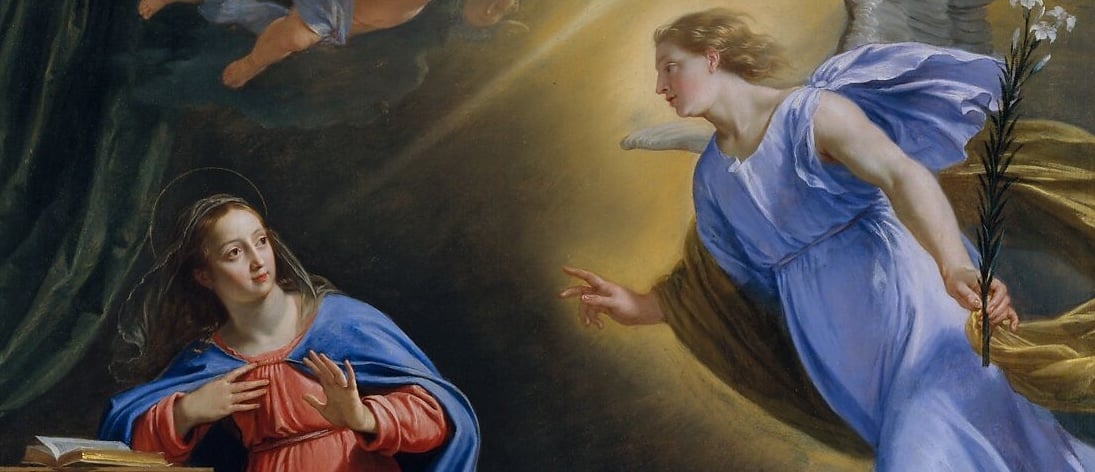
So Denise Levertov wrote in her own Annunciation poem, calling up into our minds the familiar image of Mary and Gabriel as figured by Fra Angelico, or Rossetti, or Tanner. We know the scene. But does Marchina? We’re starting Advent in an odd way. There is no angel here, no startled woman; instead, we find a veiled God and blazing faces, fires or literally, torches. Without the title, would any of us be able to name the scene? What fiery Annunciation has she given us?

Marchina’s poem may not evoke Luke, but she does have another passage in mind, Moses’ encounter with God in the burning bush from Exodus 3-4. In the Vulgate, the Latin translation of the Bible, the author uses the same verb ardeo, to blaze or burn, that Marchina repeats in her poem to describe both God and the faces that he sends forth. So Marchina’s image of the Annunciation is of Mary as the burning bush—a site for God’s presence on earth, but one that is not consumed. Marchina’s description of Mary as “untouched” evokes this reality. This is more than a claim about her virginity, it is a statement about the mystery of the Incarnation, that a human could hold the God of Glory within her own body and remain unscathed. She was not consumed. 

Here Marchina’s allusion to Exodus serves an additional purpose, to remind us of the topsy-turvy work God begins at the Annunciation. When Moses realizes that God is present in the burning bush, he “hid his face, because he was afraid to look at God,” aware of God’s holiness and his own unrighteousness (Exodus 3:6). But the Incarnation began with God “veiled within a maid,” swaddled inside Mary. It is God who hides his face now, or rather, God who stoops to meet us. It is the Lord of Light who descends to us, becoming human in the same way we all become human, enfleshed in our mother’s womb, so that he could be with us, could rescue us. When we see Jesus, we can gaze into the face of God, and like Mary, remain unscathed.

As a final note, I love Marchina’s use of faces, torches, to describe God’s light. To modern people, the word “light” often conjures up images of glowing Edison bulbs, or perhaps the annoying glare of an overhead LED. But to Marchina’s seventeenth-century world, light was primarily found in fire. Her repetition of faces jolts us out of the anodyne vision of Jesus as the Lightbulb of the world, softly buzzing, illuminating the darkness. Fire does enlighten, but it can also purify. What good news, then, that this fire has come to earth in human form, because, as Marchina writes, as a human he can send forth his “flaming, mild fire,” literally “more mildly” than before. Grammatically, the adjective mitis in line four meaning mild, kind, or gentle, can describe both the torches, faces (4), or God, Deus (3), though of course, in this instance, they are one and the same. That is good news indeed.

Elspeth Currie

Elspeth Currie is a Ph.D. candidate in history at Boston College, where she studies women in Renaissance Europe, and a former high school Latin teacher.