
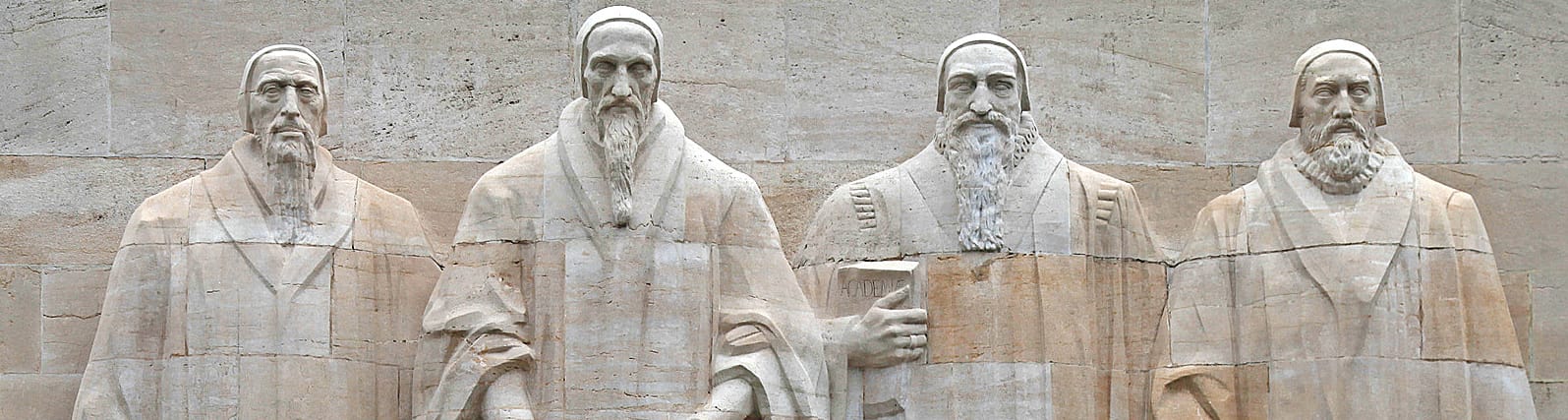
The role of natural law in Reformed Protestantism has been a topic of considerable debate since the twentieth century. As early as the debate between Karl Barth and Emil Brunner in 1934, two competing views on natural law emerged: the classical view, which claims continuity with early Protestant orthodoxy and promotes a robust place for natural law in Reformed ethics, and the critical view—associated especially with Karl Barth, Cornelius Van Til, and their students—which highlights the noetic effects of sin and the necessity and sufficiency of Scripture for ethics.
In turn, each side has interpreted the history of Reformed thought on natural law according to different narratives. The classical narrative is that Calvin stood in basic continuity with the medieval-scholastic tradition (specifically the Thomist/Scotist realist trajectory of natural law), and that this pattern of basic continuity was further developed and systematized throughout the period of Reformed orthodoxy (16th-17th centuries). Then, a radical break was introduced in the twentieth century by Barth, Van Til, and others. As a result, natural law underwent a period of dormancy in Reformed circles throughout much of the twentieth century, until a revival of interest was sparked in the 1990s, which continues to this day.
By contrast, the critical narrative is that Calvin had already sown the seeds (though inconsistently) for a radical break with the medieval-scholastic tradition, but that later generations of Calvinists fell back into the scholastic trap with its nature-grace dualism (this narrative has also been referred to as the “Calvin-against-the-Calvinists” thesis). According to this narrative, the subsequent secularization of natural law theory—beginning with Hugo Grotius (17th century) and culminating in the Enlightenment—was inevitable. Thus, for the critical view, the repudiation of natural law by Barth, Van Til, and others was simply a consistent application of Reformed principles, come to full fruition.
So which side got it right? I believe that in examining the sources themselves, we find that the evidence weighs more heavily on the side of the classical view.
John Calvin
The Genevan Reformer John Calvin (1509-1564) never developed the idea of natural law in a systematic fashion, and it is difficult to discern the exact influences on his views on natural law. However, late medieval Augustinian and Scotistic elements are evident in his writings.[1] In his Institutes of the Christian Religion, he describes natural law within the framework of his doctrine of the twofold knowledge of God (duplex cognitio Dei), corresponding to knowledge of God as Creator and as Redeemer. In the realm of creation and providence, “God provided man’s soul with a mind, by which to distinguish good from evil, right from wrong; and, with the light of reason as guide, to distinguish what should be followed from what should be avoided.”[2]
Likewise, in his treatment of civil government and the need for human laws to conform to the principle of equity, Calvin writes, “As it is evident that the law of God which we call moral, is nothing else than the testimony of natural law, and of that conscience which God has engraven on the minds of men, the whole of this equity of which we now speak is prescribed in it.”[3]
Calvin does at times differ from the medieval natural law tradition, due mainly to Protestantism’s emphasis on human depravity and the impossibility of works righteousness. While the Thomistic view of natural law would emphasize the priority of humanity’s prelapsarian intellect in discerning principles of morality, Calvin’s use of natural law foregrounds the role of the postlapsarian conscience in convicting sinners.[4] He writes:
The purpose of natural law, therefore, is to render man inexcusable. This would not be a bad definition: natural law is that apprehension of the conscience that distinguishes sufficiently between just and unjust, and which deprives men of the excuse of ignorance, while it proves them guilty by their own testimony.[5]
On the other hand, Calvin agrees with the Thomistic natural law tradition with respect to the content of the natural law, as well as the role of natural law in preserving social order. It should also be noted that Calvin’s definition of “conscience” necessarily includes the intellect; after all, the human mind must have some ability to define sin in order to be convicted of sin. Therefore, one sees both continuities and discontinuities between Calvin and the medieval tradition. Karl Barth certainly errs in reducing Calvin’s use of natural law to its purely negative role in the conviction of sin, but it is true that such a role is more prominent in Calvin’s thought than in that of his medieval predecessors.
Jerome Zanchi
The Italian-born theologian Jerome Zanchi (1516-1590) stood at the transition from the Reformation to the period of early Reformed orthodoxy and Protestant scholasticism. Zanchi is considered to be one of the best examples of a “Calvinist Thomist,” combining Reformed theology with the philosophy and methodology of Thomas Aquinas.[6] His unfinished magnum opus, the eight-volume Theological Writings, was his attempt to create the Protestant equivalent of Aquinas’s Summa Theologica.
In the tenth chapter of his fourth volume, he presents a systematic treatment of natural law, where his indebtedness to Aquinas is apparent. He follows the Thomistic understanding of natural law as the rational creature’s participation in eternal law, and like Aquinas he classifies the three levels of natural law as self-preservation (the vegetative level), procreation and the education of children (the sensitive/animal level), and worshiping God and living justly in society (the rational level).[7]
There are two areas where Zanchi differs from Aquinas. First, whereas for Aquinas the natural law is ultimately grounded in divine wisdom, for Zanchi it is rooted in the divine will, making Zanchi’s view a kind of hybrid of Duns Scotus’s voluntarism and Aquinas’s intellectualism. This shift is seen in many of Aquinas’ expositors, both Catholic and Protestant, and for good reason.
The grounding of natural law in God’s will enables one to speak of its obligatory force; on the other hand, a law rooted only in God’s wisdom would be formally indistinguishable from impersonal laws that govern, say, animal instincts or physical constants. However, since both Aquinas and the early Protestants affirmed a strong view of divine simplicity in which God’s will and wisdom are ultimately one, this is a relatively minor difference.
The second point where Zanchi differs from Aquinas, while evidently well intended, seems to be somewhat redundant and ad hoc. Maintaining a strong commitment to the Reformed doctrine of total depravity, Zanchi insists that natural law cannot have its proximate source in corrupt human nature:
After the Fall, however, natural law was almost entirely blotted out as was any law that looks to God and the worship of him or to our neighbors and the just and fair relationship with them…. [I]f we ever see a sliver of this aspect of natural law again in a human being, we must believe that it was written in that person’s soul a second time in its entirety by God himself….[8]
Zanchi refers to this post-fall “second writing” of the natural law on the human heart as a divine “reinscription,” and he explicitly denies the Thomistic view that natural law is a relic of the original created imago Dei in man. Related to this point, Zanchi also asserts that natural law must not be an essential part of human nature, since the loss of it at the fall did not entail the destruction of our human nature. If we ever see some unbelievers acting more morally and others less, says Zanchi, it is because God has graciously reinscribed the natural law in each individual to differing degrees, not because individuals make better or worse use of an innate moral faculty.
If these claims are true, then natural law would turn out not to be “natural” after all, deriving instead from a special supernatural act of God. It would also mean that human nature could be defined entirely apart from our moral sense. As it turns out, other Reformed thinkers did not feel compelled to embrace Zanchi’s “reinscription” thesis in order to maintain total depravity. It is possible to hold that natural law exists as a remnant of God’s image and as an essential aspect of our nature as rational (though fallen) creatures, while also recognizing that sin inevitably corrupts and distorts our apprehension and use of natural law.[9]
Francis Junius
Another key figure in the era of early Reformed orthodoxy was Francis Junius (1545-1602), who served on the faculties of the universities of Heidelberg and Leiden. Junius was most noted for his work De Vera Theologia, in which he was the first to develop the Reformed distinction between archetypal theology (God’s own knowledge of divine things) and ectypal theology (creaturely knowledge of divine things). Additionally, he wrote The Mosaic Polity, in which he classifies the different types of law in the Old Testament. While this work focuses mostly on distinguishing between the mutable and immutable elements contained within the Mosaic judicial laws, Junius also devotes some attention to the topic of natural law. As with Zanchi, Junius’s direct reliance on Aquinas is clear.
What is noteworthy in Junius’s treatment of natural law is how it implicitly lays the groundwork for the Reformed doctrine of the covenant of works, which was beginning to be developed by some of Junius’s contemporaries at that time. He writes:
Indeed, since no human being living according to pure nature either would have known supernatural life and grace (which leads to life) by natural law, or would even gain it naturally, it was necessary that a law superior to nature be added by the grace of God.[10]
Junius here forges the basis for the Reformed scholastic distinctions between nature and grace, between creation and covenant, and between natural law and divine positive law. According to Junius’s reasoning, natural law is only sufficient for man to attain the natural end of continuation in his earthly existence; but if man is to attain the supernatural end of heavenly communion with God, an additional law must be graciously given by means of positive divine command.
This would explain the purpose of Adam’s probation in the Garden of Eden, with its peculiar prohibition against eating the fruit of the tree of knowledge of good and evil. Junius’s view thus entails an understanding of the covenant of works that is both gracious (God was under no obligation to offer Adam a higher reward) and also meritorious (the reward is conditioned on Adam’s obedience). While not all Reformed thinkers have agreed with Junius’s formulation, it did become the majority view during the Reformed scholastic period.
Johannes Althusius
Johannes Althusius (1557-1638) has been called “the clearest and most profound thinker which Calvinism has produced in the realm of political science and jurisprudence.”[11] He served as syndic (legal counsel) of Emden and as a ruling elder of the church of Emden. His greatest contribution to history was his trilogy of writings on ethics, politics, and law, which are Civil Interactions, Politica, and Dicaeologica respectively. Althusius combines a wide array of Christian and secular sources to provide categorical definitions and distinctions within the field of law and jurisprudence.
Building upon the medieval-scholastic tradition, he classifies law as either natural/common or positive/proper. Natural law is defined as “the will of God for men,” continuing Zanchi’s hybrid-Scotistic voluntarism over against Aquinas’s more thoroughgoing intellectualism.[12] Further, Althusius says that the notions and inclinations of this law are divinely inscribed to varying degrees on every human conscience—though unlike Zanchi, Althusius is silent on whether such inscription is to be considered a second, postlapsarian act of God.
One of the challenges for any theory of natural law is to define its content, particularly in light of the fact that different individuals and societies have different understandings of what actions count as just or unjust. The solution, says Althusius, lies in the convergence of biblical laws and the laws of nations. John Witte, Jr., summarizes Althusius’ view:
If the ancient Israelites directed from Sinai and the ancient Greeks and Romans directed from Olympus independently embraced the same legal teaching, that had to speak volumes about the natural foundations and qualities of this teaching. If Aristotle and Moses, Cicero and Christ, Plato and Paul all concurred on a given principle of right living and proper ruling, that had to give this principle a special priority in discerning the content of natural law.[13]
Althusius believes that the moral precepts of the Ten Commandments in particular are simply a clearer codification of the logically prior law of nature: “The Decalogue has been prescribed for all people to the extent that it agrees with and explains the common law of nature for all peoples.”[14] He sub-categorizes natural law according to the two tables of the Decalogue, pertaining to our duties toward God and toward man respectively. In an interesting move, Althusius argues that only the precepts of the first table are fixed and immutable, “and not even God himself is able to reject them.”[15]
On the other hand, God can and does sometimes exercise the right to relax some of the precepts of the second table, although this right has not been granted to us humans.[16] According to Stephen Grabill, this position aligns Althusius more with Duns Scotus’ voluntaristic account of natural law.[17] The underlying concern here seems to be twofold: first, if the second table of the Decalogue were immutable, then that would be difficult to square with many of the famous so-called “hard cases” of the Old Testament, where God seems to relax a moral commandment or even command its opposite (Abraham’s sacrifice of Isaac, Israel’s plundering of the Egyptians, etc.). Second, an immutable second table would seem to make God’s decision to create humanity a logical necessity, thus undermining divine freedom. This would become a point of debate among the later Reformed orthodox (as will be seen with Turretin below), but Althusius represents the minority view here.
Samuel Rutherford
The Scotsman Samuel Rutherford (1600-1661) was a pivotal figure in the development of modern political theory, especially with regard to the ideas of social contract and popular resistance to tyranny. He served as a commissioner to the Westminster Assembly in the midst of the English Civil War, during which time he authored his most famous treatise, Lex, Rex. This work provided the theoretical foundations for opposition to the royalists, who at that time defended the divine and natural right of kings to rule over their subjects unconditionally.
William Reddinger has recently observed that there were two distinct traditions of Reformed political resistance theory: Continental and Anglo.[18] The older Continental tradition included such figures as John Calvin and Theodore Beza, who maintained a relatively restrained position on resistance to tyrannical government. In their view, resistance could only be authorized by so-called “lesser magistrates,” or lower-ranking governing authorities.
On the other hand, the Anglo tradition, which included Rutherford, held that not only lesser magistrates, but also private citizens, had a right to resist tyrants. According to Reddinger, this difference stemmed from these traditions’ differing uses of natural law. Given the absence of any biblical texts explicitly warranting resistance, those in the Continental tradition were generally more reluctant to empower private subjects to violently oppose unjust government. However, those in the Anglo tradition were convinced that popular opposition to tyranny did not depend on specific biblical proof-texts; it could be supported by appeal to natural law.
Rutherford uses natural-law arguments repeatedly throughout Lex, Rex. Like Aquinas, he distinguishes between general precepts of natural law, secondary conclusions, and positive/voluntary laws. He makes the case that although civil society in principle is natural, the specific form of government—say, whether monarchy or democracy—is voluntary. Likewise, individuals possess a natural right to self-defence, but when they agree to delegate that right to one or more rulers, that arises as a “positive and secondary law of nations.”[19] This entails that submission to governing authorities is conditional upon their just rule: “if the conditions be not fulfilled, the party injured is loosed from the contract.”[20]
Rutherford argues that governing authorities forfeit their right to govern when they threaten the life or well-being of the citizenry. In such cases, citizens may exercise the right to resist, even violently. This is because the right of resistance is grounded in one of the most fundamental principles of natural law: the right of self-preservation (see Zanchi above). To be sure, Rutherford insists that violent resistance should be a last resort, but when all other options have been exhausted, “a tyrant, without a title, may be resisted by any private man.”[21] Rutherford thus became a crucial link between the classical natural law tradition and modern theories of constitutional democracy, paving the way for the American Revolution.
Matthew Hale
Matthew Hale (1609-1676) was one of the foremost English legal scholars of his day. He famously served on the legal defense team for Archbishop William Laud during the English Civil War, and he would eventually rise to the position of chief justice on the King’s Bench. Several of his manuscripts on various legal topics were published posthumously, including Of the Law of Nature.
This treatise provides one of the most comprehensive systematic treatments of natural law in the seventeenth century—though it does not always align with Reformed orthodoxy. While Hale was influenced by Reformed Puritanism in his earlier years, he would eventually move in a more Arminian direction, as is evident in key segments of Law of Nature.[22]
Hale begins by defining law as a rule of moral action given to rational beings by one with authority to require obedience, under penalty for violation.[23] He then devotes the rest of the treatise to analyzing natural law according to the standard Aristotelian categories of causation: material (natural law’s content), formal (its obligatory force), efficient (its promulgation via general and special revelation), and final (its purpose).
One of Hale’s more helpful contributions to Protestant natural law theory was in clarifying the various means (media) of determining the content of natural law. As mentioned above, Althusius’s approach to this problem was to correlate the common laws of nations with the moral precepts of Scripture, and especially the Decalogue. Hale was not entirely satisfied with this approach, given that special revelation is not universally accessible to humanity, and the Bible itself does not make categorical distinctions between natural law and positive law.[24]
Instead, Hale favored a combination of a posteriori and a priori reasoning, locating nature’s laws in: 1) the common consent of the nations (and especially those nations more civilized, or moratiores), 2) the teachings of history’s most learned philosophers (whom he calls “the Elixir of Mankind”), 3) the conscientious judgments of those of sound mind, and 4) those precepts which reason determines to be congruous with human nature.[25]
Hale concludes the treatise with his most controversial chapter, addressing the question of the salvation of virtuous pagans. Evincing his shift toward Arminianism, he makes an argument for inclusivism: “It seems more than probable that the affirmative of this question is true, & the contrary thereof, not only untrue, but greatly derogatory to the glory perfection & amplitude of the divine beneficence, mercy, goodness, justice & providence….”[26]
In making his case, Hale appeals to the late-medieval facientibus principle that was so vehemently rejected by the Reformers: “to those who do what is in them, God does not deny grace.” Nevertheless, Hale acknowledges that salvation apart from faith in Christ is exceedingly difficult, and that the gospel provides a far more sure and certain means of salvation than natural law. Reformed readers may not be convinced of Hale’s argument on this specific question, but they should not overlook the great service provided by his treatise as a whole.
Francis Turretin
Francis Turretin (1623-1687) is widely considered to be the greatest and most influential name within the Reformed scholastic movement. He served as a pastor and professor in Geneva for over three decades, during which time he produced his Institutes of Elenctic Theology, a dogmatic defense of Reformed orthodoxy against various rival confessional systems.
One could justly argue that this work surpasses even Calvin’s own Institutes in terms of theological rigor and sophistication. In the eleventh topic, questions 1-2, Turretin specifically addresses natural law, which he defines as “the practical rule of moral duties to which men are bound by nature.”[27] Similar to Aquinas, he distinguishes between the primary notions of natural law (principles) and secondary notions (conclusions): the former are immediately and universally known, while the latter may become corrupted by sin, wrong education, or vicious custom. He also argues that natural law agrees with the moral law of Moses with respect to substance and principles, but differs in accidents and conclusions, as well as in its form of delivery. Natural law is implanted internally, obscurely, and imperfectly, while the law of Moses is delivered clearly and distinctly on stone tablets. The former is purely moral, while the latter has ceremonial elements mixed in (such as the day on which the Sabbath is to be observed).
Turretin then addresses the same question as Althusius, regarding whether both tables of the Decalogue are indispensable.[28] He lays out “three more celebrated opinions” on this question: 1) the nominalist view of William of Occam, which holds that all moral precepts are dispensable, being grounded in positive right and the free will of God alone; 2) the realist-voluntarist view of Scotus (and Althusius, though Turretin does not name him), which classifies the precepts of the Decalogue as a mix of indispensable (the first table, for the most part) and dispensable (the second table); and 3) the realist-intellectualist view of Aquinas, which holds that all the precepts of the Decalogue are indispensable, being founded on the immutably just and wise nature of God.
Turretin states that the third view is “the more common opinion of the orthodox,” and he holds to it himself, but with a key qualification. He recognizes the challenges raised by the Scotistic view, so he clarifies that moral precepts can be indispensable in one of two ways: absolutely or relatively. The former are those precepts that are grounded directly in the eternal nature of God, such that God himself cannot ever relax them or command their opposite (such as idolatry or blasphemy).
The latter are those precepts that presume God’s free decision to create rational beings with such a nature as our own. For example, given God’s decision to create beings with a sexual nature, who procreate by the union of male and female, precepts concerning chastity and continence become indispensable. Since these precepts are dependent on the particular shape of the created order, they may change if the shape of that order changes (for example, the prohibition against incest would not apply in the case of Cain taking his sister as his wife, since the created order at that time necessitated it). Turretin then surveys the various so-called “hard cases” of the Old Testament, demonstrating that these cases are not truly “dispensations” (that is, exceptions) of the moral law, but rather “interpretations” or “declarations,” their context proving that they are still in harmony with the moral law, rightly understood.
Conclusion
We find that the early Reformed orthodox, beginning with Calvin and culminating with Turretin, develop an increasingly sophisticated doctrine of natural law which, with varying Thomistic and Scotistic accents, was firmly aligned with the medieval realist tradition. To be sure, they did place a relatively greater emphasis on the role of conscience in natural law’s testimony against sin, as well on the role of sin in obscuring humanity’s knowledge of the conclusions and applications of natural law. Nevertheless, there was widespread agreement that nature teaches all human beings the fundamental principles of God’s moral will.
The doctrine of natural law is especially relevant for Christians in today’s world, where emotions have supplanted reason as the final arbiter of truth. With the loss of a shared cultural belief in a fixed natural order, we have witnessed the erosion of the common ground that makes moral persuasion possible. On the other hand, the recovery of natural law would give us a rational and rhetorical “fulcrum,” enabling us to present arguments that make contact with reality, regardless of one’s spiritual condition. This in turn will help us to demonstrate the plausibility of Christianity as a worldview that actually runs “with the grain” of the moral universe.
Natural law provides Christians with an ethic that is both deeper and wider than an ethic restricted purely to the positive commands of Scripture. It is deeper in that it shows that the commands of Scripture are not arbitrary; rather, they are grounded in a more fundamental rational order congruent with humanity’s nature and telos. It is also wider in that it sheds light on moral questions where Scripture is either ambiguous or silent—ranging from such issues as popular resistance to tyranny in Rutherford’s day, to commercial surrogacy in our own day. For all these reasons, we would be well served by recognizing the truth that our Reformed forefathers embraced: nature can indeed be a servant of grace.
Bibliography
Althusius, Johannes. On Law and Power. Translated by Jeffrey Veenstra. Christian’s Library Press, 2013.
Grabill, Stephen. Rediscovering the Natural Law in Reformed Theological Ethics. Grand Rapids, MI: Eerdmans, 2006.
Hale, Matthew. Of the Law of Nature. Edited by David Sytsma. Christian’s Library Press, 2015.
Junius, Franciscus. The Mosaic Polity. Translated by Todd Rester. Christian’s Library Press, 2015.
Milton, Michael. Foundations of a Moral Government: Lex, Rex – A New Annotated Version in Contemporary English. Fortress Book Service, 2019.
Reddinger, William. “The American Revolution, Romans 13, and the Anglo Tradition of Protestant Resistance Theory.” In American Political Thought vol. 5 (Summer 2016): 359-390.
Turretin, Francis. Institutes of Elenctic Theology. Edited by James Dennison. Philipsburg, NJ: P&R, 1994.
Zanchi, Jerome. On the Law in General. Translated by Jeffrey Veenstra. Christian’s Library Press, 2013.
Footnotes
- Stephen Grabill, Rediscovering the Natural Law in Reformed Theological Ethics (Eerdmans, 2006), 72. ↑
- John Calvin, Institutes of the Christian Religion, 1.5.18. ↑
- Ibid, 4.20.16. ↑
- Grabill, 92. ↑
- Calvin, Institutes, 2.2.22. ↑
- Stephen Grabill, introduction to On the Law in General, by Jerome Zanchi (CLP 2012), xxii. ↑
- Zanchi, 10-11. ↑
- Ibid, 12. ↑
- My thanks to Dr. Brad Littlejohn of the Davenant Institute for his insights into these critiques of Zanchi. ↑
- Francis Junius, The Mosaic Polity (CLP, 2015), 48. Junius’ view has formal similarities with the Roman Catholic doctrine of the donum superadditum; however, whereas Catholics described this grace as a supernaturally infused power within Adam, the Reformed would speak of it in terms of the covenant. See also p. 52: “For even if the principles and conclusions that are natural according to human reason are present in human beings by natural law, nevertheless it is necessary that other principles above nature be inspired and infused by God so that we may know that end beyond nature to which we have been ordered, and the truth that would certainly lead to that end.” ↑
- Carl J. Friedrich, quoted by John Witte, Jr., “A Demonstrative Theory of Natural Law: Johannes Althusius and the Rise of Calvinist Jurisprudence,” in On Law and Power, by Johannes Althusius (CLP, 2013), l-li. ↑
- Althusius, Politica, 21.16. ↑
- Witte, lxi. ↑
- Ibid, 21.29. ↑
- Ibid, 21.26. ↑
- Ibid, 21.28. ↑
- Grabill, Rediscovering the Natural Law, 249, n148. ↑
- William Reddinger, “The American Revolution, Romans 13, and the Anglo Tradition of Protestant Resistance Theory,” American Political Thought vol. 5 (Summer 2016), 359-390. ↑
- Samuel Rutherford, Lex, Rex (Sprinkle, 1982), 2. ↑
- Ibid, 54. ↑
- Ibid, 141. ↑
- David Sytsma, introduction to Of the Law of Nature, by Matthew Hale (CLP, 2015), xiv. ↑
- Hale, 6. ↑
- Ibid, 45-46. ↑
- Ibid, 47-56. ↑
- Ibid, 204-205. ↑
- Francis Turretin, Institutes of Elenctic Theology, ed. James Dennison (P&R, 1994), 2.11.1. ↑
- Ibib, 2.11.2. ↑
The Weekly Digest
Premier Thought Every Thursday.
All of our recent essays and podcasts, delivered to you. Free.
Free. Delivered Thursday mornings.