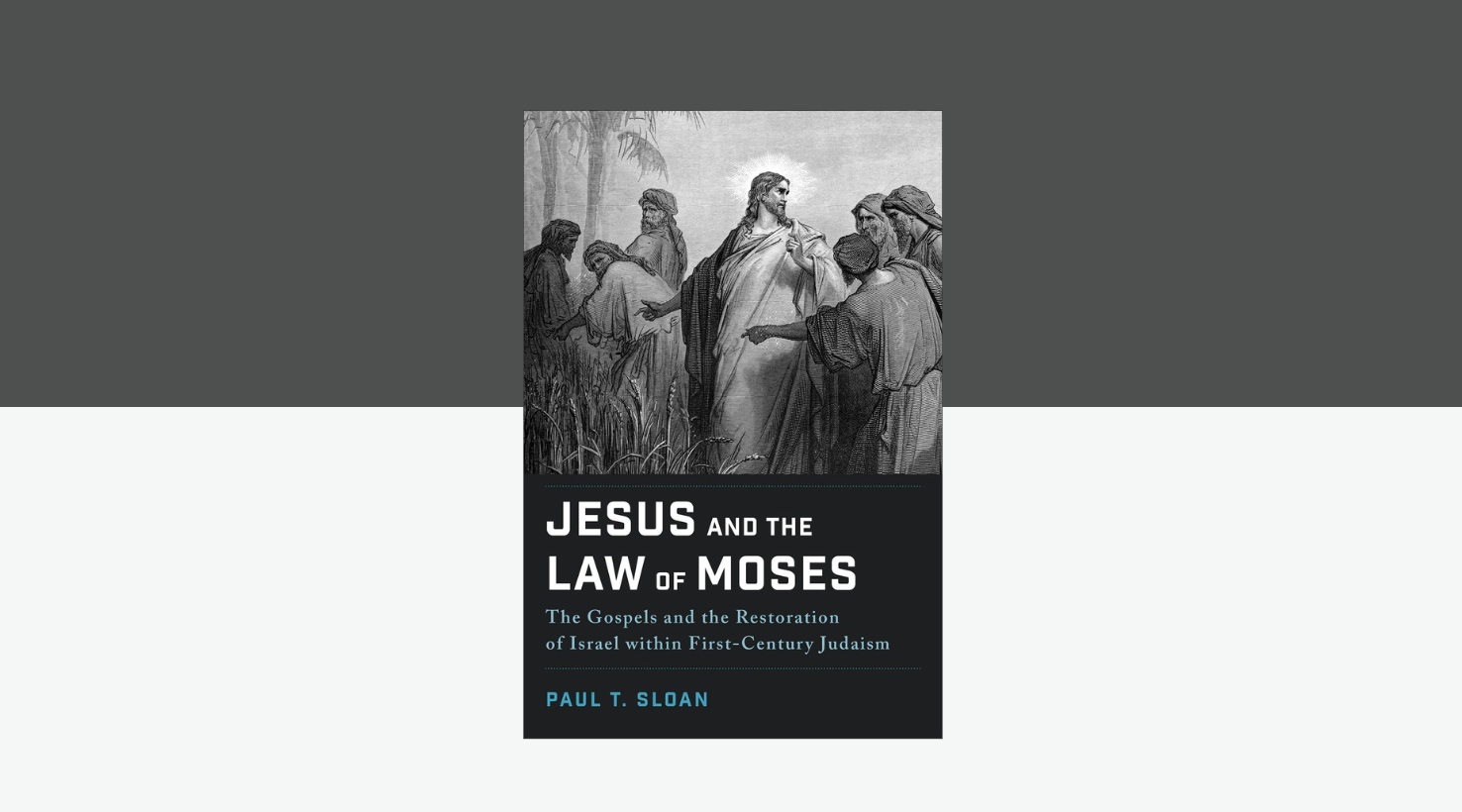
Paul T. Sloan. Jesus and the Law of Moses: The Gospels and the Restoration of Israel within First-Century Judaism. Baker Academic (2025). $32.99. 288 pp.
In the gospels according to Matthew, Mark, and Luke, how does Jesus relate to the Law of Moses? Paul Sloan’s wonderful book marks the definitive, authoritative demise of two pernicious and popular misconceptions.
Mean Moses, Nice Jesus
The first error, which I will dub the “mean Moses, nice Jesus” approach, tends to prevail in more progressive contexts or among those with more Mainline sensibilities. Take, for example, the pericope in Matthew 12 where Jesus’ disciples are eating grain on the Sabbath, or Jesus healing a man on the Sabbath in Mark 3. According to the “mean Moses, nice Jesus” school, the Pharisees and/or their first-century Jewish contemporaries simply did not have compassion. They were so set on their observance of rules that they neglected to be merciful or show pity towards the needs of others. Jesus, by contrast, is not a legalist; he relaxes Sabbath observance in order to be inclusive and compassionate.
Grace Dunking
The second error, “grace-dunking,” tends to prevail in more evangelical contexts or among those who descend from traditions associated with the Protestant Reformation. Jesus, in this vision, is the great opponent of “legalism” or works righteousness. His opponents (whether “the Pharisees” or first-century Jews writ large) are conflated with the beliefs and practices of the late Medieval penitential system of indulgences, a treasury of merit, and more. So, in texts such as Matthew 12 or Mark 3, Sabbath observance is equated with legalism, while Jesus ushers in an entirely new pattern of religion based on grace. After all, does not John’s gospel say, “the law was given through Moses; grace and truth came through Jesus Christ” (John 1:17)?
Crucially, it does not matter what was actually happening in the complex historical environment in the first century. But also, the nuances of what Luther, Calvin, Melanchthon, the confessional Reformed and confessional Lutheran traditions, and more actually had to say about the law, justification, the covenants, and grace is judged to be rhetorically and homiletically unimportant. All that matters is that in sermons and lessons that we have a foil (albeit a strawman) of legalistic works righteousness over and against which we can set grace in the final point of our sermon.
Countless other passages in the gospels can be shoe-horned into those two misconstruals of Jesus—such as concluding that Jesus does away with laws of ritual impurity by purifying a leper either because he is compassionate or by juxtaposing the grace of God with the accrual of merit through personal righteousness.
What is Wrong with Both Errors
The foremost problem with both errors is that they are not a Christian hermeneutic. Rather, they reflect the interpretative trajectory of Marcion of Sinope, an arch-heretic from the early Christian centuries. Marcion rejected the authenticity of much of the New Testament, retaining only fragments of Luke and some of Paul’s epistles, and contrasted the evil “God of the Old Testament” who is responsible for material creation, with the good “God of the New Testament” who brings spiritual salvation and love through Jesus Christ. The Christian church has always rejected that error, discerning instead that there is one unified, symphonic testimony to the triune God found in both the Scriptures of the Old and New Testament.
It would be bad news if Jesus overturned the law; it would be moral anarchy if Jesus opposed what God established—namely, what St. Paul calls the “holy, righteous, and good” and even “spiritual” law (Rom 7:12, 14). It would not be compassionate inclusivity for Jesus to set aside God’s wonderful torah that is celebrated for 176 verses in Psalm 119. Rather, the good news of the gospel is that Christ the law-keeper overcomes sin by his humiliation and exaltation, which distort God’s law such that it produces death in us (Rom 7:5–6). However, it does not remain self-evident even to canonical readers how to handle texts where Jesus has a complex relationship with law observance, like those mentioned above. We might be asking ourselves, sure the “mean Moses, nice Jesus” and the “grace dunking” crowds are mistaken, but nonetheless what do we do with Jesus appearing to profane the Sabbath?
How Jesus Kept the Torah
Paul Sloan’s contribution to preachers and teachers on this matter is a powerful demonstration that Jesus kept the torah and taught others to do the same. As Jesus declares in Matthew 5, “Do not think that I have come to abolish the Law or the Prophets; I have not come to abolish them but to fulfill them. For truly, I say to you, until heaven and earth pass away, not an iota, not a dot, will pass from the Law until all is accomplished.” Jesus does not relax God’s law; would that not make him an opponent of righteousness? And Jesus does not replace one religious system (a law-based, ‘legalistic’ pattern) with another one (a grace-based); would that not set Jesus at odds with the work of God in the scriptures of the Old Testament? Rather, Christ himself kept the torah and taught others to do the same, precisely in these difficult passages.
For example, Sloan masterfully demonstrates there is an “override” principle operative in the gospels. If a male, Jewish baby is born and the eighth day since his birth (the day appointed for circumcision) falls on the Sabbath, the law expressly makes a provision that the circumcision requirement overrides the Sabbath requirement; the law is thus ultimately being kept even when the Sabbath law per se is not being observed. Alternatively, the torah makes provision that certain laws can override others in order to preserve life. That is the context wherein we need to locate Jesus when we see him overriding the Sabbath laws either to preserve life, or because the year of God’s promised jubilee has arrived with the coming of the Messiah.
Still, in his future work, I would love to see Sloan address two lingering questions I had as I read his book. First, while I broadly agree that “restoration eschatology” is a sound framework whereby we may historically locate Jesus in relationship with his first-century Jewish context, the precise content of that restoration might need further clarification. My sense is that more critical historians tend to speak about Jesus having hopes of a restoration of the lost tribes of Israel that amounts to a failed imminent eschatological expectation; meanwhile, more theologically-inclined interpreters tend to think about the restoration Jesus brought as in some sense an apocalyptic, or soteriological, or eschatological-qua-spiritualized restoration.
Consequently, when Sloan speaks about Jesus’s death not as a sacrifice but rather as an undergoing of covenant curses, I appreciated many of the distinctions he drew, building on David Moffit’s work on sacrifice. But preachers, teachers, and readers of the New Testament will want to ask about how this relates to other portions of the canon. For Paul, Jesus absolutely underwent the punitive discipline of God’s covenant people; his mode of death thereby took upon himself the covenant curses (Gal 3:13). And yet, Paul plainly uses explicit sacrificial language to speak about Christ (1 Cor 5:7; Eph 5:2). This is not necessarily incompatible with Sloan’s readings of the Synoptics, but it might mean that we simply need to delineate between several different valences that sacrificial language either does or does not imply throughout the New Testament.
Second, a consistent emphasis of Sloan’s is that within the torah itself only Israelites and/or Jews are obligated to keep the whole torah, while gentiles are only obligated to keep certain parts, an outlook reflected in the decision of the apostles at the Jerusalem council in Acts 15. But beyond the synoptic gospels, and especially in Galatians 3:15–4:7, and Hebrews 8–10, something further appears to be said than merely that ethnic particularity determines for whom the torah perpetually applies.
In those two texts, there is at least some sense in which the torah has temporal significance relative to the economy of the saving action of the one God who sends the Son in the fullness of time and sends the Holy Spirit to unite us with him, in whom we are made “perfect” in a way that the law could not (Heb 7:19). While that does not necessarily entail the abolition of the Law in a Marcionite scheme, and has the continuity of being a fulfilled promise, surely something about the law’s significance in covenant history has changed now that the telos (Rom 10:4) of the law has appeared in Christ. Beyond the bare recognition that gentiles do not have to be circumcised and live Jewishly, what precisely does that entail about the torah’s abiding significance for Jews in Christ, let alone for Jews who do not believe Jesus is the Messiah, for whom Paul was heartbroken (Rom 9:1–5)?
Those who want to learn more about how Jesus relates to the law in his first-century context cannot improve upon Paul Sloan’s wonderful book, which will prove essential to anyone preaching or teaching from the synoptic gospels.
The Weekly Digest
Premier Thought Every Thursday.
All of our recent essays and podcasts, delivered to you. Free.
Free. Delivered Thursday mornings.