

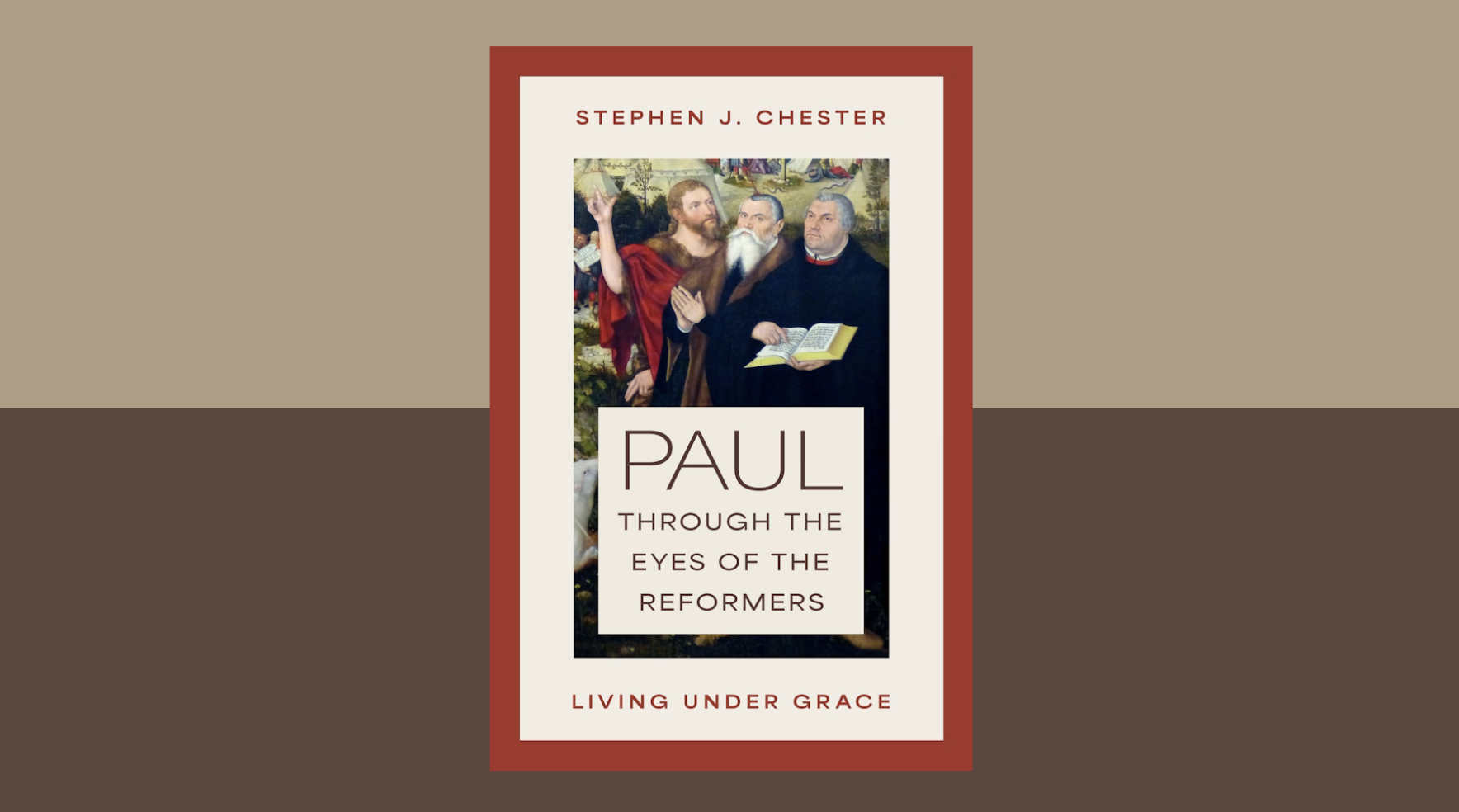
Stephen J. Chester. Paul Through the Eyes of the Reformers: Living Under Grace. Eerdmans, 2025. $28.99. 288 pp.
Earlier this year, after I presented a paper on the eucharistic liturgy of the 1662 edition of the Book of Common Prayer, an Anglican priest noticed that I seemed not only sympathetic but appreciative of the theology of the Protestant Reformation. I cannot remember the precise words of his question, but he inquired, more or less in these words: has not modern New Testament scholarship demonstrated many times over that the Reformers misunderstood Paul, so their theology was misguided from its roots up?
The concern is a common one today. At the popular level, a lingering awareness remains of the debates between N.T. Wright and John Piper in the late 2000s about the doctrine of justification. Regardless of how other New Testament scholars have evaluated Wright’s work since then, his extremely successful career as a writer of popular Christian Bible studies and devotional works means that his views of the Reformers are widely influential today among many parishioners, lay people, and clergy.
At a scholarly level, Reformation readings of Paul have fallen on complicated, if not hard, times. That did not begin recently, however. The rise of critical, academic study of the Bible as a secular enterprise of religious studies might have some precedents in earlier Protestant exegetical practices, but critical scholarship transformed the task of reading Paul so far beyond recognition that by the time of Albert Schweitzer in the early 20th century, the views of the Reformers were by no means still dominant. Subsequently, Rudolf Bultmann’s now largely abandoned program of demythologizing the New Testament and translating its message into the categories of existentialist philosophy, undermined central pillars in the theological architecture of Luther and Calvin.
Then in the 1970s, the so-called “New Perspective” on Paul took flight. Of course, it had numerous forerunners in earlier eras (notably Kristar Stendahl, who critiqued Luther for projecting his own psychological struggles onto Paul). But the work of E. P. Sanders demonstrated that Jews and Judaism had been horribly misrepresented for centuries by Protestant interpreters, who compared themselves with Paul and contrasted themselves from Paul’s Jewish opponents, who were cast in the theology and practices of the late Medieval Roman Catholic church the reformers opposed. Sanders’s analysis of Second Temple Judaism significantly informed the works of James Dunn and Wright, who argued that the Reformers’ vision of grace and justification by faith alone were profound misreadings of Paul, for whom justification was about being identified as part of Abraham’s family, not being declared righteous. In time, John Milbank and the Radical Orthodoxy movement rejected Reformation theology as nominalist, and insufficiently sacramental in its metaphysics.
Yet, in recent decades, that narrative has grown more complex. Some noted that Second Temple Judaism is far from monolithic, and that Jewish attitudes to the law in the first century were extremely complicated and conflicting. Readings of Paul within Judaism reject the way Dunn and Wright cast Paul’s gospel as the triumph of universalizing tendencies over particularity, while apocalyptic readings of Paul critique Wright’s historical and theological method, underscoring the disjunctive and disruptive nature of God’s revelation of grace in the crucified and risen Messiah, among other things.
An especially notable contribution has been that of John Barclay. Barclay notes that Sanders was correct: Second Temple Judaism was indeed largely a religion of grace and not a self-salvation through works, but we need to more precisely characterize what we are talking about when we talk about grace, which can mean a lot of different things. Barclay’s key insight about Paul is that Paul not only describes the Christ-gift as involving divine initiative, or as superabundant, or as prompting a reciprocal response from the receiver, but Paul especially emphasizes in passages such as Romans 4 that grace is incongruous: a gift given to the undeserving.
However, along the way, very few have taken the time to ask the question: How, actually, did the Reformers read Paul? There have been exceptions, such as the notable work of Jonathan Linebaugh and Stephen Westerholm, among others. But when the old perspective has been rejected, was the old perspective in view actually the perspective of the Reformers themselves, or a bastardized form of it found in popular Christian discourse or in Bultmann’s existentialism? When the Lutheran Paul has been rejected, is it actually Luther’s reading of Paul that is in view, or a caricature of it?
I remember once being at an academic conference and hearing a senior New Testament scholar discuss justification in Paul, setting his own reading of Paul over and against that of John Calvin, whom this scholar faulted for allegedly giving no place for the Holy Spirit in his vision of justification. I immediately thought about Calvin’s own comments in Institutes III.1, that the Holy Spirit unites us with Christ by faith such that we share in all of Christ’s saving benefits distinctly and inseparably and simultaneously. I thought about Calvin’s commentary on 1 Corinthians 6:11. I thought about B.B. Warfield calling Calvin “the theologian of the Holy Spirit.” I thought back to my own seminary teacher Sinclair Ferguson, who taught an entire course on “Calvin’s Doctrine of the Holy Spirit,” and showed us how it is impossible to understand justification in John Calvin if you do not first understand how the Holy Spirit unites us with the risen and ascended Christ. But all I could do was sigh and wonder why so many scholars seemed to treat Reformation readings of Paul as a strawman.
But Stephen Chester has now provided a readable, accessible answer for anyone interested in these questions. His 2017 book Reading Paul with the Reformers covered these questions and more in an in-depth way written for scholars. Paul Through the Eyes of the Reformers is not merely a popularization of that larger book, but it also includes new discussions in relationship to contemporary conversations in Pauline theology.
Arguably, this book’s greatest contribution will be not only for academics, but specifically for preachers. What is union with Christ? What is justification? How do Law and Gospel relate to one another? What is faith, and how does it relate to works? Anyone who wants to understand what the Reformers themselves actually believed on these perennially vital matters cannot do better than to take up this volume.
For only a couple of examples, Chester’s chapters on Martin Luther provide a powerful explanation of why the charge is baseless that justification by faith alone is a “legal fiction.” There are terrible caricatures of what Luther believed about law and the conscience in modern New Testament scholarship, and too little grasp of what Luther taught about union with Christ through faith as the key to justification. Differently, for those readers who are long accustomed to reading and appreciating the Reformers, Chester will help understand modern scholarship better. For instance, those who have read John Murray or Mark Garcia will be accustomed to thinking about union with Christ as the central doctrine of salvation. But Chester explains the habits of thought assumed by modern New Testament scholars, and why Calvin remains surprising to so many of them:
…[Calvin] identifies twin principal saving benefits received in union with Christ by the agency of the Spirit, a duplex gratia or double grace. The first of these is justification, and the second is regeneration or sanctification. It is at this point that potential for considerable confusion arises, for Calvin clearly defines justification in forensic terms even as he insists it is part of union with Christ. This conflicts with the marked tendency in modern interpretation of Paul to treat the forensic and the participatory as contrasting twin track’s in Paul’s thought, with justification belonging to the former and union with Christ to the latter… Calvin simply does not share the frequent later assumption that forensic justification is less participatory than sanctification.
To be clear, Chester is by no means uncritical of the Reformers. In his concluding chapters, he notes the perils of attempting to repristinate or merely reproduce their readings today, especially given how problematic their views of Jews and Judaism at times could be, especially with respect to Luther. Chester is also very skilled at comparing Luther, Calvin, and Melanchthon with one another. The differences among the views of the Reformers are as illuminating as their agreements, especially on the nature of growth in holiness across the Christian life.
As a writer, Chester occasionally uses theological jargon (for instance, the adjective “apocalyptic”) that might take a lay reader by surprise. Still, this is a largely accessible book, and words from other languages are transliterated into English. For instance, the summary of what Calvin believed about union with Christ and soteriology is a masterful example of an attentive reading of primary sources that is in conversation with the most significant secondary scholarship on Calvin, yet still written in an accessible way for non-specialists.
I am thankful that the next time someone asks me, “hasn’t modern New Testament scholarship basically discredited reformational theology?” I can direct the inquirer not only to the Reformers themselves, but to Chester’s book as not only an insightful and judicious study, but a powerful resource for the constructive work of proclaiming Christ today.
The Weekly Digest
Premier Thought Every Thursday.
All of our recent essays and podcasts, delivered to you. Free.
Free. Delivered Thursday mornings.