

So much seems to be going wrong in our society. There is so much dissent, there are so many acts of violence, and there is so much division about the acts of violence. So much worry, anxiety, depression.
Many of us in economically prosperous nations feel that “society is broken” and declining. So much seems outside our control. The crises seem political, economic, and technological in nature; no doubt, such forces are changing our world and presenting new challenges. Yet the deepest roots of our problems are more basic. They involve personal and social order, direction, and purpose. The deepest roots of our problems are spiritual.
Take just one unspeakably horrific example that has become a recurring and all-too-familiar feature of our news cycles: school shootings. Americans have had access to guns for decades and centuries. In the early twentieth century students even regularly shot, hunted, and participated in school-based gun clubs. Only in the last few decades have school shootings become a major social concern.
My point with this example is not to debate gun policy or the Second Amendment but to suggest that something more fundamental has shifted under our feet beyond merely law, politics, or technology. Something is different in our very culture and way of life. We could give other examples to make this same point. Earlier generations of Americans faced more difficult economic, geopolitical, and legal circumstances, yet they suffered from fewer mental health maladies, built strong families, and experienced greater contentment in life.
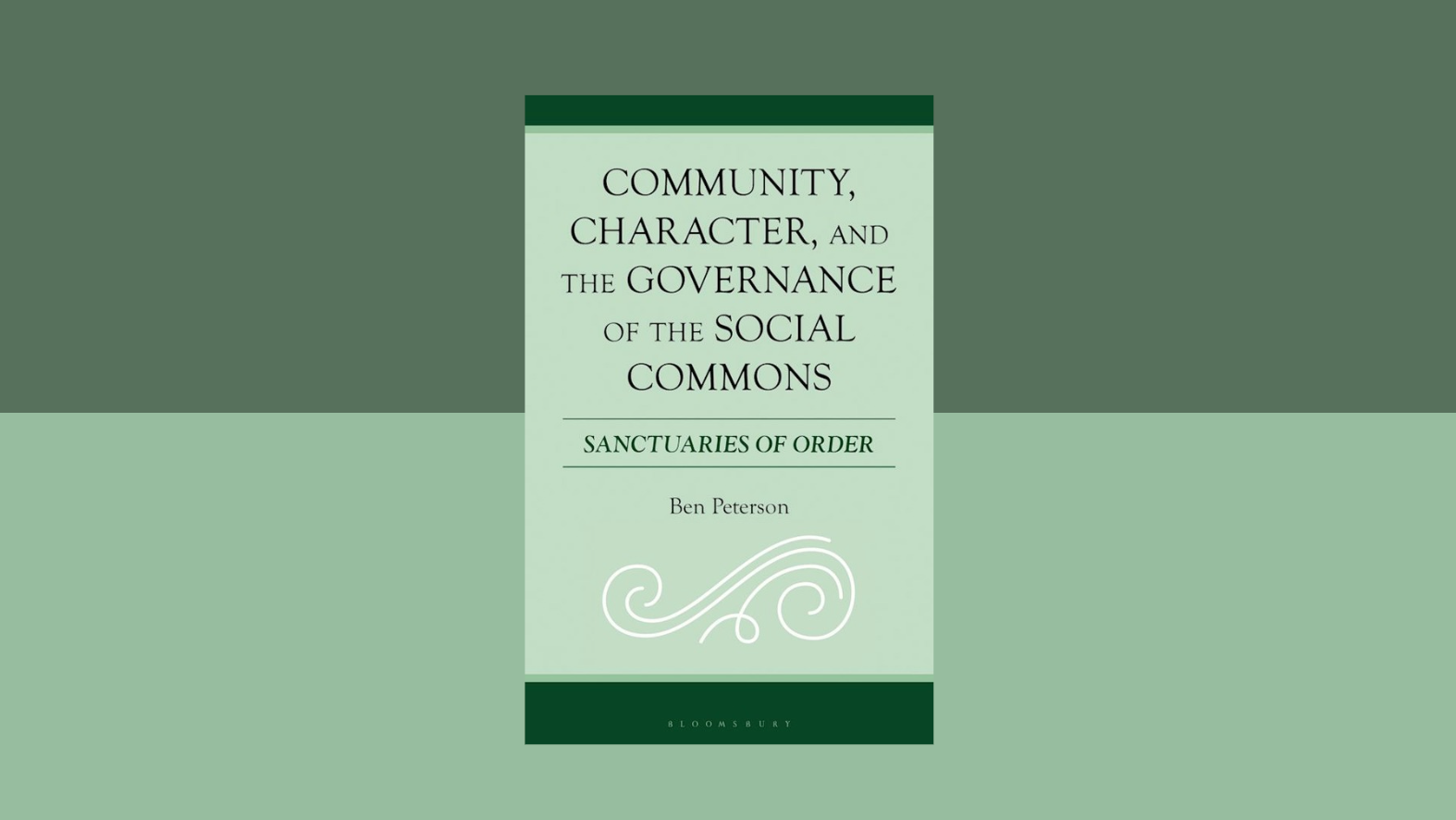
Neither the left nor the right in our politics seem able to adequately confront the underlying disorder driving the symptoms all around us. In my new book Community, Character, and the Governance of the Social Commons: Sanctuaries of Order, I offer an account of that shift. I argue that we have been losing the ability to govern ourselves and establish a tolerably ordered, decent, livable society. This ability involves, first and foremost, informal mechanisms for inculcating habits of restraint, courtesy, commitment, discipline, and respect, and reinforcing these habits through social sanctions and rewards. As our capacity for self-government has declined, we have become overly reliant on formal, legal methods of social control and order-maintenance.
Borrowing from the great political scientist Elinor Ostrom and her analysis of commons governance, the sustainable management of shared resource systems like lakes and fisheries, I employ the idea of the “social commons” to express the notion that we are building a social world together. We don’t live and die only to ourselves; we are helping to form, shape, and color the social environments we inhabit—often in subtle ways we are tempted to deny or downplay.
There is probably at least one area in which each of us would like to retain freedom to behave in a way that contributes to deterioration of the social environment, even as we decry that deterioration. Maybe it’s a choice to view pornography. Maybe it’s a choice to pursue divorce without biblical justification—or ignore it in our church when we should not. Maybe it’s to cuss. Maybe it’s something as simple as checking a phone during a conversation or in a shared space.
Each of these actions in the abstract, while more or less selfish and sinful, may not appreciably damage the social world. If we consider only a single, discrete, isolated action, we could make a case that our choice isn’t harming anyone. But when such actions, as we repeat them, solidify into behavioral regularities, we slowly and almost imperceptibly allow the behavioral patterns we adopt and accept to degrade the social commons. Women in contemporary society largely have to expect, even if they do not condone, that men they want to date struggle with porn; divorce is not as common as it was in the ‘70s and ‘80s, but neither is it at all uncommon; cursing and phone distraction are all around us.
There is a sense of sternness that has existed at other times and places, including in the American experience. It has involved an ability to set high expectations and standards of behavior and largely see them met. We have been losing it in the last several decades, to our detriment. We see the loss of that sternness in parenting, in public comportment, in policy, in church governance or lack thereof. To be sure, not everything about ages and places of greater sternness is good. But the ability to set and uphold behavioral expectations, norms of courtesy, commitment, and decency, is an ability we can and should recover. Expectations of decency are essential for the construction of a livable social world, a social milieu in which we can live with a measure of liberty, justice, and dignity.
Where did it come from? The short answer is social bonds and participation in relational networks that promoted accountability and shared norms. Membership in particular relational networks with a sense of intergenerational partnership, with agreed-upon rules, opportunities for monitoring behavior, and instillment of shared norms allow us to govern ourselves, to discourage narrow egoism. Through enmeshing our lives in ongoing relational connections, we tie our fortunes and wellbeing to the lives of others; we expose ourselves to potential reputation costs and establish mutual accountability. At a deeper level, the social bonds of family, neighborhood, and other associations offer personal connection and even love. These are the kinds of relational networks that have lost their place in our society, leading to the degradation of the social commons.
The deterioration of the social commons and attendant wreckage in the lives of persons are a problem of wide scope, but it is most acute for those with the least education and means. Scholars and commentators like Robert Putnam, Charles Murray, Rob Henderson, and W. Bradley Wilcox note that elites may embrace radical individualism and antinomianism in theory, but they tend to embrace bourgeois moral and cultural norms in practice. The breakdown of traditional social institutions like the family has especially affected the least well-off and educated members of our society.
The paradox of our time is that our greatest social need is to establish and renew the kinds of bonds and mores that generations before us managed to secure almost by instinct. We are wired for the kinds of self-governing community we seem to lack the most. Yet such bonds are hard to renew or generate when they break down and dissolve. We are shaped by the social commons we inhabit and help to shape it in turn. The irony of personal and social order is that we need good communities to form good persons, but we need good persons to build good communities. Thus, as I noted above, the deepest problems we face are not technical, political, or economic, they are spiritual.
We might prefer to talk about legal, technical, or medical fixes for problems like school shootings, crime, drug overdose, suicide. Reckoning with the spiritual roots of personal and social disorder can be daunting, because it means reckoning with the fact of human wickedness and sinfulness. Yet we must reckon with the real root causes of such evils.
The church is and remains a unique sanctuary of order. The church—the social witness to the gospel of Jesus Christ—forms and transforms her members through participation in practices of confession, repentance, and restoration. God’s grace transforms us in the church. While church hurt and abuse of church authority are real and they merit concern, the much greater, if less easily perceived, damage to the social commons has come from de-churching and loss of ecclesial authority and discipline.
We have more power than we think. In each of our actions and words, we are helping shape the social commons and form the persons in our orbit, helping strengthen and beautify or degrade the social environment we inhabit. My book is an invitation to join, build, and revive the sanctuaries of order so desperately needed to renew the social commons and offer hope to generations starving for meaning, purpose, and life.
The Weekly Digest
Premier Thought Every Thursday.
All of our recent essays and podcasts, delivered to you. Free.
Free. Delivered Thursday mornings.