Since the 1960s, conservative Christians have railed against public schools as little more than “leftist indoctrination factories.” Christian critics of “government schools” (as the cool Rushdoony kids say) regularly accuse administrators and teachers of hijacking captive public school audiences, pushing left-wing, anti-American history, weaponizing libraries, and turning their students against “traditional,” conservative, or Christian values.
I’m not going to litigate the truth or prevalence of these claims. Instead, I’m going to offer a personal story about public school.
Cards up front: I am a public school kid. Our two kids are public school kids, and my wife, who was a public school kid, has worked for decades in public schools.
And while some of my conservative Christian friends might be tempted to label my story as an example of indirect, on-the-sly “leftist indoctrination” or an early, slippery slope version of “woke,” I’m going to argue differently.
It was something very lovely, and something we desperately need more of today.
But first, I have to talk about 1974.
***
It was an auspicious year in America.
President Nixon’s resignation stunned the nation in August, and just weeks later, President Ford pardoned his predecessor and offered a conditional amnesty for Vietnam War draft evaders. In December, the Senate accused the Pentagon of spying on the White House, and Seymour Hersh broke his blockbuster story about the CIA’s domestic operations against antiwar activists.
When historians talk about the feeling or mood evoked by this period — the zeitgeist —they simply call it “post-Watergate.”
And if one locale incarnated “post-Watergate” more than any other, that place was Los Angeles.
Earlier, in May, the Los Angeles Police Department’s SWAT surrounded a house used by the Symbionese Liberation Army (SLA). Television viewers across the country watched live as the siege concluded with gunfire and the house engulfed in flames. Mere days before Nixon’s resignation, Muharem Kurbegovic, a Yugoslav-American aerospace engineer arrested for lewd conduct and fired from his job, killed three and injured 36 in a bombing at Los Angeles International Airport.
And it wasn’t just the violence. Los Angeles was at the forefront of America’s “post-Watergate” cultural transformation, whether in the debut of folk rock’s melancholic “Los Angeles sound,” or in the introduction of All in the Family, M*A*S*H, and The Mary Tyler Moore Show — the controversial, socially conscious “greatest lineup in television history.”
In 1974, Los Angeles was the vanguard. It premonished the almost-dawning American culture war.
It was also the year I entered Mrs. Mary Higuchi’s kindergarten class at John Adams Elementary School in Los Angeles’ South Bay suburb of Torrance.
——————
Historically, Los Angeles’s South Bay—including Torrance and Gardena—has had one of the largest concentrations of Japanese residents in Southern California. Outside of Honolulu, Torrance has the largest Japanese population of any city in the United States. When Japanese immigrants came to California, many leased or bought South Bay farmland and also built nurseries and garden centers. Though much of the farmland was eventually replaced by tract homes and designer neighborhoods, the Japanese-American community remained. In fact, in the late 50s and early 60s, Honda, Datsun/Nissan, and Toyota all flocked to the South Bay to set up US headquarters.
In 1974, John Adams Elementary was filled with Tanakas, Kikunos, Yoshiokas, Kamiyas, Uyematsus, Sumitomos, Nishihiras, Muranakas, and Oshimas. One of my good childhood friends was a Kashiwai. It was a mix of older Japanese-American families and newcomers, some direct from Japan and others via Okinawa or Hawaii.
Growing up in Torrance didn’t just mean Farrell's Ice Cream Parlour and pizza, but also Children’s Day parties with koinobori (carp streamers). We all watched KWHY-TV and reenacted scenes from Japanese tokusatsus (live action) and robot cartoons like Kikaida, Kamen Rider, and Brave Raideen. My dear grandmother went out of her way one birthday to drive me to a Japanese toy store in Gardena so that I could get the chest missile-firing UFO Senshi Diapolon figure I’d seen on a commercial. I learned how to write my first name in Japanese script after my friend dropped it in a birthday card.
And in Mrs. Higuchi’s class, we bowed upon entering. We greeted her every day with “Konnichiwa, sensei!” We learned our numbers to ten in Japanese. If you ask me today to name the four primary islands of Japan, I will give them to you in order from northeast to southwest — precisely in the way Mrs. Higuchi taught me. My mom recalls Mrs. Higuchi keeping a very decorative class, complete with live fish swimming in containers that hung from the ceiling. I definitely remember tie-dyeing homemade kimonos as a class — which, let’s be honest, is 1970s California cultural fusion at its finest. It was a special and fond year for me, and my mom knitted Ms. Higuchi a shawl in appreciation.
I’d always understood that one of the reasons — if not the reason — Mrs. Higuchi shared her culture and taught us rudimentary Japanese was because we had a non-English speaking Japanese girl in our class. If it’s accurate, it’s easy to see how inviting and wonderful of a classroom Mrs. Higuchi’s approach would make for a new, tentative, and perhaps scared foreign language speaker.
That said, looking up Mrs. Higuchi decades later gave me a deeper appreciation of what she did for me and my classmates. It unveiled why what she did wasn’t perhaps merely about making a more comfortable classroom for a Japanese girl, if my memory is even correct.
I had always pictured Mrs. Higuchi as being in her early or mid 20s when she was my kindergarten teacher. Kids don’t know better, and I was definitely off on my assessment.
You see, in 1974, Hatsuko Mary Yoshioka Higuchi was actually 35 years old.
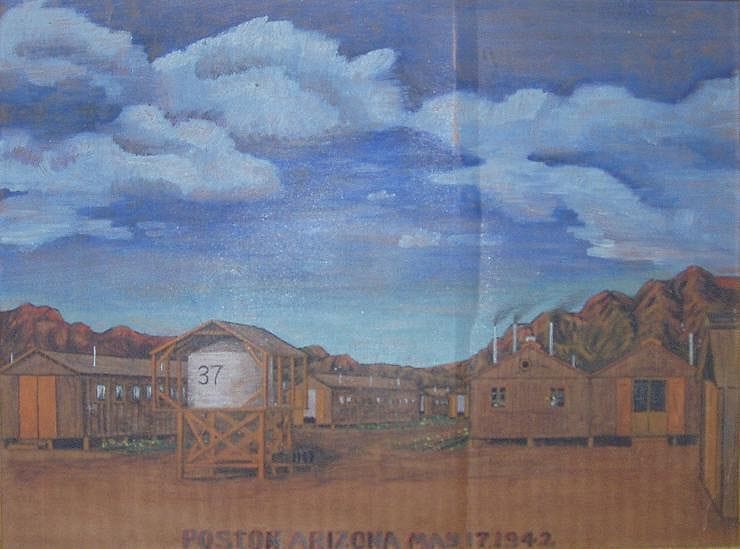
And when she was just three years old, on 6 August 1942, Hatsuko Yoshioka, her parents, Goro and Kiyoko Yoshioka, and her younger sister, Etsuko, were removed from their South Bay home and arrived at the Poston War Relocation Center, just to the east of the Colorado River in Arizona’s Sonoran Desert, where they were interned for three years as Family Number 42128.
***
A standard high school American history textbook will certainly address Japanese-American internment, but it often won’t give a good sense of the rapidity with which it all happened. It will outline the locations of the different internment camps in the American West and Arkansas, but it almost assuredly lacks details on the organizational and bureaucratic players behind the camps, or about the internal politics of the camps themselves.
The US War Relocation Authority (WRA) started construction on Poston in March, just a month following President Roosevelt’s Executive Order 9066. The camp was still being built in May and June, as the first Japanese American families arrived. Unlike most camps, the incoming families weren’t first filtered through “assembly centers” (like the one at Santa Anita Racetrack). Instead, they came directly from their homes, farms, and nurseries in Southern and Central California. By September, the Poston War Relocation Center was, in effect, Arizona’s third-largest city. Its population was nearly half the size of Tucson, and 40% of Phoenix.
Poston was different from all of the other Japanese internment camps in one, specific way. It was initially managed jointly by the WRA and the US Office of Indian Affairs (OIA). It was located wholly within the bounds of the Colorado River Indian Reservation, built on Mohave and Chemehuevi land. The two tribes had not wanted to house the camp, but, overruling tribal elders, the WRA and OIA considered Poston a bureaucratic win-win. The WRA got its camp, and the OIA believed it would ultimately reap longer-term infrastructure benefits (like new roads and irrigation systems) without having to break its own budget.
Ariel Wiebe, a doctoral student at University of New Mexico, recently explained how the OIA saw the internment camp through the lens of social science. The OIA believed that lessons learned from the “colony’s” governance could assist in postwar reconstruction efforts. Wiebe highlights many of the tensions that rarely make it into high school textbooks — camp conflicts between first-generation Japanese immigrants (issei) and second-generation Japanese-Americans (nisei), labor unrest, fights over wages, and fears of law enforcement informants.
Poston was actually three separate camp “units” (Poston I, Poston II, and Poston III), eventually barbed wire-fenced as a single entity. Each of the three units were sub-divided into what might be thought of as “neighborhood” blocks, containing about 14 individual housing barracks, a mess hall, communal restrooms and showers, and laundry facilities. In each of the housing barracks, four families were typically allotted 500 square feet of living space each.
The Yoshioka family was assigned to Poston III, Block 318. This meant one single room — about the size of Mrs. Higuchi’s elementary classroom — for her issei father, kibei nisei mother, and, at first, Hatsuko and her sister. Another sister and brother would be born at Poston, eventually making the family a household of two parents and four Japanese-American children straddling the nisei-sansei divide. (Third-generation Japanese-Americans are often referred to as “sansei.”)
Like others at Poston, Hatsuko’s parents divided the family’s space into private “bedrooms” with sheets. And for a good part of the year, that space was the only spot to escape the heat. Poston’s average summer daytime temperature runs about 105 degrees, and it’s almost always above 100 between May and September, which makes it unsurprising that Poston I, II, and III were colloquially called “Roasten," "Toasten" and “Dustin.”
In a 2019 oral history, Mrs. Higuchi’s memories of Poston were understandably fleeting— just like my own memories of her class. Her remembrances centered around the family’s living quarters, the weather, and, unsurprisingly for her age at the time, play:
"Well, we played a lot, I know...I don't really remember that much more except for we used to just play around, run around all over. During the daytime, mainly because it was so hot outside, we would play indoors. We would just run through the house and jump on the bed, and we would use it as a, what do you call it, like a trampoline, and we would just jump all around."
"Well, we didn't have a playground with equipment, swings and so forth, however, we did play outdoors a lot. I guess more indoors because of the heat. I don't know, we enjoyed coloring, paper dolls. But I really don't remember that much more because we were so young at that time, three, four, five."
Interned at Poston, Mrs. Higuchi’s father, Goro Yoshioka, a first-generation immigrant vegetable hauler, became a mess hall cook. Kiyoko, her mother — who had been born an American citizen in Santa Monica, California, sent back to Japan by an overwhelmed, widowed father at the age of six, and returned in her early twenties to work at a Southern California cannery — settled into the camp’s sewing classes and learned how to knit. Mrs. Higuchi’s most vivid memories were of her mother’s struggles with childrearing and day-to-day domestic life:
"[My mother] kept herself pretty busy with the four kids, and everything had to be hand washed, of course. Washing all the diapers, the cloth diapers and always hanging them, and I could remember the rope being strung across the room with clothes dripping onto, the water dripping onto the floor, because she didn't have a wringer or anything, you just did the best you can to get the water out. And mainly because there was severe dust storms in Arizona, so she had to dry most of her clothes indoors."
"We did go to the mess hall and eat, but my mother found it really difficult because when we went there, we just wanted to play, run around, and not eat. And so she had a hard time getting us to sit down and eat, and caring for the little ones. So oftentimes we would just stay in the barracks and my father would bring home the food for us and we would eat there in the barracks."
And then, after three years, just as rapidly as it had been constructed and populated, Poston closed.
A little over 100 days after Japan’s surrender, all of the interned Japanese-Americans at Poston had left. Most took buses or trains back to their old California hometowns. The camp and all its infrastructure then reverted to the Colorado River Indian Reservation, which, in 1945, added Hopi and Navajo tribes to its jurisdiction.
***
Mrs. Higuchi dates her family’s return to the South Bay to her start of her first grade year. She was six years old, and had just completed kindergarten at Poston.
Her family came back with very little, and they returned to very little.
They hadn’t been allowed many possessions and heirlooms at Poston, so her parents had left boxes and suitcases with a neighbor. Mrs. Higuchi relates what happened when they went to collect their belongings:
"...And when we came back, a friend, our neighbor, had said that they would take care of our suitcases and all our boxes of goods that we were not able to take to camp. But when we came back, we went into that barn, and I remember my mother crying because everything was broken into. There were just a few broken dishes, empty boxes all torn apart, there was nothing there. And so all her wedding gifts, I know she was just heartbroken to come back to that."
Goro Yoshioka didn’t have a truck, so he wasn’t able to get back into vegetable hauling. They, however, had access to land for rent in the South Bay, so Hatusko Yoshioka and her family learned to farm. The years between 1945 and 1951, as Mary Yoshioka wrote to her training teacher, were “the happiest days of [her] life.” This comes across in her oral history, too. Mrs. Higuchi talked of her father’s baked goods, his pier-fishing trips with her brother, Tetsuo, playing tag and hide-and-seek in the cauliflower fields, doing homework and art at the dining room table in the evenings, her mother reading them Japanese stories, and walking alongside her father as he irrigated the crops. The kids went to public school, and as their Japanese names were considered difficult to pronounce, the teachers soon bestowed them more “American” names: Mary (Hatsuko), Betty (Etsuko), Mitzi (Mitsuko), and Jimmy (Tetsuo).
Her parents saved enough money to purchase their own property, but, in November 1951, right before they could move, Goro Yoshioka, who had been ill on-and-off at Poston, died of heart failure. Mary Yoshioka was in the middle of seventh grade, and during the Christmas holiday, she, her mother, and her three younger siblings moved to Torrance. Kiyoko Yoshioka, now widowed, had a house physically moved from Gardena to Torrance, and — having no other option — transitioned into a life of farming romaine lettuce and cauliflower, and into single parenthood.
In the face of this, Mary’s mother was adamant — adamant — that her children get a solid education, including piano and Saturday Japanese language classes. “Every day,” Mrs. Higuchi recalled her mother saying, “it was benkyo shinasai, ‘study, study, study,’ benkyo shinasai.”
And Mary Yoshioka was the oldest child par excellence.
Farming at home, she became president of the Girls’ League, and in her high school senior year (1956-1957), she was Torrance High’s homecoming queen, rode in the parade celebrating Torrance’s designation as an “All America City,” and, scholarships in hand, she graduated and went to UCLA. That same fall, she’d even had the time to represent Gardena Valley as a Nisei Week Festival Queen contestant and win the local Miss Walteria pageant.
Mary majored in education, and she didn’t shy away at all from extracurriculars. “I was very active at UCLA,” she said, “I was in social clubs, I was in all the big social clubs that were really popular.” These included the California Club, the Prytanean Women’s Honor Society, and UCLA’s Bruin Belles Service Association. “I was Bruin Belles president,” she added, “where we would go meet the football teams, and any visitors coming[.] [W]e would be the official greeters.” After graduation, she began her student teaching. By the end of 1964, she’d started full-time at John Adams and married Mokoto Higuchi, a recent Loyola law graduate, a fellow UCLA alumnus, and the past president of UCLA’s Nisei Bruins.
And, by 1974, she’d even made her own splash as an elementary educator. From 1967 to 1970, Mrs. Higuchi and another John Adams teacher, Ms. Karen McDonough, experimented with whether sex-segregated first-grade classrooms helped young boys read sooner and better. Their approach, based on earlier studies from a school in Virginia, made the local papers, which played up the school’s program as a type of “good” and “novel” form of “segregation” in the Torrance Unified School District.
***
It’s fuzzy, but I can remember one particular moment of correction in Mrs. Higuchi’s class. Being an oldest child myself, I was very upset that I’d not been able to draw a perfectly round circle for an art project, so I’d cajoled our teacher’s aide to draw one for me. Mrs. Higuchi would have none of it, and told me that no matter the result, I was to be doing my own artwork.
I wouldn’t learn until long, long after I’d left the South Bay how important art was to her.
Her mother Kiyoko didn’t enjoy drawing as much as her late father, but Mrs. Higuchi believed she’d inherited her mother’s close attention to “the shapes and beauty of things.” She described her mother as entranced by nature, and — perhaps not surprising given Poston’s history — her mother had a lifelong fascination with Native American culture. Mrs. Higuchi attributed most of her own interest in art, though, to her father. “He used to spend so much time drawing every night with us,” she recalled, “I think probably my interest [in art] comes from his spending time with us in that way.” Goro Yoshioka not only drew, but he worked with his hands. In Poston, he hand-carved birds and butterflies, made vases, and fashioned Sonoran desert ironwood into sculpture.
And later, Mrs. Higuchi met an artist who invested in her just as her own father had.
For many years, she taught art classes at Torrance’s Joslyn Recreation Center. It was there, in 1989, that she began a friendship with Henry Fukuhara, the prominent Japanese-American watercolorist and mixed-media artist.
Born in 1913, Fukuhara demonstrated an early aptitude in art at Santa Monica High School. Financial constraints meant Fukuhara wasn’t able to complete art school, yet, when he was only in his mid-20s, the Automobile Club of Southern California published some of his linoleum-cut block landscape prints, and they were displayed at the Los Angeles Museum. Money was tight, and Fukuhara’s artistry took a more applied turn as he ran a landscaping business and nursery with his brother.
Then came the war.
As was Mrs. Higuchi’s family, Fukuhara, his wife, and children were interned, held with over 10,000 other Japanese-Americans at the Manzanar War Relocation Center. There, on the desolate, eastern slope of California’s Sierra Mountains, Fukuhara’s prowess landed him employment in the camp’s drafting department, where he surveyed locations for gravesites. In his spare time, he did his own sketch work. He painted his first watercolor. He also received permission to travel to other internment camps, which he also sketched.
One way to obtain passage out of the internment camp system was through furlough work, typically on farms facing wartime labor shortages. This is something Fukuhara did on and off. Eventually, by promising to move away from the West Coast, he and his family left Manzanar permanently and moved to Long Island, New York. He published a book of his internment sketches in 1944, which were exhibited for Manzanar’s own residents for two weeks that same year. Thankfully, the California Historical Society has made Fukuhara’s prints available for online viewing.
Fukuhara, his father, and his brother ran a successful greenhouse business in New York for over 40 years. He didn’t jump back into art until the 1970s, but over that decade and into the next, his watercolors were displayed in galleries and public buildings across Long Island. He retired to Southern California in the late 1980s, moving back into his old, childhood home. Teaching through Santa Monica College’s Emeritus program, he continued to run exhibitions, and offered Thursday and Saturday workshops (or “paint outs”), giving students the opportunity to explore their craft, plein air, around greater Los Angeles.
“[Fukuhara] really encouraged me,” said Mrs. Higuchi. “I mean, there was a special bonding that occurred and he was just fatherly, like missing my long-gone father.” Mrs. Higuchi describes the kind of mentor everyone hopes for. She began to attend his “paint outs.” He wrote her weekly letters, pointed her to important books and exhibitions, and connected her to other international watercolorists.
In 1998, Fukuhara — with a core group that included Mrs. Higuchi — began taking students to Manzanar, which became multi-day “paint outs” in and around the former camp. Fukuhara held his Manzanar workshops until 2005, at which time a friend, Al Setton, took over for him. Fukuhara died in 2010, at the age of 96. Mrs. Higuchi described Fukuhara’s approach to the Manzanar “paint-outs”:
“[W]e went there for the weekend, and he would do a [demonstration piece] of Mt. Whitney or go to the Manzanar site, and he would paint there. And then he'd let us go off on our own and paint. [A]nd at maybe two o'clock, we would gather together and we [would] critique[.] [W]e would put all our paintings against the buildings at the [Manzanar] visitor center. And we would sit out there and he would [critique] our work, and that was quite an experience.”
Fukuhara inspired Mrs. Higuchi’s exploration of her own family’s internment experience through mixed media, especially after she retired from Torrance Unified School District in 2003. Her “Executive Order [EO] 9066” collection is the most well-known, with individual paintings from the series shown over the last two decades across museums, exhibition halls, and university galleries in California and the Western United States.
In her EO 9066 series, Mrs. Higuchi often blurs or sometimes removes the faces from the Japanese American subjects. They’re anonymized, reduced to a sole racial category, reflecting the US government’s disregard of the individual in internment. She weaves barbed wire in and around the figures, framing them on one side or the other with an ever-present guard tower. Some paintings later in her series focus on the child’s world of play in the camps, but no gallerygoer ever escapes the War Department’s order, “Instructions to All Persons of Japanese Ancestry,” What the War Department plastered on posters up and down the West Coast explodes across many of Mrs. Higuchi’s EO 9066 canvasses. It is an essential element of her first five.
Sometimes, however, Mrs. Higuchi’s use of wartime phrases is part of a more complex, layered conversation. Take, for example, EO 9066 Series 11, which depicts Spider Rock in Arizona’s Canyon de Chelly National Monument. The War Department’s order is there, but it’s barely discernible. You can see some of it buried on the side of a three-table-topped mountain on the right. Glancing to the sharp peak on the left, one finds starkly carved words from a January 1942 newspaper column by Hearst sportswriter Henry McLemore. These words, calling for “herd[ing]” and “pack[ing off] Japanese-Americians to the “Badlands,” are actually emblazoned at Manzanar’s Visitor Center. One easily observes in the painting McLemore’s poisoned conclusion, “Personally, I hate the Japanese. And that goes for all of them.” Ghostly guard towers surveil the camps on each peak. The piece, Mrs. Higuchi explains, was all but complete but for an announcement from the US Department of Justice. In May 2011, President Obama’s Acting Solicitor General publicly admitted that his predecessor, Charles Fahy, hid a 1942 Office of Naval Intelligence report from the Supreme Court in the Hirabayashi, Yasui, and Korematsu cases. The report assessed, at the time, that Japanese Americans on the West Coast didn’t constitute a military threat. Mrs. Higuchi splashed the center of the canvas, in blood red, with language from the ONI report, scrawling parts of her own journal entry about the announcement below it. “Today,” one clearly distinguishes in her cursive, “I feel anger.”
Mrs. Higuchi’s artwork became a doorway, just slightly ajar, into her mother’s struggles and fears during internment. Kiyoko Yoshioka traveled to Manzanar with her daughter, who laughs as she recalls her mother’s High Desert napping. As for many other elderly Japanese Americans, it was hard for her mother to talk about Poston. Even when Mrs. Higuchi gently asked while painting, she encountered anguished hesitancy. “Hatusko,” her mother would answer, “hanashitakunai” [“I don’t want to talk about it.”]. Mrs. Higuchi would in turn plead, “kodomo no tame ni” [“For the sake of the children.”]. Eventually, Mrs. Higuchi was able to convince her mother to give a few of her thoughts on paper. “Kyampu no koto omoidasu,” [“I remember the camp.”], her mother wrote. Mrs. Higuchi described further:
“[her memory of Poston] makes her very sad, mainly because she thought about the children. ‘What's going to happen to my children, kodomotachi?’ [‘The children..’] ‘Kodomotachi,’ she said, We would come home, and come home fighting and crying, and she said, ‘Watashi mo…' [‘I also (was crying)’] When we came home, she, herself, ‘Namida ga, boroboro,’ [‘The tears were pouring out.’] the tears came down her face as well. She just could not help crying, because all she kept thinking is, ‘What is going to happen to my children?’”
——————
Today, evangelical Christian subculture is fixated on the so-called wrong uses of empathy. Over and over again, one hears about toxic or “untethered” empathy, and how people “manipulate” empathy, or use it for “emotional blackmail.” Sympathy, as two scholars have related, is giving a hand to someone trapped in a pit, while empathy — well, that’s like jumping down into the pit so that you can better relate to “pit living,” or adopting the grievances of everyone unlucky enough to have fallen into a pit. Sympathy, with its proper distance and boundaries, is taken as a good. Empathy, on the other hand, they say, leads to “emotional fusion.” It assumes any and all victims are in the right, regardless of what those victims stand for.
I can’t tell you how much I despise this debate.
This war on empathy has done little but produce a greater coarsening among fellow Christians in the public square, particularly when one talks about the more distasteful, horrible moments of American history. It’s become much, much too easy for conservative Christians to yell “toxic empathy!” or “woke!” or “emotional fusion!” in any debates that could involve race, class, civil rights, or political liberalism. I’m even willing to wager that some of my fellow conservative Christians take this very article as tacking in the direction of “toxic empathetic” — intentionally manipulative — for no other reason than it addresses internment.
Setting empathy against sympathy is, in the end, a losing tactic.
Mrs. Higuchi never invited our kindergarten class to "actively share” in her family’s lasting emotional pain. She never addressed her family’s internment to engender pity or allow us to acknowledge pain from a safe distance. Again, I’d not known at all about her early childhood experience until looking her up decades later. To the best I can recall, she didn't read to us any books about Japanese-American internment. (In fact, it doesn’t appear there *were* any kindergarten-level picture books on internment until the early 1990s).
I think we can all agree there are very few, if truly any, hand-holds for kindergarteners when it comes to Japanese-American internment. You can't teach them Korematsu vs. United States. You can't teach them Judge Robert Jackson’s warning about how criminalizing inheritable characteristics is a “loaded weapon” in the wrong government hands. You’re not going to get them to understand whether the judicial validity of a curfew order should have been extended to forcible relocation. There's something to be said about age-appropriateness, ensuring young students know America’s good and true ideals deep deep down, which makes the cracking and breaking of those ideals ever more striking to kids as they mature.
There was nothing remotely directly or indirectly “woke” or “leftist” about Mrs. Higuchi’s public school classroom. There was no “indoctrination.” It wasn’t about empathy or sympathy. Instead, it was something much more classically humanist — perhaps even personalist. She taught love. She taught us to love Japanese language, to love Japanese culture, and to love Japanese Americans, and to love them all together with one another. She taught us to love difference, to honor difference, to enjoy difference, and enjoy it together with one another. She taught us connection together with one another.
Her classroom acknowledged the South Bay’s Japanese-American community. Her approach said, “Our community is worth bringing into the classroom. Our language and traditions are worth bringing into the classroom.” To a first-generation, non-English speaking Japanese girl, her message was “I want you to be at ease, so I'm going to teach all of these other students some of your language, and I want you to know that it is ok for you to speak your language here.” To those in the class, like me, who weren’t of Japanese heritage, it was, “Behold your neighbors. They are who you live around. Love them and appreciate them for who they are.”
That is how you teach kindergartners about internment.
You teach them to love and honor their neighbors, the neighbors’ heritage, and their neighbors’ culture, and in doing so, you make the concept of internment incomprehensible to them — impossible to even countenance. Moreover, again as they mature, you also make them horror-struck that it was ever considered a viable option to begin with.
“What is going to happen to my children?” One doesn’t have to declare oneself for Tribe Empathy or Tribe Sympathy to know — really know — a mother’s lament. Hers is a quintessential human fear, and it’s not difficult at all to grasp how much pain it caused her at Poston.
Mrs. Higuchi has continued to give talks over the last decade or so. She has visited other internment camp sites, attended pilgrimages, sat on internment-related panel discussions, and painted. She still tells her audiences about her mother’s overall hesitancy (“I don’t want to talk about it.”), but she emphasizes to them, as she did to her mother, it is something that we all must talk about, kodomo no tame ni [“For the sake of the children.”].
In today's atmosphere, one could offer an even greater sense of urgency -- Kore wa shinken ni hanasanakereba narimasen [“We must talk seriously about this.”]
For me and for my fellow public school kindergarteners, Mrs. Higuchi fit a larger world into a Torrance elementary classroom. It made 1974 a little less auspicious for all of us.
And it was lovely.
Mukashi osewa ni natta koto o, ima mo taihen kansha shite orimasu.
The Weekly Digest
Premier Thought Every Thursday.
All of our recent essays and podcasts, delivered to you. Free.
Free. Delivered Thursday mornings.