

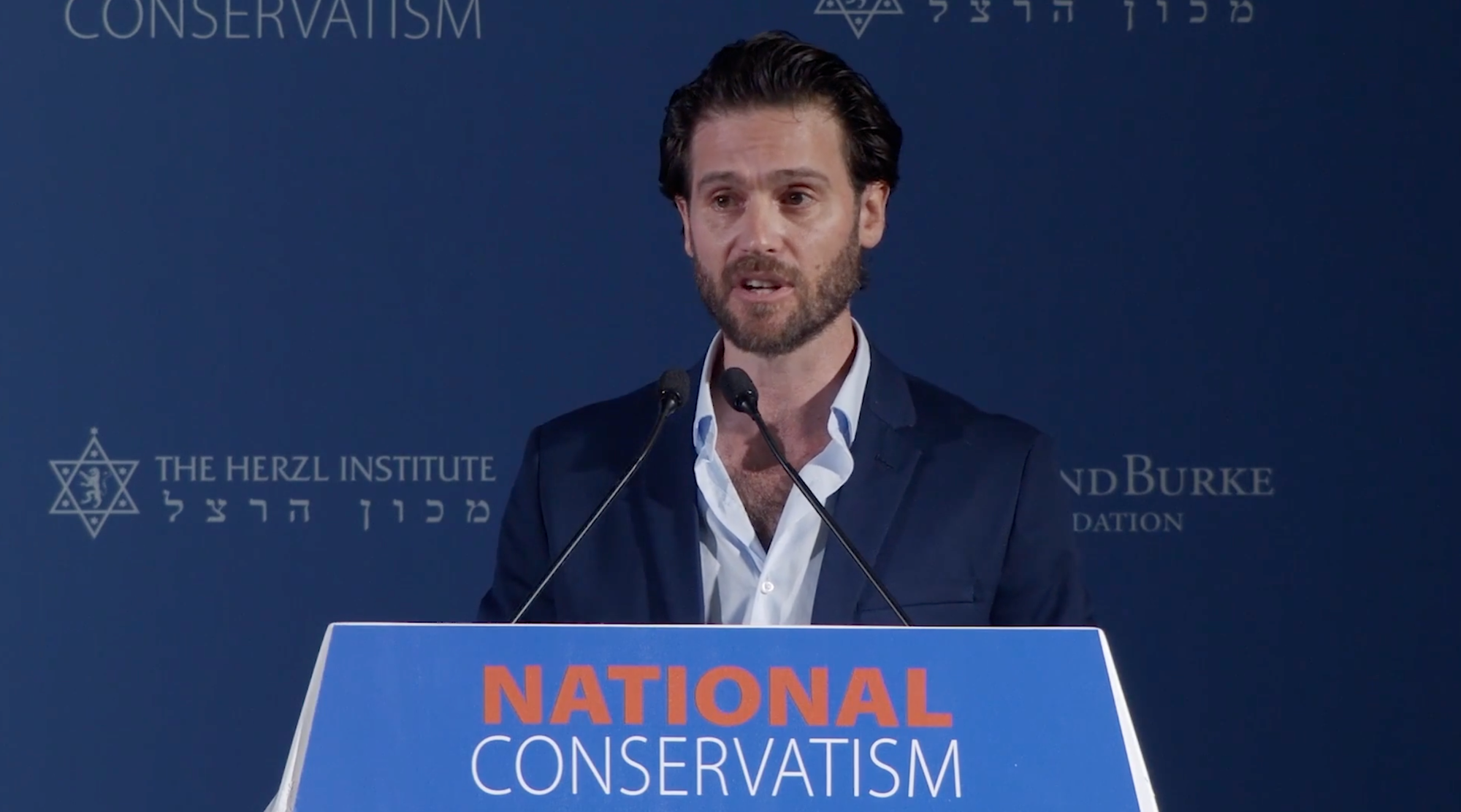
Last week saw the latest National Conservatism conference organized by Yoram Hazony's Edmund Burke Foundation as well as the Herzl Institute. This event was held in Jerusalem and featured a typically eclectic array of speakers, ranging from Rod Dreher and Rusty Reno to Jonathan Keeperman, William Wolfe, Shmuel Eliyahul, Bezalel Smotrich, and Hazony himself.
The reaction to the event was fairly predictable, given the reaction to earlier conferences, with Hazony's defenders largely papering over the sharp disagreements amongst some of the speakers and minimizing the genuine evils that a number of them support. Hazony's critics largely relied upon established rhetorical tropes to do the work of careful moral evaluation.
The outcome, as is commonly the case with the furore inspired by Hazony's nationalism, produced relatively little in the way of understanding. What follows is an attempt to treat Hazony's nationalism as both a coherent intellectual project and one deeply antithetical to Christian ideas regarding the dignity of human persons and the nature of justice, particularly as they have been understood and articulated by post-war Christian intellectuals.
Understanding the First Principles of National Conservatism
We begin with Hazony's book The Virtue of Nationalism, published in 2018 with enthusiastic endorsements from Patrick Deneen as well as Reihan Salam, whose Manhattan Institute is now home to Keeperman's podcast cohost Christopher Rufo. Once one understands the core arguments Hazony makes in his book, most of what has followed will rightly be seen as a predictable development given Hazony's principles.
To set up the argument: Hazony's book is an attempt to make the case that nationalism is a preferable political arrangement relative to individualistic anarchy or highly centralized imperialism. Anarchy, Hazony argues, allows for high individual liberty, but routinely lapses into chaos and cruelty because it lacks structure. Imperialism, on the other hand, fails because it imposes order and public security from the top down, depriving humans of the chance to politically organize themselves more organically via the bonds of family, clan, tribe, and so on.
Nations, Hazony argues, solve both problems because nations arise from the natural ways human beings interact with one another. Our life in the world begins with our family. Our families then form bonds with other families, for reasons of mutual affection and mutual security. Those bands of families then unite together with other bands which share a common religious heritage, language, and generalized culture. This is how Hazony understands what a nation is.
By a nation, I mean a number of tribes with a shared heritage, usually including a common language or religious traditions, and a past history of joining together against common enemies--characteristics that permit tribes so united to understand themselves as a community distinct from other such communities that are their neighbors. By a national state, I mean a nation whose disparate tribes have come together under a single standing government, independent of all other governments.
Nation-states, then, are a kind of administrative container that protects and preserves the common life of nations relative to the lives of other nations. Note that Hazony particularly singles out “religious tradition” as part of a nation’s heritage. Thus from the start there is a key question here regarding religious liberty: If, for example, India claims that Hindu religious practice is part of its national heritage, does Hazony’s system allow India to harass Christians and Muslims on grounds that it is protecting its national identity? Hazony’s own past behavior will provide an answer to that question, as we will see shortly.
It is worth noting here that there is a tremendous amount of overlap between what Hazony says here and what Stephen Wolfe argues in The Case for Christian Nationalism, which is unsurprising given that Hazony endorsed the book, calling it, "A pioneering work that paves the way for a new genre of American Christian-nationalist political theory."
Here is how Wolfe discusses what makes a nation:
I use the terms ethnicity and nation almost synonymously, though I use the former to emphasize the particular features that distinguish one people-group from another. Since every people-group has internal differences (e.g., class-based differences), nation is used to emphasize the unity of the whole, though no nation (properly speaking) is composed of two or more ethnicities.
Wolfe foregrounds ethnicity in a way Hazony does not, yet both are arguing on essentially phenomenological grounds about the nature of political society. Both begin with the bonds of one's kin, expanding those bonds in a limited way via a specific appeal to "ethnicity" (Wolfe) or to common culture, religion, language, etc. (Hazony). Both then, as we will see, harden that definition by erecting a moral barrier around the container of the nation, rendering it immune to external critique in how it conducts its own affairs.
Wolfe does this via the explicit call for a “Christian prince”, which is an anti-liberal caesar-like figure who exemplifies the spiritual vitality of the people. A regime organized under such a figure would, almost by definition, devolve into despotic rule given that it is anti-liberal (and therefore hostile to liberal rights) and built on the notion of a singular figure whose very existence is a kind of symbol for the spiritual life of the nation and who rules that nation accordingly.
Hazony, for his part, also wants to insulate nations from liberal moral critique. In his chapter on principles of nationalism as a form of international organizing (which he contrasts to imperial forms of international organizing) Hazony explicitly says,
The second principle (of the order of national states) is that of non-interference in the internal affairs of other national states. This is what, in a free state, permits the nation to pursue its interests and aspirations according to its own understanding. Without this principle, powerful nations would take control of the affairs of smaller nations, and the order of national states would collapse into an imperial order.
In other words, if one nation-state observes another treating people residing within its own boundaries in ways it judges to be immoral, the first nation-state still must leave the second alone on grounds that each nation-state has the right to "pursue its interests and aspirations according to its own understanding."
What about minority nations or groups within a national state?
This does raise a rather obvious question, which concerns the status of residents living within the boundary of a nation-state who do not belong to the dominant nation.
If the dominant nation within a nation-state is English-speaking, Christian, and individualistic, where does that leave someone who is Spanish-speaking, non-religious, or who comes from a more collectively focused culture? To turn the screws a bit, where might this have left Black slaves in antebellum America? Where might it leave the Uyghurs in contemporary China? Where might it leave the Palestinian Christians and Muslims living in Gaza and the West Bank today?
In fairness to Hazony, he does at least attempt to address this concern in his book. Later in the same chapter on principles for the order of national states he writes about this issue. I am going to quote it at length because I think it is immensely important for understanding what has become of national conservatism.
In an order of national states, the problem of unprotected minority populations is an aspect of the problem of anarchy. Every minority nation or tribe has interests and aspirations that are at least slightly removed from those of the majority national or tribal group in the state, and often more so. But where such a minority nation or tribe does not enjoy the protection of the national state, or where it suffers abuse at the hands of the state, it necessarily becomes a fertile ground for disaffection, for the attenuation of bonds of loyalty to the state, and therefore for the establishment of a sphere of anarchy within the state. Protection of minority nations and tribes by the national government is thus a necessary sixth principle in an order of national states. Although this principle has moral force on other grounds as well, I am here concerned with it as an obligation deriving from the nature of the national-state system itself. It is a principle without which the order of national states cannot persist, for wherever the obligations arising from it are not met, anarchy and empire follow. This is the case despite the fact that this principle obviously places limits on the collective self-determination of the majority nation or tribe in every state.
He then continues,
The protection and accommodation of minority nations and tribes cannot express itself in the same way in every national state. There are national and tribal minorities whose disaffection is to a substantial degree the result of abuse and neglect, in which case the national state is itself guilty of creating a sphere of anarchy within its own borders, and consequently of undermining the order of national states as a whole. At the same time, there are national and tribal minorities whose disaffection is aggressively cultivated by other national states or by imperial powers, which stoke fear and anger among them for their own purposes. And of course, both may be true. In some cases, the problem of disaffection must therefore be dealt with by greater attention to the needs of the people in question, which may involve a greater measure of political or religious autonomy than had been considered tolerable; while in others, there is no choice but for the national state to apply more rigorous measures to deprive imperialist and anarchic elements of their aspirations by force. And it may be that both approaches have to be applied at once.
I would suggest that virtually everything one needs to understand the trajectory of Hazony's movement exists in these paragraphs I have quoted above. The principles are something like this:
First, nations are collectives of people who share common culture, heritage, language, and (usually) religion.
Second, nation-states are governments set up to protect the common heritage of the dominant nation within their boundaries.
Third, how they choose to protect and promote that culture is the affair of the nation-state, and other nation-states should not meddle in these matters.
Fourth, in cases of minority groups within nations, the dominant nation should attempt to tolerate them so as not to undermine the broader national state order or themselves provoke anarchist violence. But in some cases national states must use "rigorous measures" to suppress minority groups. Significantly, Hazony does not provide a more extensive explanation for this principle. He does not specify, for example, what sort of “rigorous measures” might be admissible and when, and what measures would always be inadmissible, no matter the behavior of the minority nation.
This takes us to the actions, policies, and words of the various speakers Hazony has hosted at his conference over the years. In one sense, the crew he has assembled over time can seem quite strange and implausible.
Jonathan Keeperman, for example, is ethnically Jewish but his publishing house, Passage Press, has in the past published Man's World magazine, which as I documented several years ago is very obviously a pro-Nazi publication. Indeed, prior to Keeperman buying the magazine it quite routinely mocked the National Conservatism conference. Given those associations, it is not surprising that Keeperman would, on October 7 of all days, tell an audience full of Israelis that the American Right is tired of hearing about the Holocaust. But it is odd that he should be invited to do so by a Jewish political theorist.
Keeperman has also called for mass deportations, calling the current efforts of the Trump administration insufficient and suggesting that somewhere between 15 and 50 million people need to be deported. More recently, he and his podcast cohost Christopher Rufo have taken up "the Indian Question" in the aftermath of racist tweets posted by a Texas republican named Bo French.
It should go without saying, but lest I be misunderstood: It is right and good to protect national borders. It is right and good to have just and transparent systems for welcoming or rejecting immigrants, as is best for the life of the nation. But any scheme in contemporary America for deporting as many as 50 million people (or even 120 million according to some of Keeperman's fellow travelers) will unavoidably require acts of enormous cruelty and violence. Are such acts appropriate "rigorous measures" for Hazony? One can only conclude that they apparently are, given Keeperman's invitation to speak.
Alongside Keeperman, Hazony last week also hosted the Rabbi Shmuel Eliyahu. Eliyahu has made a number of alarming remarks over his long career. For example, in 2007 he said that Israel should respond to the violence and war crimes of groups like Hamas with a strategy of total war which would include the targeting of non-combatants. (This is, of course, an explicit rejection of traditional notions of just war, which, amongst other things, emphasize proportionality as a necessary condition for just warfare.) Here is what Eliyahu said in 2007:
If they don't stop after we kill 100, then we must kill a thousand. And if they do not stop after 1,000 then we must kill 10,000. If they still don't stop we must kill 100,000, even a million. Whatever it takes to make them stop.
Again, this should go without saying, but just to be as clear as possible: One can recognize that Hamas has committed war crimes and also recognize that Eliyahu’s proposed response is also gravely immoral. The point here is not to paper over the evils committed by Hamas. The point is to recognize that there are acts which are themselves wrong, regardless of what was done to provoke that act.
Another speaker that Hazony hosted last week in Jerusalem was the Israeli finance minister and Minister of Settlements Bezalel Smotrich. Smotrich's speech is, if anything, even more alarming than that of Eliyahu. In 2024, Smotrich said that it would, in principle, be moral for Israel to cut off food to Gaza, even if it resulted in the death of two million people due to starvation:
We bring in aid because there is no choice. We can’t, in the current global reality, manage a war. Nobody will let us cause two million civilians to die of hunger, even though it might be justified and moral, until our hostages are returned.
Later in 2024 after leaked footage depicting ten IDF soldiers gang raping a Palestinian prisoner was released, Smotrich's response was to demand an investigation to identify the leaker so that they could be prosecuted for the damage their leak did to Israel. He called for,
an immediate criminal investigation to locate the leakers of the trending video that was intended to harm the reservists and that caused tremendous damage to Israel in the world and to exhaust the full severity of the law against them.
According to reports, the rape victim's injuries were so extensive that he was unable to walk after the attack. But according to Smotrich the guilty party here is not the prison guards who raped him, but the person who leaked video footage of the rape. Again: We can say that what Hamas did on October 7 was evil, and also the act of gang raping a prisoner is evil and the act of ignoring the offense for the sake of political optics and choosing, instead, to target the leaker of the video is evil. It is possible to simply attempt to speak what is true, without concern for political ramifications. Or, at least it is if your politics are governed by something other than concerns with raw power, who has that power, and whom they seek to punish through the use of power.
More recently, this past summer Smotrich gave a speech in which he described Israel's current policy in southern Lebanon as "thorough cleansing," of the area so that the Israelis could annex it and take control of the region.
Hazony has also hosted similarly alarming speakers in the past, of course. Several years ago he hosted Ram Madhav, a senior official in the Bharatiya Janata Party of India, which has presided over a sharp increase in persecution of Muslim and Christian Indians in the name of preserving India's traditional Hindu culture.
The thing that links these various figures together is that all of them have endorsed or adopted policies that are obviously cruel and are aimed at minority groups within their respective nation-states–groups which, according to Hazony, the dominant nation can sometimes seek to suppress through “rigorous measures.” When the dominant nation chooses to do that, Hazony’s principle of non-interference stipulates that neighboring states cannot get involved on behalf of the minority group.
This is the key thing to understand: Because the nation is preeminent for Hazony, it is the shared identity of the dominant nation that carries weight for him rather than any particular moral norms that might constrain that majority group. This identitarian move allows Americans who claim to represent the majority 'American' nation to do what they want in protection of that nation while also allowing Israeli and Indian nationalists to do the same in their contexts.
To be sure, Hazony does at least pay token attention to the idea that dominant groups have a responsibility to not abuse minorities, as we saw above. But the way he does this is important: He defines, in abstract, the idea that sometimes dominant cultures need to tolerate minorities and sometimes dominant cultures need to suppress minorities through "rigorous measures." This is important to understand because it means Hazony has given himself some deniability on this point. Indeed, his response to my critique might well be to quote the very paragraphs I already quoted.
The problem is those paragraphs ring hollow when he has promoted men like Smotrich, Eliyahu, Madhav, and Keeperman. If the actions endorsed by Smotrich or Eliyahu, for example, or the actions taken by Madhav's government, are not forms of unjust abuse by a dominant nation targeting a minority nation, I simply cannot imagine what would qualify.
But on the evidence of his choices, Hazony seems to think Smotrich's endorsed policy of starving millions of Palestinians to death or Madhav's party's policies of burning churches and harassing pastors and missionaries all fall under the category of sadly necessary "rigorous measures," meant to protect their nations rather than being unjust acts of tyrannical abuse. (After writing this essay, the 60 Minutes segment on the “Hilltop Youth” in the West Bank aired. I couldn’t help wondering if these youth are practicing a form of national abuse–and are therefore committing an evil in Hazony’s eyes–or if these too are examples of “robust measures.”)
Why write about this?
What is the point of writing about all this? Why write about it in a magazine of Christian concern that also writes on so many other topics? There are a few reasons.
One point is the simple and obvious point that the life of the church is not self-contained. It branches out into the world, rivering every way in the evocative phrase of Mary Karr. The water of life that burst out of that tomb in Jerusalem two thousand years ago is a river that now runs all across the world.
We owe much to it which we now take for granted: The ending of the gladiatorial games in Rome, for example, was a direct consequence of the growth of Christianity. Christianity has also helped bring about the (admittedly gradual and uneven) abolition of slavery, the elevation of women such that abuse by their husbands or abandonment by their fathers now meets broad condemnation, and the establishment of international law in the aftermath of World War II. That last act was not the exclusive accomplishment of Christians, of course, but it was heavily promoted and aided by them, including by the Lebanese diplomat Charles Malik, a long-time friend of Bill Bright, whose homeland is now being “cleansed” according to one of Hazony’s speakers.
The fruit of what Tom Holland has called “the Christian revolution” is extensive, but as Christian influence now abates, that fruit is beginning to disappear. As both a Christian and a democratic citizen of a nation who owes much of its legal and political norms to Christian faith, I lament that disappearance and I am keen to do what I can to resist the things bringing it about.
When we say the Gospel is good news, we do not simply mean it is good news for individual souls or even just individual people. We mean it is good news for the world. "He comes to make his blessings flow far as the curse is found," as Charles Wesley famously put it. Quietism is not a political posture proper to Christians.
A second point is that many Christians, as evidenced by the list cited above, have been drawn into Hazony's project, even as Hazony's project also includes multiple figures whose politics have at times been violently hostile to Christian believers. The same policies that Madhav's party enacts in India are the policies that threaten our brothers and sisters in India. Indeed, India is far from the only nation to adopt such policies. Christian missionaries all across Asia and parts of Africa are threatened by similar policies meant to protect "national identity," though doubtless the nationalists would say those are simply nations protecting their traditional culture and way of life via "rigorous measures."
Because Christians have been either deceived into supporting this movement or have compromised their principles in order to promote it, I feel a burden to warn other believers about the nature of Hazony's project. When western Christians endorse the political principles that directly produce the persecution of their brothers and sisters around the world, something has gone badly wrong.
A third point, and this relates to the reason I've written on this in the way that I have: One aspect of being in a society that is shifting away from the written word and back toward orality while also being deeply concerned with image and identity-creation via disembodied digital means, is that we tend to react rather than reflect and tend to make decisions based on vibe rather than principle.
You can see both sides of this in the reaction to NatCon: For those more attuned to right-wing political or social concerns, many of which are valid to varying degrees, NatCon has a certain appeal because it feels like something that has political solutions sufficiently aggressive and proportional to the anxiety they feel and the nature of the threat they sense. Likewise, for people with more left-coded political or social concerns, many of which are also valid to varying degrees, it is easy to simply whip out certain god words when addressing NatCon and expect that to be sufficient as a form of persuasive speech. Or perhaps persuasion isn't the goal and the point of the rhetoric is simply to signal one's own purity. I am sure it depends on the person.
All these behaviors are highly corrosive of democratic life. They make mutual understanding impossible because it is excluded as a valuable good from the start. It reduces politics down to little more than "who, whom?" which was a Leninist idea before it was a dissident right idea. If we want our political life together to be governed by laws rather than men then we have an obligation to reason together, to attend to first principles, and to condemn political movements on the basis of their principles and their policies. This means standard left wing responses to events like NatCon are insufficient, but it also means that NatCon itself is a problem in as much as its founding principles deviate so radically from Christian principles regarding the duties we owe our neighbors.
Of course, the sufficiently black pilled amongst us might ask a follow-on question: Why should I care about democratic life? My answer to that is simple: First, because there are joys that a democratic life affords that are harder to access otherwise. The Australian political philosopher Alexandre Lefebvre is good on this point. There is a delight in finding common joys we share and common concerns we can act upon with neighbors who are wildly unlike us. There is joy in taking the time to understand an idea and persuade someone toward or away from that idea. There is joy in being able to speak and reason in public without fear of reprisal by the government. There is joy in being able to exercise one's religious beliefs without fear, even if those beliefs are a minority within one's nation. Liberalism delivers these joys far more reliably than any other political system I can think of. It does not do so perfectly, but perfection should not be our standard.
But there is also a more basic reason you should value democratic life: Because you will not always belong to the dominant group. All of us will be vulnerable to the power of a dominant majority at some point in our lives. And, I expect, all of us would prefer something other than “rigorous measures” to suppress us from that dominant group. If you would have a dominant majority treat you generously and justly when your turn as a minority comes, you would do well to treat minority groups generously and justly when you are the one in power. This I take to be little more than the application of the Golden Rule to our common life.
We all by now know the joke about living in "interesting times." But interesting times can quickly become dangerous times if we become comfortable endorsing moral atrocities, forming political alliances of convenience with the endorsers of gross moral evil, or looking the other way when vicious acts are committed, provided the victims are people we regard as enemies. Anarchy is loosed onto the world when these things happen. And anarchy, as Hazony rightly says, knows nothing of the rule of law. It knows only power. What is tragic is that Hazony’s lack of moral controls on the behavior of majority nations means that his own system is ultimately also bereft of anything save an atavistic struggle for power.
If you desire a public square and common life governed by something other than Darwinian violence and the survival of the fittest, then you should oppose the nationalist turn on the right because at this point there can be no doubting what it actually is: the endorsement of right-wing Leninism. And to anyone who knows their history there can, likewise, be no doubting of where Leninism of any kind will lead us.
The Weekly Digest
Premier Thought Every Thursday.
All of our recent essays and podcasts, delivered to you. Free.
Free. Delivered Thursday mornings.