

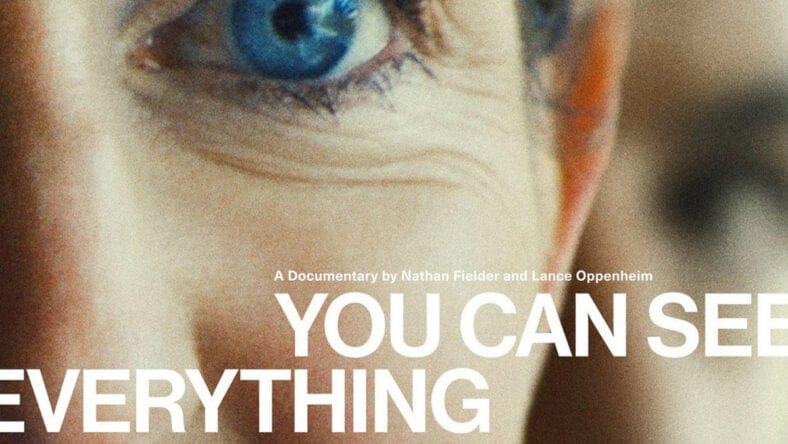
Nathan Fielder and and Lance Oppenheim’s recent documentary/performance art film You Can See Everything is a movie that critics and movie fans will be talking about for years to come. It has already generated Oscar-buzz and plenty of money at the box office. More importantly, it has opened up a cultural conversation around the nature of truth and the feasibility of truly knowing another person.
Without spoiling the brilliant, three-hour, jaw-dropping rollercoaster of a movie, Fielder and Oppenheim expertly muddy the waters on whether or not two human beings can ever really get down to the essence of each other. Even further, the film raises the question of whether we can really ever truly know ourselves. The now infamous trailer of Fielder staring skeptically into the bugged-eyes of fraudster Elizabeth Holmes as she insists on her obviously false innocence has already become a cultural icon. “Of course, I’m not deceiving you.”
I am still wrestling with what a Christian ought to do with such a message. I have watched Fielder since I was in high school and would consider him a uniquely potent commentator who knows our cultural moment with an unrivaled clarity. You Can See Everything feels like his magnum opus where all of the strands of his career come together into one beautiful and maximal statement. In many ways, I applaud his efforts and I recommend you see it. Still, despite Fielder’s clear diagnosis of our particular moment, I am anxious about what this means.
Through the divine revelation of the Triune God of the Scriptures, self-knowledge is not a muddy stream, but an ever clearer mirror. In the Gospel, God reveals Himself to sinners reliably and clearly, and through this knowledge we also have knowledge of ourselves, both our belovedness and our sinfulness. In God’s light, we can see our wounds and we can see the Spirit slowly and certainly heal them. This certain self-knowledge is something that the post-Christian West seems more and more determined to deny is even possible. Truth is harder and harder to come by. Anthropological norms are ever-shifting. Even something as given as personhood is negotiable.
Take for instance, as a random example, a recent episode of Amy Poehler’s podcast where she interviews a similarly brilliant comedian/cultural commentator, Kate Berlant (warning: this episode is not suitable for young audiences). Berlant and her frequent collaborator John Early, for those unfamiliar with their work, are the millennial heirs to the Christopher Guest-style of satirical comedy. Like Fielder (and Elizabeth Holmes), you watch them and have no idea when the sincerity begins and they stop being “their character.” Are they always in character? Are they just like this?
In the podcast, Berlant discusses this with Amy in the episode, pointing out that all human existence is a “performance.” According to her, gender is something we perform, sexuality, relationships, even regular awkward interactions on airplanes, it’s all just performance. You can feel Poehler, the podcast crew, and the progressive-leaning audience nodding along to this as they discuss it. Of course, there is something true to this observation. We are all enmeshed in a web of scripts, expectations, and narratives which dictate how we ought to act in any given situation. It can be difficult to make a clear distinction between where our “programming” and our “real self” begins. I think of Neil Peart riffing on William Shakespeare in the song “Limelight”
All the world’s indeed a stage
And we are merely players
Performers and portrayers
Each another’s audience
Outside the gilded cage
However, as I listen to all of this, I can’t help but feel a deep sense of dread. Is this really all we can say about our relationships to one another? That it might be impossible to really know someone? To even know ourselves? Are our lives just a string of performances? I can’t help but think about how a social media centered age might further contribute to this feeling of constantly performing, as Bo Burnham, another comedian/prophet has observed.
As a Christian, I want to insist that this is not true. Your life is not a series of performances. It is not fake. It is real. Your identity is not just a series of false narratives that other people have imposed upon you and that have now randomly collided together and created your confusing life. Your personhood, your gender, your essence is not fluid. You are created in the image of God. You were made to glorify Him and be holy. You were not made to figure this out one day. You were made to do it today. All the things you have done wrong have been paid for and God offers you a real way to transform now, in this very moment.
Maybe performance isn’t the worst metaphor, however. Michael Horton and Kevin Vanhoozer have taken up the metaphor with great fruitfulness. Maybe what the world gets wrong is not the imperative to perform, but what the performance ultimately is. As a Christian, I want to say we do indeed have roles and duties, a narrative which comes from outside ourselves that we must follow. But it’s the script of holiness, self-denial, and Christ-like conformity. It is not a fleeting and ultimately unknowable script. It comes to you in the inspired Word of God.
Biblical theologians have long pointed out the pattern in both the Old and New Testaments of indicative-imperative. God never commands us to do things before He transforms us. Liberation comes before the Decalogue on Sinai. Paul’s letters always begin with a rehearsal of what God has done before he gives the ethical implications. This is the imperative of holiness, the biblical drama. First, your identity is established securely and from outside yourself. Then and only then is your destiny prescribed. In The Christian Faith, Dr. Horton says, “Where most people think that the goal of religion is to get people to become something that they are not, the Scriptures call believers to become more and more what they already are in Christ.”
The Gospel enables us to remove our cynicism as we stare into the eyes of another or even ourselves, because it reveals that there is a God who searches hearts. The Christian faith offers modern people something we all seem to be crying out for: a final and unchanging performance that we don’t need to search for or be skeptical of. The script is given to you, freely, as a pure gift. In the Gospel, both God and man are named as definitive players with a definitive future. God searches and knows hearts. There is no hiding from Him. He knows you. And you can know Him. And if Someone can truly know you, if Someone can truly see everything, then there is hope for you. You can embrace honesty and integrity. You can embrace stability in your identity. You can stop searching for yourself.
The Weekly Digest
Premier Thought Every Thursday.
All of our recent essays and podcasts, delivered to you. Free.
Free. Delivered Thursday mornings.