
The logic, spirit, and economy of contemporary pornography is a near-perfect reflection of society’s failure to provide us with the tools necessary to meet the Responsibilities of Self-Belonging. Pornography assumes that we are each our own and belong to ourselves. It’s a tool that promises to give us a kind of personal validation, a sense of identity, a taste of meaningfulness, and a glimpse of intimate belonging. But by its own logic, pornography, like modernity, is an empty promise. Rather than helping us meet our responsibilities and cope with an inhuman world, it exacerbates our condition. Rather than bringing us closer to our humanity, it dehumanizes at every turn, turning our intimacy into instrumentality and leaving us addicted, depressed, exhausted, lonely, and bored — which also happens to be an accurate description of our society in general.
Contemporary pornography is merely a continuation of a long tradition of human efforts to depict sex and the sexualized body. Some might argue that there’s really no difference between erotic murals in the homes of ancient Pompeii and what the average, healthy, imaginative, sex-positive young man or woman accesses on their smart phone today. Humans have always creatively depicted sex and sexualized bodies. What does it really matter whether they’re drawn by hand or filmed and uploaded to the internet? Is there a meaningful difference between kids today hiding porn on their smartphones in 2021 and kids hiding copies of Playboy under their mattresses in the 1981?
It is not the same; the internet has changed pornography. And those changes reflect our contemporary anthropology. Consider the power of choice. Today you can find a pornographic depiction of virtually any fantasy. If you can dream it, you can find it. And you can probably find it for free within three minutes. When you inevitably get bored of that fantasy, just dispose of it and find something new — indefinitely. Humans have always been able to imagine all kinds of sexual scenarios, but we haven’t been able to make them exist, unless you happened to be a tremendously powerful despotic ruler. We all have the power of Caligula now.
With just an internet connection and a smart device you can entertain yourself with real humans performing any sexual fantasy you desire, no matter how debased, abusive, or bizarre. And on the off chance that you can’t find what you want, with a little money you can contact a pornographic performer and ask for a private video, customized and personalized to your tastes. Contemporary pornography is the most affirmative experience we can have.
But you say, “I can’t have anything. What I’d really like is a video of a particular co-worker and me having intercourse, and since she won’t even go out for coffee with me, there’s no chance of that happening.” Don’t worry, technology will find a way. And it almost has. With the rise of “deep fakes,” it’s now possible to create realistic videos where one person’s head is replaced by another’s. Currently this technology is used to create bootleg porn of famous actresses. The user takes footage of the actress, uses a program with advanced AI, and splices it with an existing pornographic video. The result is a realistic pornographic video of your favorite celebrity, whether or not she has actually done the sex scenes. And given enough time and images, it’s possible to use this same technology with your co-worker, without her permission. Because your co-worker, like most of us, has posted many images of herself online, you have all the raw material needed.
If this discussion has turned your stomach, that’s a good sign. It ought to turn your stomach. But what I’d like you to see is that contemporary pornography puts the individual user at the center of the universe. We have a godlike freedom to pursue any fantasy we wish. We can consume the most intimate human experience, taking in image after image after image, amassing a collection of human intimacy so vast and diverse that you come to feel that by rights you should have access to anyone’s body for your own pleasure. That’s one reason why young people — particularly young women — are so often pressured into sending nude photos and videos of themselves to their boyfriend or girlfriend. When so many bodies are so widely available for (primarily) the male gaze, exposing yourself can feel like the ante everyone pays to play the game.
Another result is that the economic value of exposing your body for the sexual gaze of others has dramatically fallen. During the COVID-19 pandemic of 2020–2021, the New York Times reported that a website allowing people to sell pornographic images of themselves had grown from one hundred twenty thousand “content creators” in 2019 to over one million. Unemployed and desperate, these content creators sold images and videos of themselves to pay their bills. But with over one million people selling content on top of an already vast market of pornography, one body simply isn’t worth that much. Nobody’s body is worth very much — which makes it even easier to imagine that you deserve to see whatever fantasy you desire.
In following your erotic preferences, you feel a sense of self-expression. The kinds of people you look for, the kinds of acts, the settings, the music, the tone and mood — all of it reflects your identity. By consuming moments of intimacy, you feel yourself become a little more real and more powerful. Your existence feels justified as you consume the intimacy of others. Perhaps you feel more “alive” with the thrill of accumulating images. Or perhaps you feel a sense of belonging, since belonging to someone is central to the act of sex, even its most mediated forms. But as with all consumption, you can never linger long; it never satisfies, which is why it’s good that search engines and internet speeds can accommodate your appetite. As quickly as you can imagine a fantasy, you grow dissatisfied with it. The thrill of the hunt, of discovery, is always inevitably followed by the letdown. Possession loses its edge.
For a moment, you felt a sense of intimacy, of passion, of sexual conquest, of power, but you know it’s a game. It isn’t real. Even when the videos are created by amateurs and lack all the benefits of professional editing, it never feels genuinely intimate. This is the unspoken logic of pornography: this beautiful, unique human is giving themself to me, exposing themself intimately for me, and so I must matter. In the act of sex, two people give themselves as vulnerably as possible. They may put up psychological or physical barriers to protect themselves from intimacy and union, but the act itself is inseparable from a profound sense of giving, unity, openness, and therefore belonging. Any abuse of sexual intimacy is a uniquely evil affront against someone’s personhood precisely because it treats that personhood as a means to an end.
Even in highly mediated and artificial forms of sexual intimacy, like edited pornographic videos, there remains the feeling that the viewer is receiving special access to someone’s person by virtue of their worthiness. I believe the best description of this this feeling is “tiny and meaningless and — sad-making,” a phrase used by one of J. D. Salinger’s characters to express a pathetic effort to feel existentially justified through a grotesque game of make-believe. What we will discover is that, as with pornography, many of our attempts to meet the Responsibilities of Self-Belonging are “tiny and meaningless and — sad-making.”
It is an “unspoken” logic of pornography because if we name it, if we admit that in pornography we momentarily allow ourselves to believe that a mass-reproduced image represents intimate and personal affirmation, then it would lose much of its power. It is also unspoken because, for men at least, it’s easier to admit to being biologically driven by lust than emotionally driven by loneliness or inadequacy. And as the sociologist Alain Ehrenberg argues in his history of depression, inadequacy is the pathology of contemporary depression. Sex, even masturbation, cannot help but involve the heart. When the moment passes, however, and you are faced with how tiny and meaningless and sad-making your fantasy really was, you may feel more alone and inadequate than ever. And to alleviate the renewed feelings of inadequacy, you return to pornography.
So a tool created to help give you justification, identity, meaning, value, and belonging cannot fulfill its promise. It only leaves you worse off than before: depressed and inadequate, anxious and addicted.
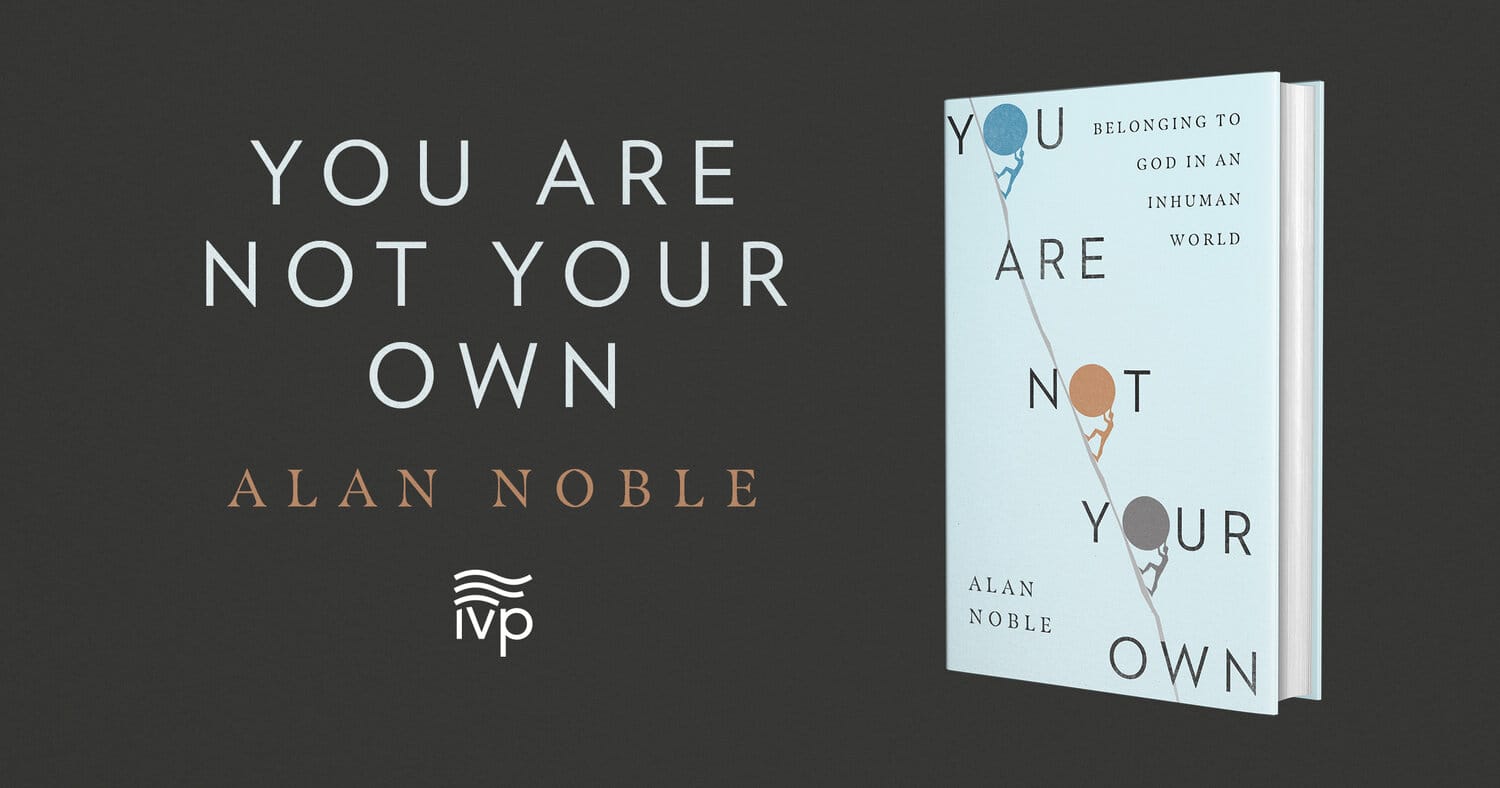
Taken from You Are Not Your Own by Alan Noble. Copyright (c) 2021 by Alan Noble. Published by InterVarsity Press, Downers Grove, IL. www.ivpress.com
The Weekly Digest
Premier Thought Every Thursday.
All of our recent essays and podcasts, delivered to you. Free.
Free. Delivered Thursday mornings.