
It has become common to look back on our cultural and historical heroes, today, and wonder if we ever really understood them or knew them at all. When evaluating our heroes, we consistently choose a deconstructive lens: Nolan’s Odysseus, Tom King’s Batman, or the hit show The Boys. Heroes lay on a cold metal slab, dissected and rearranged to our liking. We take apart our villains too, revealing that they didn’t actually have evil intentions but rather were misunderstood or broken people. Perhaps you’ve seen Disney’s Maleficent, the Broadway (and now Hollywood) hit Wicked or one of my favorites in recent years, The Joker. In the modern age, we like to hold our heroes and villains up like a jeweler, twisting and turning them to find a new angle, a different perspective and maybe, something glistening in a place previously unseen.
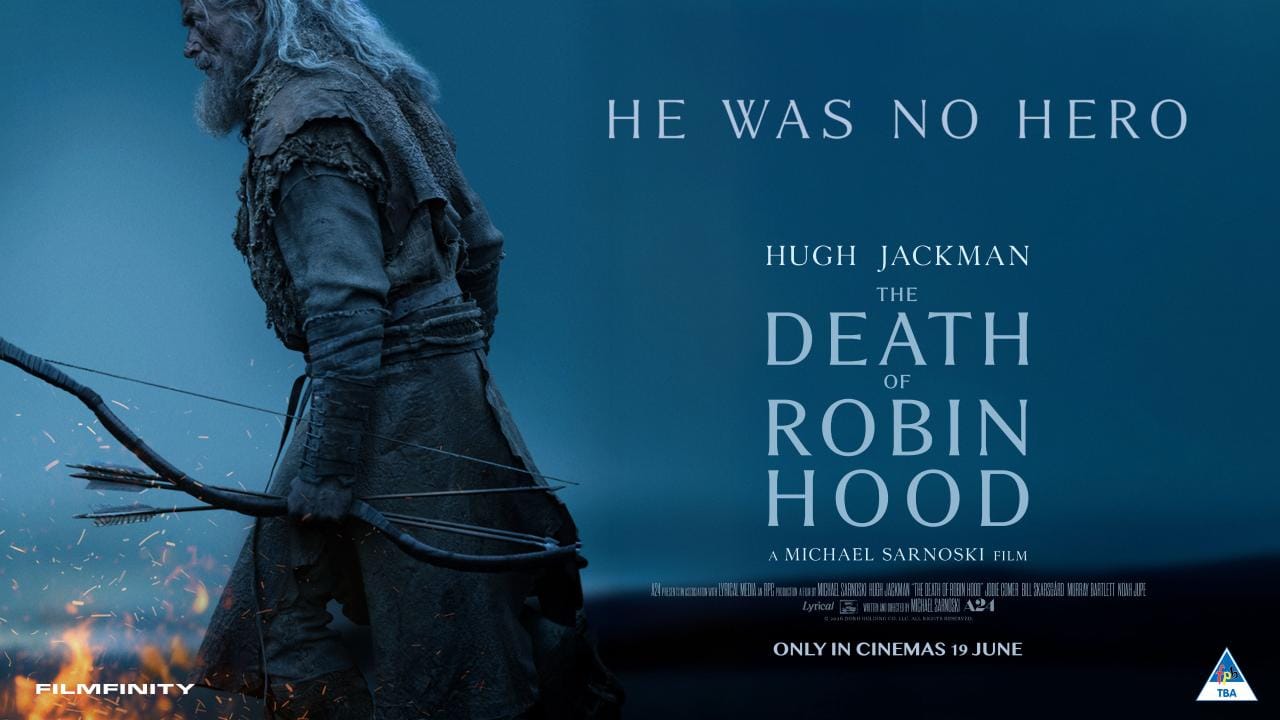
There’s nothing intrinsically negative about the idea. Although, one could suppose confusing our ideals with our dysfunctions will rear some undesired consequences. The most recent example is The Death of Robin Hood. It is not the Robin Hood you know. He is not a CGI rendered fox, and this is far from a Disney live-adaptation of the classic. But neither is this a young, spry trickster donning green apparel as he runs from authority. Instead, we meet a grizzled, gray-haired and distraught Robin played by Hugh Jackman. Robin is near the end of his life, puzzled and rather disturbed at the glorious renown his name and coinciding stories carry.
Our first appearance of the legend is in the opening segment and it is clear how the mythology of Robin Hood will be depicted. Unaware they are conversing with the man himself, a traveler esteems the character of Robin and lifts up the heroic nobleness of Robin’s deeds. To which, Robin replies with spitting responses stating the man praised was no hero. He never prayed in his life. There should be no love for one such as him and there is no one who protects the meek. The people see meaning where there is no meaning and sing lies of the hero. The man killed for the joy of it and there is no one more wicked than the falsely-famed Robin Hood. It is clear from the outset of the opening scene, this is not the Robin we know and love. This is, in fact, a Robin Hood for the modern world.
In medieval culture, Robin Hood was without a doubt a heroic figure. How one defines heroism could certainly be debated and would drastically shape one’s retrospective assessment of the figure. But first, he must be properly placed in his time. For the sake of this article, we will be leaving aside whether or not Robin Hood was a literal, real person, considering it is irrelevant to the actual existence of him in the minds of the medieval world. Robin Hood was “real” in one sense because people told stories about him. They influenced, encouraged and comforted the dejected and lowly. His name birthed hope into the hearts of the needy—an undeniable real hope.
The classic picture of Robin Hood to the vast majority of people in our time is as follows: The government is corrupt and taxing the citizens egregiously, so in comes Robin Hood to steal money from the government and give it back to the people. In today’s climate, you’d be hard-pressed to find someone who would scoff at such a mission. This would even be celebrated or defined as heroic in our day and age. But this is not original to the stories of Robin Hood. Our well-known image of Robin is indeed a later modification to address the political issues of the 16th century. When we go back to the earliest 14th century stories of Robin Hood we find something packing a heavier punch.
At the University of Hull, Lesley Coote lectures on medieval studies and Medievalism and has a specific fascination with our evolving Robin Hood. Her book, Storyworlds of Robin Hood: The Origins of a Medieval Outlaw, attempts (and succeeds in my opinion) to paint the full picture of this notorious figure. What world are these stories born out of? What ideas and theological assumptions orbit such lasting folklore? The results reveal Robin Hood lives in a world of religion and virtue, of Marian devotion and persistent corruption within both the church and the state. By sampling a few of the texts we’ll gain a cursory understanding of who the early Robin Hood was.
In the oldest full text we have, Robin Hood and the Monk (~1461), something is grieving our friend Robin. On a day of Solemnity, he cannot attend Mass due to his outlaw identity and strife with the Sheriff of Nottingham. He decides to attend with Little John as his protector until a spat between the two leaves Robin in the city all alone and without disguise. He prays to God and “mild Mary” and kneels “before the Rood.” Caught and betrayed during Mass by a monk whom Robin had previously robbed, the legend is imprisoned only to be rescued by his returning friend, Little John. Little John has intercepted the disloyal monk and murdered him, using his letters to beguile the king into allowing him into the prison where Robin is being held. The King is astonished by the loyalty between Little John and Robin only to realize Robin Hood’s bandits exhibit loyalty and faithfulness more than any of his own servants. The tale ends with an exhortation: “God, who is always a crowned king, bring us all to his bliss!”
Robin Hood and the Potter (~1468) may not contain a stop off at Mass but the elements of faith are far from absent. Here we have Robin described as:
“One of the best that ever carried a bow,
His name was Robin Hood.
Robin Hood was the yeoman’s name,
That was both courteous and free:
For the love of Our Lady,
All women worshipped he.”
When a potter comes along through the forest and is demanded to pay a road tax by Robin, the two have a fight that leads to Robin’s loss. In the wake of being bested he offers fellowship to the potter and to sell his pots in town for him. When warned of the danger of the Sheriff of Nottingham by his friends, Robin replies: “Through the help of Our Lady, Fellows, leave me alone: Ho, walk on!” Robin proceeds to sell the potter’s pots for cheap, utilizing the deal to sell to the sheriff’s wife and get himself an invite to dinner. Robin, in disguise, tricks the sheriff into following him with a promise he’ll lead the lawman to Robin Hood. In classic trickster form, this is indeed an ambush and Robin’s men rob the sheriff. With the newly acquired funds, Robin pays the potter fifteen times what his pots were worth. The potter is exalted, the sheriff humbled.
A little later on, roughly late 1490s, comes a compilation of stories entitled The Little Gest of Robin Hood. Here we find Robin ever pious—perhaps to a Protestant’s chagrin:
“A good custom then had Robin,
In whatever land he were,
Every day before he would dine,
Three masses would he hear.
The one in worship of the Father,
And another of the Holy Ghost;
The third of Our dear Lady,
That he loved altogether most.”
It would be an injustice to attempt to summarize this collection of stories as vast as it is. In fear of being unjust in the presence of Robin, may I alone suggest some themes which appear within. We see a knight who has fallen into the hands of a corrupt abbot, the traditional crooked sheriff, a lying monk and the betrayal and death of Robin. The king notices once again the loyalty of Robin’s men versus his own and the lowly are exalted while the proud and corrupt are humbled.
What stands out in these early stories in comparison to our modern understandings or retelling of Robin, especially The Death of Robin Hood, is the deep religiosity of Robin Hood and his stories. He was a yeoman. A trusted servant of a higher order, of the Virgin Mary herself. He lived on the outskirts, symbolically in another realm, and fulfilled a higher law than the rest of his surrounding world. Robin was not a vigilante who stole money from the rich and gave to the poor but rather executed judgments in a world filled with religious leaders attached to vice and oppressive civil authorities. Coote notes that “Robin Hood may be anticlerical not in the sense of objecting to the clergy perse, but because they were seen as obvious practitioners of this particular vice [avarice], which was hated by everyone.” He was a representative of God’s law and justice when the leaders who were supposed to do so were found lacking.
In the medieval mind, the forest wasn’t a place where towering trees lived and quiet streams flowed. It was a place of judgment, similar to the ancient views of the sea, with divine qualities. This forest is where the outlaw, defined in Old Norse as someone placed outside the protection of society and its laws, Robin Hood sits in judgment. But it isn’t his own judgment he wields but rather the Virgin Mary’s and thus by correlation, a divine judgment. Coote also notes that “the Virgin is reversing the unfairness of society’s values and paradigms, and the vague and often serendipitous nature of justice and law.” Yes, Robin goes about exacting justice through violent and trickster means but this wasn’t a problem for the medieval mind, for the message wasn’t the enjoyment of violence but rather the enactment of true justice in an unjust world.
Through this lens, it is apparent that Robin Hood and his early stories were similar to Revelation’s role in the canon. It was an unveiling of the true justice and spiritual reality behind the evils and injustice playing out in the daily life of the commoner. As John’s words written on Patmos were sent around to the early churches in what is now modern-day Turkey, so were the stories of Robin Hood told, performed and celebrated in the medieval towns under the oppressive hands of authoritarians who had no regard for God’s justice. This is where Robin’s heroics show through, in his divine purpose and revelation of spiritual reality.
Unfortunately, the new modern adaptation of Robin Hood’s story, The Death of Robin Hood, throws all of this away. Instead of the divine witness who seeks the virtuous and condemns the unjust, we have an old man who is burdened by the lies and stories told about him. When asked what difference we see between the original storyworld of Robin Hood versus the ones we receive today, Coote tackles this issue head on: “The most important difference between the medieval Robin Hood and now? Probably the need to contend with Robin’s moral goodness (or lack of it). Since he lost his medieval justification (his relationship with the Virgin Mary), people have mostly felt the need to give Robin and his men a backstory to explain why they’re into robbery with menaces, general thuggery and personal violence.” If modernity sees Robin’s relationship to the God and the Virgin as irrational, they are left with a puzzle missing pieces. The box with the finished image is buried in the trash can and we’ve no source point for the solving of the puzzle. We end up with a man of untamed violence and absolute cruelty who is desperate for death. A fraud who stands in the shadow of stories which paint a false picture.
The original medieval story from the 17th century called The Death of Robin Hood is about a betrayal, attributed to the prioress and her lover who want Robin dead. The prioress is supposed to help Robin but instead drains his blood, which leaves him for dead. Traditionally this crime is committed because of a shared disdain for Robin and his judgment against corruption and authority. Although, the writer and director of the new film, Michael Sarnoski, thought “maybe she’s not some evil nun, maybe she’s a healer, and maybe she has a community unlike a lot of places back then, and it’s a place where lepers and orphans can come, and she’s kind of incredible. And maybe Robin wasn’t the sweet, goodly hero that we think of.” The entire narrative has been flipped for a deconstruction experiment.
Storytelling is another critical piece of the film. The stories about Robin surround his journey as others remind him of his supposed legend. When discussing stories with the prioress, Robin states: “I have seen the power in stories. They can be used to make men do terrible things and then those terrible things become stories and stories. No. You cannot trust any of them. We cannot be trusted with them.” To which the prioress replies: “knives cut bread as well as they do flesh.” Sarnoski interprets for us: “…what she’s saying is that she uses stories to help and heal people, whereas Robin used them to perpetuate violence. That doesn’t make the stories themselves good or bad. They’re just tools that humans can use for various reasons, but we need to be responsible in how we use them and how we let them be used upon us.”
The gymnastics of reshaping Robin Hood are entirely unnecessary to tell a story of healing. If this was Sarnoski’s goal it seems bizarre how an assisted suicide to put an end to Robin’s grief over the violence of his life is truly healing and responsible. It’s a modern concoction that is truly confused on what is flesh and what is bread. It seems quite backwards to use storytelling in a seriously graphic film to criticize a traditionally revered legend who is being painted as unworthy of such a cultural position because of the violence attributed to him all the while giving him a violent ending. Perhaps Sarnoski sees this as his own justice being enacted. The stories of Robin Hood are healing all on their own. They served this purpose for the medieval people and still are accessible today in a world where injustice and corruption persist.
In our modern times, Robin is celebrated for his wealth redistribution ideology: take from the rich and give to the poor. A perusal of the early sources shows this is far from the reality of Robin Hood’s original purpose. Violence followed him, surely, often enacted by his own hands. But it was apocalyptic violence, not the celebration of cruelty.
Modernity isn’t to bear the entirety of blame. While the Reformation certainly provided undeniable and necessary changes, it damaged the original message of Robin Hood by ridding the culture of everything related to the Virgin Mary. Thus, Robin’s true purpose eventually faded. But today, we can know that Robin was uniquely tied to a divine purpose. Robin knew what bread was and he knew what flesh was. He knew the old story which with judgment, cut flesh and with mercy, cut bread. These two are not separated but rather divinely intertwined. We see this at the Lord’s Table where in a mysterious way, flesh and bread are served to us, cut by the knife of the true Storyteller. Kill Robin you may, but as time has shown he always reappears in culture. Whether it be medieval manuscripts, men in green tights, an animated fox trotting through the forest or even a gray-haired Hugh Jackman—our hooded hero has a penchant for resurrection, much like the Lord whom he serves.
The Weekly Digest
Premier Thought Every Thursday.
All of our recent essays and podcasts, delivered to you. Free.
Free. Delivered Thursday mornings.