

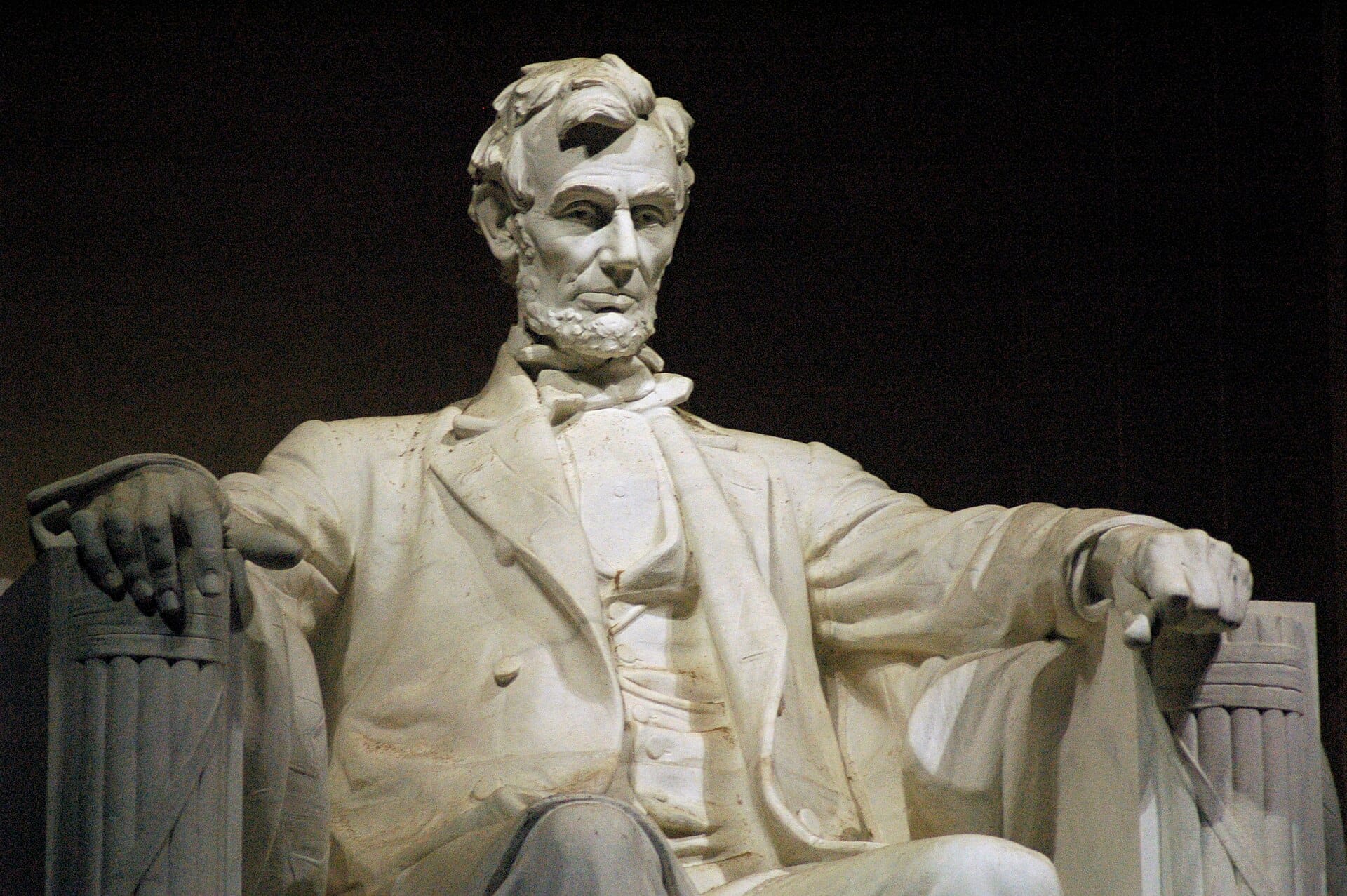
For the past few months my daughter has been talking about “Lincoln Lincoln.” When she was about a year old, my wife and I stopped by the Abraham Lincoln Presidential Museum in Springfield. We walked through and took it all in as it traced Lincoln’s life from his small Kentucky upbringing to the White House and ultimately to his death.
This time my daughter was a bit older. During that first visit we had bought her a little Abraham Lincoln board book, which she loves — especially its description of Mary Lincoln as “short and plump.” But this time I was coming off several harder months with anxiety, something I have battled for much of my adult life. It isn’t fun, but it isn’t defining either. It is not what I am but something I deal with — part of living in a fallen world, and a constant reminder of my creaturely dependence.
As we walked through the museum, I was encountering a side of Lincoln I hadn’t before. Lincoln was certainly endowed with gifts. That much is apparent to anyone who has ever read his writings — he belongs, in my estimation, alongside Whitman and Twain. But Lincoln is also very human: a man with his own struggles and weaknesses, his own darkness and his own hard-won resilience. It was this Lincoln I had in mind as I walked through the museum, and it is that Lincoln who has inspired me to write this piece.
In modern American memory, there are few leaders as towering as Abraham Lincoln. And yet Lincoln often thought very little of himself. He was of course known for his humor, often self-deprecating. Lincoln, always the master of locution, used such humor to disarm opponents, charm audiences during speeches, and to manage his lifelong battle with “the hypo” — short for hypochondriasis — or what we would simply call melancholy.
During a debate in 1858 with Stephen A. Douglas, his longtime Illinois rival, Lincoln once responded to Douglas’ accusation of two-facedness with the rebuttal: “I leave it to my audience. If I had another face, do you think I’d wear this one?”
It is ironic, of course, that Lincoln would make light of his homeliness — because his face was always easy to read. Joshua Speed, one of Lincoln’s early Springfield friends, commented that he had never seen “so gloomy and melancholy a face” as that of young Lincoln. Speed owned Bell & Co., a general store, and would be Lincoln’s roommate for several years.
I’m certainly not the first one to see the theme of melancholy in the life of Lincoln. Joshua Wolf Shenk’s Lincoln’s Melancholy covers the topic in full. Shenk writes about Lincoln less in mythic imagery and more in human terms. The Lincoln he presents is a man, not a legend — one who struggles, deals with internal contradiction (especially regarding slavery), but who returns again and again to one recurring theme that prompted this essay: melancholy.
Lincoln’s correspondence throughout his life is punctuated with this reality. When Joshua Speed confided his fear and anxiety at the thought of marrying Fanny Henning — caught up in internal torment, wondering if he could ever love her the way she deserved — Lincoln, no stranger to such nascent doubts, replied in 1842: “Remember in the depth and even the agony of despondency, that very shortly you are to feel well again.”
It is this side of Lincoln that is most endearing to me. I too battle anxiety — often debilitating, though by no means a defining feature of who I am. When life changes, as it often does, my body responds with a cocktail of upset stomach, racing heart, insomnia, and a sense of impending doom. But as I listen to Oates tell about Lincoln, I can’t help but find inspiration in the man.
So where did it begin? It was most likely hereditary — but Lincoln also suffered a series of crippling losses: the deaths of his brother, mother, and older sister. And yet, despite all of this, he would rise to become one of the giants of American politics. There are of course those who criticize Lincoln’s presidency. Some argue he was the seed of an ever-expanding federal government. The suspension of civil liberties during the Civil War lends further weight to the charge of tyranny. Yet even those who hold such views — and I do not, though I was once tempted — will find it hard to deny that Lincoln’s melancholy reveals a leader who was a man before he was a monument. Without Lincoln, the Union would not have been preserved. If the cloth that held the Union together could be reduced to a single thread, that thread would be Abraham Lincoln.
Modern leaders hide their sorrow and pain. For the better part of a century, the presidency has projected a polished image — a facade of splendor that is rarely the reality. The presidential life is not a blessing but a burden, however much the public celebrates it. Lincoln was the right leader for his times precisely because he was not perfect — he was a man endowed with gifts and humbled by the melancholy that plagued him.
So how does this encourage me? If Lincoln could face melancholy and press on — if he could persevere until he reached the highest office in the land — it gives me courage that I too can push through my own battles. It is Lincoln the man, not Lincoln the monument, whom I most relate to. And so we turn to the origins of that melancholy.
Lincoln had two notable breakdowns in his life — one in 1835 and another six years later in 1841.
Young Lincoln was engaged to marry Ann Rutledge. He had met her while boarding with her family during his early days in New Salem. When Lincoln arrived, Ann was still a teenager of about eighteen. She was short and commanded the attention of many a suitor. In 1832 she became engaged to John McNeil — a young man so embarrassed by his father’s business failures that he changed his last name from McNamar to escape the burden of the family name. McNeil was determined, however, to reclaim his father’s name and honor, and so he set out for New York to help his father settle his debts. While he was gone, young Lincoln swooped in. Despite his misgivings about his own abilities, Lincoln began to court Ann. When it became apparent that McNeil was not going to return, they prepared to wed.
One summer day in 1835, Ann fell sick with typhoid. She died in August of that same year.
Lincoln was torn apart by her death. Robert Rutledge commented that “the effect upon Mr. Lincoln’s mind was terrible; he became plunged in despair, and many of his friends feared that reason would desert her throne.”
Not long after, Lincoln met Mary Todd, whom he would eventually marry in 1842. But on January 1, 1841 — a day Lincoln would later refer to as “that fatal first of Jany” — he broke off the engagement. Reasons abound as to why, but recalling the advice he would later give to Joshua Speed, it seems reasonable to presume that Lincoln likewise battled an anxiety of love — a hesitation he could not overcome.
Upon calling off the engagement, Lincoln wrote to his first law partner, John T. Stuart: “I am now the most miserable man living. If what I feel were equally distributed to the whole human family, there would not be one cheerful face on the earth. Whether I shall ever be better I cannot tell; I awfully forebode I shall not. To remain as I am is impossible; I must die or be better, it appears to me.” William Herndon, Lincoln’s third law partner and one of the men Lincoln trusted above all others — Herndon would remain by his side through many political failures — described his friend as “a sad-looking man; his melancholy dripped from him as he walked. His apparent gloom impressed his friends, and created sympathy for him.”
Lincoln was well acquainted with loss. It touched nearly every walk of his life. Before Lincoln was old enough to remember, his infant brother Thomas Lincoln Jr. died.
In 1818, his mother Nancy Hanks died an untimely death from milk sickness. According to Francis Browne, as she lay ill, young Abraham would sit by her bedside and read whatever portions of the Bible she wished to hear. As she listened, she would occasionally interject — encouraging him to walk in honor, goodness, and truth. She died, and Abraham, not yet ten years old, felt the full weight of loss for the first time.
Later in life Lincoln would lose not one son but two. Eddie died of tuberculosis in 1850. Willie — by many accounts the son Lincoln loved most deeply, intellectually gifted and temperamentally close to his father — died of typhoid fever in 1862, in the White House, at eleven years old.
Lincoln was well acquainted with grief, and his melancholy was more than justified by what he had suffered. What is remarkable is not that he felt it but that he carried on. Melancholy has a way of making the next step feel impossible — the weight of what has been lost presses down on the present until forward motion seems not just difficult but meaningless. And yet Lincoln moved forward. He bore not only his private grief but the accumulated sorrow of a nation tearing itself apart (as we will see) — and he did so with a tenderness and a moral seriousness that the losses themselves had formed in him.
As I walked through the Abraham Lincoln Presidential Museum in Springfield, I couldn't help but reflect on this. Lincoln — the man, not the marble monument we have made of him — was a deeply broken man. And yet he carried on.

Lincoln walked up the steps of the Illinois statehouse — the building stood like a Greek pantheon in the center of Springfield. His law office, which he shared with Billy Herndon, overlooked the capitol. From his second-story window he could see the building’s towering Greco-Roman pillars rising at the back.
He had been up late waiting on the tallies. Now it was settled: Lincoln had won the presidency. The rail-splitter candidate — born in the backwoods of Kentucky — was president-elect of the United States.
The race had been anything but ordinary. The Democratic Party had imploded. Stephen Douglas, a short, stocky, fiery man from Illinois, had split from John C. Breckinridge, a Southern Democrat from Kentucky, and the fracture had proved fatal to both. Douglas was hard to pin down on slavery — if not downright contradictory. Would slavery reign in the territories or not? Would popular sovereignty rule the land? Douglas often dodged the question with the vague phrase “unfriendly legislation,” a formulation that satisfied nobody. Breckinridge was harder to misread. A thoroughgoing Southern hardliner, he ran on an explicitly pro-slavery platform, demanding federal protection of slavery in the territories — no hedging, no ambiguity.
The split fractured the Democratic vote and opened the door for Abraham Lincoln — who detested the moniker “Abe” — to walk straight into the presidency.
As Lincoln climbed the statehouse steps that morning, men pressed forward to hail him president-elect. He received their congratulations with the quiet dignity that would come to define him. And yet there was a weight beneath it all, a burden he carried even in the moment of triumph. The death threats had been arriving almost daily — scrawled notes, anonymous and ugly, stacking up on his desk (one showing the Devil casting Lincoln into the fires of hell). Southern newspapers were savaging him. In some towns his effigy had been burned in the streets. He was president-elect of a nation that was already coming apart at the seams — and he knew it.
Lincoln was always a melancholy man. Carl Shurz, a Lincoln biographer, would write that while Lincoln was a man who enjoyed reading and pondering — often staring off into space and thinking — he was also given to “strange spells of melancholy, from which he often would pass in a moment to rollicking outbursts of droll humor.” Francis Browne called this his “pensive melancholy” disposition which he inherited from his mother.
As Lincoln marched up the stairs, he was marching toward the future — a future marred by uncertainty. The nation was threatening to break apart at the seams, and yet it was to him they turned.
There are a few reasons for Lincoln’s resilience. First, he had been forged by failure. His story was not built on success after success but rather on the ruins of crushed attempts and broken dreams. He had lost races for the Illinois state legislature, two races for the U.S. Senate, and a race for the vice presidential nomination — all of this on top of the personal losses already mentioned.
What these failures produced was a man undeterred by defeat and undaunted by the prospect of failure. Most of the generals and politicians of his era were always positioning themselves for the next political opportunity. General McClellan is a perfect example. During the Civil War he was conflict-avoidant, in part because he knew he would eventually — and indeed did — run for the presidency. His caution on the battlefield was inseparable from his ambition off it.
As Doris Kearns Goodwin has shown in Team of Rivals, Lincoln had been forged by failure in a way his rivals had not. He was immune to the threat it posed, and as such he was able to carry on in spite of it.
Lincoln was also, as this essay aims to show, chronically melancholic. Joshua Shenk writes that:
“Whatever greatness Lincoln achieved cannot be explained as a triumph over personal suffering. Rather, it must be accounted for as an outgrowth of the same system that produced that suffering. This is not a story of transformation but one of integration. Lincoln didn’t do great work because he solved the problem of his melancholy. The problem of his melancholy was all the more fuel for the fire of his great work.”
In other words, Lincoln’s melancholy was far from a liability — it was an asset. It fueled him. He wrestled with it, and often won. His lifelong experience of contending with darkness gave him a moral register that more cheerful men simply could not reach. He had lived too long in the shadows to flinch from what he found there.
And so when he assessed the challenge of a nation split in two, he felt it. Lincoln understood the cosmic weight of what had been placed on his shoulders. He felt the burden of the Union’s cause as a man feels grief: personally, physically, without the comfortable distance of mere political calculation.
In his annual message to Congress on December 1, 1862, he closed with words that captured this sense of sacred obligation: “The struggle of today is not altogether for today — it is for a vast future also. With a reliance on Providence all the more firm and earnest, let us proceed in the great task which events have devolved upon us.” And likewise, in the very same speech, he called the present war a “fiery trial.” An ordeal unlike anything the nation has known.
Lincoln, whatever challenges his melancholy pressed upon him, was always thinking about the cause he believed had been Providentially placed in his hands. In a letter dated December 22, 1860, to Alexander Stephens, he wrote: "I fully appreciate the present peril the country is in, and the weight of responsibility on me." Lincoln bore the weight of the nation as his own — the country's burden became his burden. This is the mark of a great leader, and only a man with his own long experience of struggle could write such a sentence and mean it.
On September 24, 1862, responding to the Emancipation Proclamation, he said: “What I did, I did after very full deliberation, and under a heavy and solemn sense of responsibility. I can only trust in God that I have made no mistake.” Again, he framed his actions in the context of divine will.
Allen Guelzo has written a helpful assessment of Lincoln’s faith in Abraham Lincoln: Redeemer President — I won’t rehash the whole argument here. I remain fairly ambivalent about Lincoln as a Christian in any formal sense, and instead follow the line of thought that he was deeply indebted to his Calvinist upbringing. Whether that amounted to a genuine personal faith, only God knows.
The most private expression of Lincoln’s anguish is his “Meditation on the Divine Will,” written in 1862. Oates describes this as something of a turning point in Lincoln’s discourse about God. This meditation is lesser known — so much so that the collected works I employed for this piece did not even include it. The fragment was found and preserved, according to Abraham Lincoln Online, by John Hay — a White House secretary who noted that it was written not to be seen by others but as a personal reflection. Lincoln was a serious, anguished soul, and this document shows it more plainly than almost anything else he left behind. I am going to quote it in its entirety:
“The will of God prevails. In great contests each party claims to act in accordance with the will of God. Both may be, and one must be, wrong. God cannot be for and against the same thing at the same time. In the present civil war it is quite possible that God’s purpose is something different from the purpose of either party — and yet the human instrumentalities, working just as they do, are of the best adaptation to effect His purpose. I am almost ready to say that this is probably true — that God wills this contest, and wills that it shall not end yet. By his mere great power, on the minds of the now contestants, He could have either saved or destroyed the Union without a human contest. Yet the contest began. And, having begun, He could give the final victory to either side any day. Yet the contest proceeds.”
Lincoln, just as he had come to understand that his own suffering was preparation for a greater purpose, found in this meditation that God’s purposes were at work in the conflict itself. Despite the human carnage, the destruction, the immense loss — God “wills this contest, and wills that it shall not end yet.”
In the same year, Lincoln wrote a letter to miss Fanny McCullough dated December 23, 1862. In it Lincoln extends comfort to Fanny on the loss of her father. He writes that “in this sad world of ours sorrow comes to all, and to the young it comes with bittered agony because it takes them unawares.” It’s hard not to hear Lincoln’s own loss at a young age — the loss of his mother. He goes on: “the older have learned ever to expect it.” To expect loss and sorrow is certainly true and yet Lincoln doesn’t leave her in her anguish. He offers a glimmer of hope: “you are sure to be happy again…I have had experience enough to know what I say, and you need only to believe it to feel better at once.”
As I walked around the Lincoln Presidential Museum, I was struck by how Lincoln’s struggle was itself a blessing — without it he would not have been the person he was, nor the president he was. The nation would not exist today were it not for Lincoln. He bore the struggle as his own, carried it as his own, and ultimately sacrificed for it.
Biographers capture an unsettling story. One day Lincoln, seeking some much-needed rest from the many political friends pressing him for positions in his administration, went home and lay down on the sofa in his chamber. As he rested, he looked across the room at a looking glass on his dresser and saw his own reflection. But his face had two separate and distinct images. He got up, walked over, and the illusion disappeared. He went and lay back down — and saw it again. This time it was clearer than before. Two faces: one alive with color, the other pale and deathly. When he told Mary, she was disturbed and believed it foretold that he would survive his first term but would not live through his second. Lincoln reflected that “the thing would come up once in a while and give me a little pang, as though something uncomfortable had happened.”
As someone who deals with anxiety, it was encouraging to find Lincoln wrestling with the “hypo” that shadowed him throughout his life. And yet despite his battle he overcame — he grew, he learned how to look his suffering in the eye and draw from it rather than be destroyed by it.
As a Christian, I take comfort in the fact that Jesus is neither stoic nor aloof, but intimately acquainted with suffering. I’ve been reflecting on Hebrews 2:17, which says that “he had to be made like his brothers in every respect, so that he might become a merciful and faithful high priest in the service of God, to make propitiation for the sins of the people.” Jesus sweat drops of blood in Gethsemane. He felt the full anguish of impending suffering — and yet he endured it.
I am glad to worship a God who knows what I am going through. But it was also quietly comforting to walk through that museum and encounter Lincoln — this towering figure in American history — and discover that he was, like me, a regular person who had to face his struggles one day at a time and press on anyway.
The Weekly Digest
Premier Thought Every Thursday.
All of our recent essays and podcasts, delivered to you. Free.
Free. Delivered Thursday mornings.