
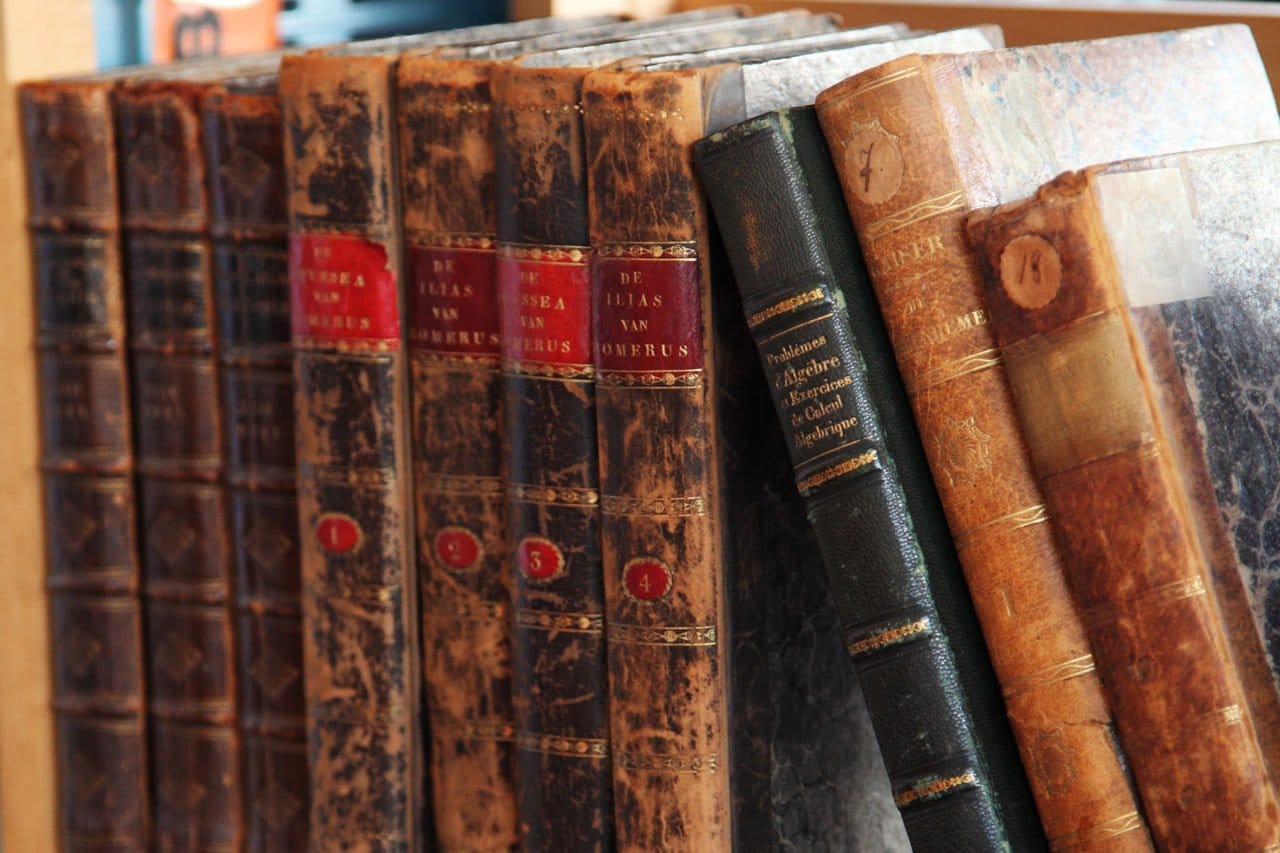
Joel J. Miller. The Idea Machine: How Books Built Our World and Shape Our Future. Prometheus Books, 2025. $34.95. 344 pp.
People who write books spend a remarkable amount of time writing about, well, books. Fictional characters from Woolf’s Orlando to Tolstoy’s Pierre Bezukhov to Austen’s Dashwood sisters to Cervantes’ Don Quixote to Wu’s Sun Wukong reveal themselves through their relationship to reading and writing. Non-fiction books exploring our relationship to books make up a tidy genre of their own. Biographies of writers abound. It’s all a little self-referential, a little meta, but it makes sense: Writers and readers enjoy books and think they’re important. But what’s so special about these little bundles of words that have captured our attention for so long?
While many books-about-books tilt their focus toward things like content, effect on character, or just sheer enjoyment of reading, Joel J. Miller’s The Idea Machine stands out in its consideration of the book primarily as an apparatus for facilitating thought. At its most fundamental, Miller writes, “The book is a portable collection of written ideas, designed to elevate the human mind beyond its natural limits of experience, memory, distance, and time.” The centrality of a book in Augustine’s conversion story—“take and read!”—provides a springboard for demonstrating this thesis.
Miller divides his project into four parts: Basics, Developments, Applications, and Reflections. The first two sections offer a fresh and often humorous review of the evolution of the book from its beginnings as cuneiform-on-clay accounting records through wax, papyrus, parchment, and paper, scrolls and codices, the invention of the printing press, and so on. The regular illustrations supporting the text—manuscripts, carvings, paintings, mosaics, and, eventually, photographs—add to the enjoyment. And Miller’s paying attention to not just the how of the changing book. The why and the then what provide even readers who know the basics of the tale with new insights and further food for thought.
Manuscript Evidence
The Idea Machine shows us a world where books begin as capital, inaccessible to most and accumulated by a few. They are expensive to produce and slow to read, but for those happy few they augment memory, facilitate the honing and comparison of ideas, and offer ways to “explain the world, even the human heart” across space and time. These advantages far outweigh the concerns of the change-hesitant about whether reliance on books will weaken human memory or delude people into thinking possession of facts equals wisdom. Those who can compile libraries, then create tools to keep track of—and search for—what’s in them.
As the centuries pass, the use of books spreads—sometimes quietly, like ripples in a pond, and sometimes with the intensity of a wildfire—in a self-perpetuating cycle with ingredients including the Pax Romana, the Christian Church, cheaper materials, and more accessible formatting. So does the quantity of books, both in number of volumes and in individual titles. Techniques for finding what one wants in this growing body of information grow right along with books and readers. Concerned attempts to curb undesirable elements of the booksplosion become more widespread as well (though no more effective).
In “Applications,” Miller explores how these aspects of book qua book (portability, durability through time, extension of memory, refinement of thought, access to the ideas of others, ease of reference, affordability, etc.) continue to shape and be shaped by the modern era. “The history of science,” he writes, “is the history of books in various states of dress (loose notes, first drafts, second editions).” This could describe each of the overlapping categories he examines: science, government, abolition, social conscience, and the rise of the Information Age.
This section contains some of the most beautiful writing of the book. Miller chooses vivid cases in point for each category. Ground-breaking scientists record observations over time, then share them widely in books, leading to major advances and changes in thinking. Revolutionary politicians read books “of and about the past to orient themselves in the present,” then write books of their own on their way to creating new forms of government. Enslavers grasp at power by restricting literacy while enslaved people “force a reckoning” with dehumanization through their reading and writing. Novelists open readers’ eyes to the interiority of people very different from themselves, challenging barriers between sexes, classes, and races. It becomes clear that, even for the most inveterate non-reader, it is impossible to overstate the importance of the book in every aspect of life.
Machines to Think With
Precisely because of this importance, those of us who love books tend to worry about the much-documented decline in the percentage of people reading them—and this certainly includes Miller himself. Many of us also tend to think of books in opposition to digital tech, particularly given the possible role of the PC, the smartphone, and social media in said decline. This is an uneasy position, since we’ve been using computers to facilitate the world of books for some time now. I’m typing up this review on a laptop, and you may well be reading it on a screen. Even Wendell Berry (may his shadow never grow less) has publishers who use computers to get his writing into the hands of readers.
But one of Miller’s main points is that even when we’re reading a bound, printed book (or a papyrus scroll, or a wax tablet, etc.) we’re using technology. Books are tools we have developed to extend our capabilities. He sees the digital revolution as merely one more stage in a process that stretches back to ancient Sumer. From the title page on, The Idea Machine makes deliberate use of language that emphasizes the blurred lines between print and pixel. Books are “information technology,” “hardware as well as software,” an “external hard drive of the mind, cloud storage for your head.” They are, to quote I. A. Richards, “machines to think with.”
And as Miller points out, once there are more than a few of them, books are much more useful if there’s a way to look for things in them without having to read all of every tome. An index lets us search an individual book. Catalogs let us search libraries. But even in the first half of the 20th century, readers were lamenting the way the “growing mountain” of pertinent material that needed to be digested to stay abreast of their field was miring their work. The Internet made searching faster and easier. But it also, in a continuation of the cycle that has repeated throughout the history of the book, increased the amount of material to be searched. So what comes next as we cope with this “information overload”? Miller suggests it’s generative AI.
Extending the Book?
If the book is an extension of the mind’s ability “to preserve information and expand access to it, to organize and utilize data and analysis, to build on what we know and broaden what we can learn,” then the search capacity and data analysis offered by AI can be seen as “an extension of [the book’s] affordances.” By “atomizing books down to discrete blocks of information,” AI offers the possibility that readers could spend less of their time looking for existing data and more of their time making new connections and discoveries in that data. He offers such recent examples as researchers from Israel and from the University of Chicago making breakthroughs in the translation of cuneiform tablets, University of Notre Dame scholars transcribing and search-enabling medieval manuscripts, and a team accessing carbonized scrolls from Vesuvius without damaging them, all with the use of AI. Both the theory and the practice here seem heavily weighted toward researchers and historians. What is lacking is a consideration of how this or other aspects of AI might affect poets and novelists.
Of course, while the “atomization” of books through AI could provide a way to deal with the sea of information, it also disrupts some of the benefits previous changes in technology brought us, whether the organizational gains that came with the codex, or the advantages of “scholars referencing the same texts” that came with printing. As Miller notes, “progress is a story we tell retrospectively,” and the aspects of a world shaped by books that we now see as positive weren’t necessarily a given. Nothing here excludes the possibility that, as Gabriel Rossman writes for Compact, reliance on AI in the first 16 years of education may mean “we run out of people with motivation and background to learn, know, and do” even the basics of books, let alone exciting things at higher levels. In the introduction to The Idea Machine, Miller describes the book as “a victim of its own success.” He thinks the importance of the book is underappreciated. Only time will tell if the digital revolution will prove his words more broadly true.
But The Idea Machine reminds us that “the way things were before” is no guarantee of goodness. (Think Renaissance humanists reviving ancient wisdom with the goal of ushering in a new Golden Age, only to revive its flaws and errors as well in a sort of keeping-the-bathwater-along-with-the-baby moment.) Technological change—and fear of technological change—in the realm of the book has been disruptive again and again over the centuries, and again and again we’ve adapted and found new benefits in new technology. After more than two decades of involvement with books as a salesman, writer, editor, and publisher, Miller remains optimistic about their future.
Shaping the World and Our Own Hearts
Perhaps the best reason for both optimism and pessimism about technology of any kind is the fact that human beings are behind its invention and use. Despite massive cultural and technological differences across time and space, human beings seem to keep drawing from the same common pool of affections and temptations, flaws and gifts, down through millennia. It’s this that makes classic books classic. We’re still reading about Gilgamesh and Sappho and Beowulf and the gang because all these thousands of years later, they still speak to us. From a Christian perspective, human beings are warped because we are part of a damaged world—and beautiful because we are made in the image of a loving, creative God. We leave the fingerprints of both aspects of our nature on our work.
AI-interested readers may find The Idea Machine reinforcing their readiness to experiment while also offering food for thought for protecting the aspects of the book they value. AI-concerned readers may see continued cause for caution while also finding encouragement in reminders of human and bookish resilience. But perhaps the most important take-away is that we consider what makes what Miller calls in his conclusion “humane applications” for tech of any stripe—and how we get there.
The history of the book shows us that human frailty and cruelty have led to horrors, and that human goodness and strength have created powerful change for the better. We can and do use our creativity to harm and to help ourselves, each other, the plants and animals, and even the dirt that sustains us. Our technologies have certain leanings that tend to shape us as we use them—“they suggest some uses more than others”—but the ways we use any technology also shape the direction it leans. Which of our human impulses is most formative for a given technology? Is a particular technology influencing us more for good or for ill? How can we tell when we see behind us such a long train of unintended consequences?
Fittingly, books can help us wrestle with these questions, allowing us to join in thousands of years of conversation about what makes a good human life. So can conversations in real-time—whether face-to-face or via tools like apps—with fellow questioners. But as we make our pilgrimage through the ever-changing world, as we ponder the implications of our technologies and choose which to use and how to use them, the most important tool at our disposal remains unchanged: the pursuit of wholeness—of integrity, all-of-a-piece-ness, lovingkindness.
The Weekly Digest
Premier Thought Every Thursday.
All of our recent essays and podcasts, delivered to you. Free.
Free. Delivered Thursday mornings.

