

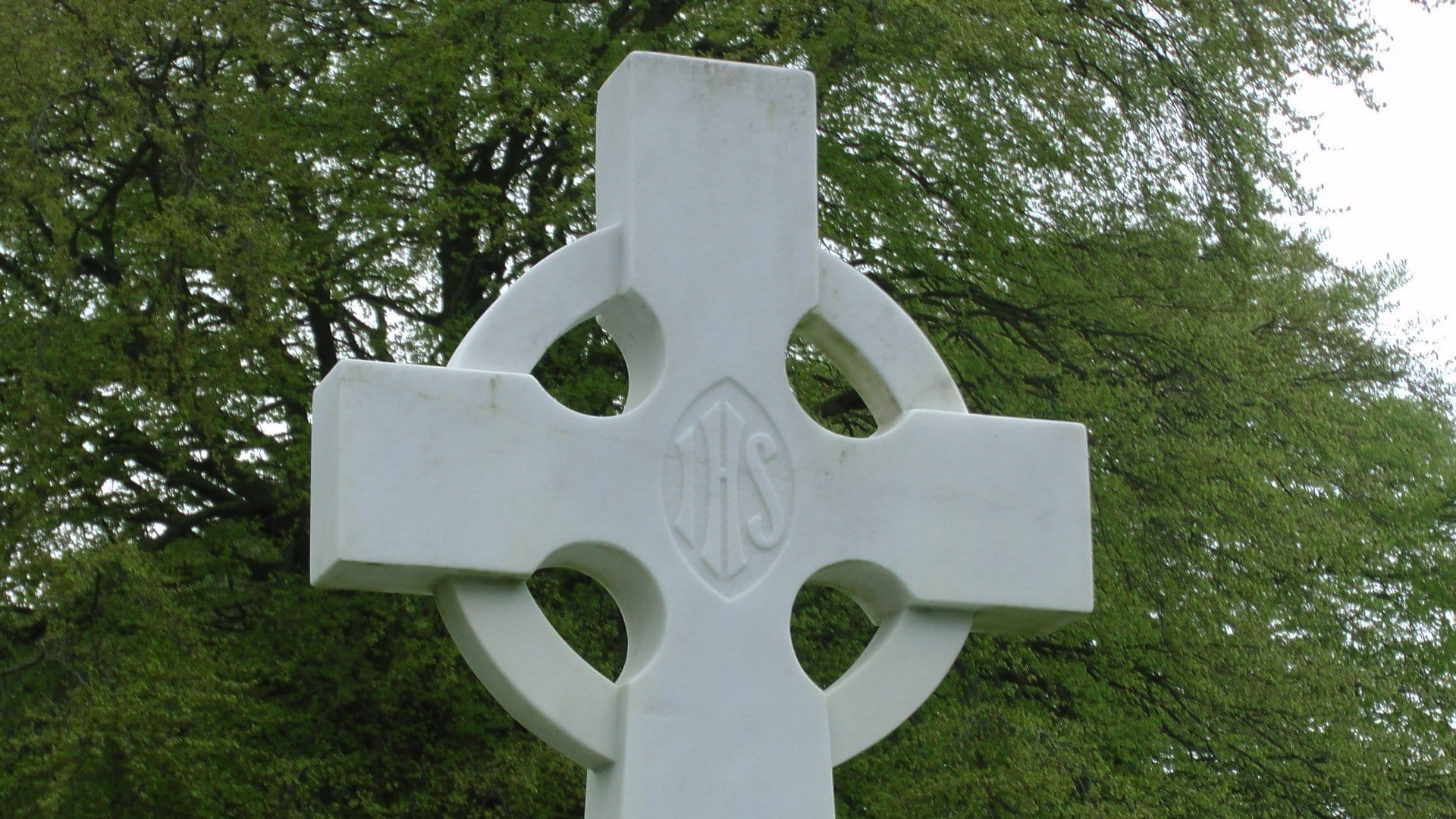
[38] After these things Joseph of Arimathea, who was a disciple of Jesus, but secretly for fear of the Jews, asked Pilate that he might take away the body of Jesus, and Pilate gave him permission. So he came and took away his body. [39] Nicodemus also, who earlier had come to Jesus by night, came bringing a mixture of myrrh and aloes, about seventy-five pounds in weight. [40] So they took the body of Jesus and bound it in linen cloths with the spices, as is the burial custom of the Jews. [41] Now in the place where he was crucified there was a garden, and in the garden a new tomb in which no one had yet been laid. [42] So because of the Jewish day of Preparation, since the tomb was close at hand, they laid Jesus there.
On Good Friday the Christian church pauses to commemorate the death of Jesus on the cross. In this brief burial scene from John’s gospel, we see not only the reality of Jesus’ death but also that his death elicits a profound response in two men.
The Reality of Death
These five verses from John solidify the reality of Jesus of Nazareth’s earthly death. Three times, John refers to Jesus’ body––each time in the Greek singular accusative case, used to indicate a direct object being acted upon. This body is then taken and bound––verbs showing action done to the direct object. Thus far in John’s gospel Jesus has been the primary actor: teaching, healing, traveling. Now, he is being acted upon. John wants his readers to know that this once living man from Nazareth is now a passive, lifeless corpse.
And it is this corpse that is taken from Pontius Pilate. It’s worth remembering that Pilate was a Roman governor under the authority of the current Caesar, Tiberius Caesar. Tiberius was known to be ruthless and paranoid, with a zero tolerance policy for insubordination. Earlier in John’s account, the Jews twist Pilate’s arm by reminding him that anyone who makes himself king (as Jesus had done) is no friend of Caesar’s. Their point was clear: let this man live, and you are aiding and abetting an insurrectionist against Caesar.
Thus, Pilate desperately needed Jesus to be dead. In simplest terms, Jesus’ life would almost certainly have cost Pilate his own. Therefore, Pilate would never have let Jesus’ body go if there was even the slightest chance of remaining life. This would have ruined him––he would have solidified his legacy as an incompetent governor, unable to carry out the quintessential Roman punishment of crucifixion.
Pilate, however, could rest easy in the certainty of Jesus’ death. Rome was a highly calibrated, efficient society. Rome was good at what they did; they were military experts and their expertise included execution. Rome simply did not “miss” on crucifixions. Ancient Rome was a shame-honor society. This is why in Acts we see the Roman guard pull his sword on himself when he believes Peter to have escaped prison under his watch––better to die than to fail one’s duty. Indeed, either way death was sure to follow in cases of such incompetence. To have “missed” on the crucifixion would have meant the death of all involved. Rome was simply too advanced and too proud; Tiberius, Pilate, and the Roman soldiers too professional to let this happen.
And that was just Rome! The Jews, likewise, had equally efficient rituals around death. These two Jewish authorities––Joseph of Arimathea and Nicodemus––prepared Jesus’ body with linen cloths and spices “as is the burial custom of the Jews.” This was a highly significant and sacred process. To do this with a living body would have been a gross violation of this sacred burial rite. These devoutly Jewish men would never have done this if Jesus were alive, and they would have known if he was alive because of the time and attention it took to wrap yards and yards of spice-soaked linen around Jesus’ body.
Thus, the actual, physical death of Jesus of Nazareth is one of the most historically reliable events of antiquity. Virtually all scholars––past and present, Christian and secular alike agree. Even the second century Roman historian Tacitus wrote:
Christus, from whom the name had its origin, suffered the extreme penalty during the reign of Tiberius at the hands of one of our procurators, Pontius Pilatus, and a most pernicious superstition, thus checked for the moment, again broke out.
Like a good historian, Tacitus gives us both geographical and temporal markers as footnotes for authenticity and reliability. Tiberius and Pilate were serious players; no one came back from a cross alive.
And it is precisely this undeniable death of Jesus that seemed to have contradicted his claims. After all, Jesus had claimed to be the Son of God––a claim that now seemed to have been refuted by his death.
A college professor of mine, while teaching on the history of Christianity, ended a lecture with what he must have thought was the ultimate death blow to the Christian faith. After leading us in a discussion on the reliability of the death of Jesus, his claim to be God, and his shed blood on the Roman cross the professor concluded… “but gods don’t bleed, do they?”
This professor believed the historical reliability of Jesus’ death contradicted his claims of divinity. However, it is Jesus’ shed blood that actually fulfilled his claims of divinity. Throughout John’s gospel we have heard things like: “This was to fulfill the word that Jesus had spoken to show by what kind of death he was going to die.” Isaiah had prophesied the kind of death God’s Suffering Servant would die; namely, an atoning one. The power of Jesus’ divinity was confirmed by his death as the Suffering Servant––the power of one who suffers for and with God’s people. We see this power reflected in the responses of Joseph and Nicodemus.
The Response to Death
The apparent contradiction of a God who bleeds gave birth to new contradictions. Joseph of Arimathea, a disciple of Jesus but secretly for fear of the Jews now comes forth in boldness demanding the blasphemer’s body from Pilate. Such a request could have not only outed him to the very Jews he feared, but it could have also rendered him guilty of sedition by association!
Likewise Nicodemus––who once sought out Jesus under the cover of night––now comes in the light of day. His stealth has turned to the clamor of carrying 75 pounds of spices fit for a royal burial.
These two men are walking contradictions: high ranking members of the Sanhedrin, fear turning to boldness, anonymity turning to openness, both relinquishing the riches of costly caves and expensive ointments to bury a blasphemer!
What can account for such responses?
Remember what Jesus had told Nicodemus earlier in John: to enter the kingdom of God will require a contradiction––you must be born again. And such a new birth necessitates a death. Newness of life, Paul argues in Romans 6, requires a burial. Thus, Jesus’ burial scene serves as a kind of burial for Joseph and Nicodemus’ old selves. They have died to the power of wealth, of status, of good standing in their societal systems of influence.
Thus, the historical death of Jesus is not merely a historical event––it accomplished something. It was the power of the Son of God to atone for sin, and therefore an invitation for any who believe in Jesus to be transformed by that power. The God-man’s blood was a payment for sin, covering the heart-level contradictions of loving wealth, status, comfort more than God. He bore the wrath due such sin in his body. But it was also a payment for pardon––to release those in bondage to the darkness of the old self to a life in the light. Such freedom is possible because through faith in the God who bled on the cross, we die too––we are united with him in a death like his (Rom. 6:5). This is the goodness of Good Friday––everything that keeps us from God goes to the grave.
This dying with Christ is beginning to be reflected in the lives of Joseph and Nicodemus. As they carefully wrap Jesus’ lifeless body in linen and spices, their actions reveal hearts already moved by God’s grace. Their old selves, once bound by fear, secrecy, and worldly attachments, are now dying with him. Only dying with Christ through union with him can account for this profoundly transformative response.
But such a death is not a hopeless one.
Paul continues: if we are united with him in a death like his, we shall certainly be united with him in a resurrection like his. It is interesting that only John’s gospel mentions that this tomb is in the middle of a garden. A garden is the place where death gives way to life. My wife planted flowers last Fall in preparation for this Spring, and they have since been lying dormant under an icy graveyard. But now there are signs of life sprouting. The graveyard of death is giving way to a garden of life.
This is the hope of Easter.
The resurrection is coming, and all who are planted with Jesus through faith will raise to new life with him. But such planting means death. Our old lives must be laid to rest along with Jesus, covered by his blood. It is on Good Friday that we remember that God bled not only for us––to atone for sin––but also with us, as one who knows our suffering. And as we wait for Easter morning, in our suffering and dying, we do so with the hope of life beginning to stir in the tomb.
So this Good Friday, embrace the contradiction of the God who bleeds. For Jesus’ body buried in the garden holds the promise of new life.
The Weekly Digest
Premier Thought Every Thursday.
All of our recent essays and podcasts, delivered to you. Free.
Free. Delivered Thursday mornings.

