

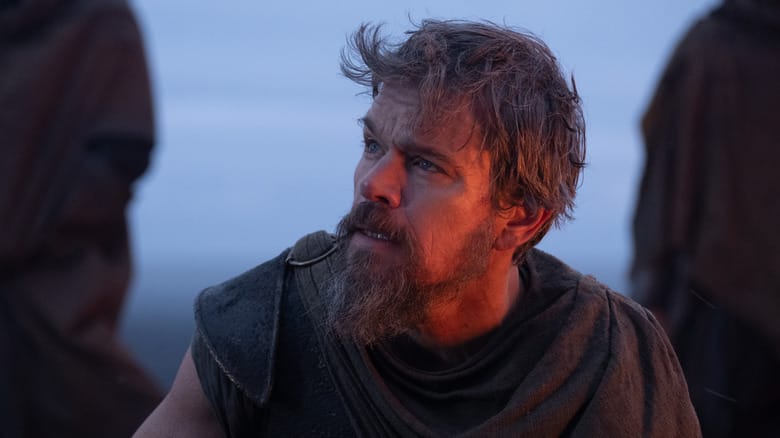
The stories a culture chooses to tell — and how it chooses to tell them — are among the more reliable indexes of what a society actually believes about the world. Often the form of retelling says as much as the substance. To that end, this is not a review of Christopher Nolan’s Odyssey so much as a review of the moment in which it arrives — an attempt to ask why this story, why this filmmaker, and why now.
In 2004, Petersen made a film that gave America exactly what it wanted. Troy featured Brad Pitt, Eric Bana, and Orlando Bloom and grossed handsome profits — nearly $500m worldwide. Petersen delivered blood and beauty without even an echo of the transcendence which permeates the Iliad. Homer’s gods were reduced to stone figures cast down by men without consequence whilst Peter O’Toole grieved in the background. The Trojan War became devoid of myth and explicable in purely human terms: pride, lust, fortune, and fame. Divinity was an embarrassment the serious filmmaker had outgrown.
The irony is that Petersen was not a man ignorant of what myth requires. Two decades earlier, he had directed The NeverEnding Story, a film whose entire premise is the crisis of a world that stops believing in stories. “The Nothing” that threatens Fantasia is not a monster but an absence — the encroachment of a disenchanted world consuming its own imagination. Petersen understood this intimately. He made Troy anyway. That is not a contradiction so much as a confession: twenty years later, the disenchanted telling felt the more commercially responsible option, even philosophically sophisticated.
The gods in Homer’s Odyssey are present from the first lines — not as decoration or metaphor, but as actors in the drama, playing a direct role in whether a man will make it home. The human story is held, from the outset, inside a divine one. That is the story Christopher Nolan has chosen to tell now.
—
Nolan is a filmmaker who has most successfully held artistic seriousness and mass commercial appeal in tandem over the last quarter-century. His choices are not eccentric; they appeal to broad audiences while telling deep stories. When he turns to a foundational story of Western civilization and decides to make it strange rather than smooth, that decision is itself a cultural signal.
His own account of how he depicts the gap between worlds is insightful: “One of the things I needed to crack,” he told Empire, “was how to approach mythological elements in a sort of real-world way. The big breakthrough creatively in thinking about the gods was that everything that is now explained by science was once supernatural. Lightning, thunder, earthquakes, volcanoes… people are literally seeing gods everywhere.” Nolan is not explaining the gods away — he is asking what it felt like to inhabit a world in which they had not yet been explained away. He is saying that we have been so thoroughly conditioned to explanation that we have lost the capacity to feel what the ancients felt: a world in which the overwhelming is also the personal, in which nature does not merely cause but addresses. His method — the real ocean and a CGI-less set designed to achieve total immersion — is an attempt to return a modern audience to that felt experience. Whether it fully succeeds is a question the viewer will answer, but the plausibility of such a proposal is a key indicator to our societal appetites.
Nolan has flirted with the transcendent in Inception and Tenet, coming to the edge with Interstellar, framing for his audiences a window to the cosmos only to ultimately reveal a mirror of human self-salvation. The immanent frame swallows the transcendence in the end. The Odyssey may be the furthest he has traveled in that direction — a story whose gods are not explained away, whose drama cannot be collapsed into mind-bending psychology. It is worth asking what might have changed in the twenty-two years between Wolfgang Petersen’s Troy and Christopher Nolan’s Odyssey.
—
Charles Taylor published A Secular Age in 2007, three years after Troy premiered, and its central argument was not simply that the modern West had lost its belief in God. It was that the West had reconstructed itself so thoroughly around immanent explanations that transcendence had become a personal option rather than a shared horizon. The stories we told ourselves no longer required divine scaffolding. Taylor called this the “buffered self”: sealed from the possibility that anything outside it might make a genuine claim on it – or that there was even anything else to make a claim. The cosmos was now a system of causes and effects in which the experience of transcendence had to justify itself as subjective feeling rather than objective encounter. What Taylor raised, without quite resolving, was whether the frame could hold — whether the hunger it generated would eventually press against its own walls.
Marvel understood this appetite even if it couldn't fully satisfy it — growing bolder from a secular superhero like Iron Man to entire franchise voyages into Norse mythology. The gods are aliens. The magic is technology. But the hunger for something beyond the imminent kept pulling the stories further out.
The same pressure appears in quieter auditoriums. Mainline Protestant denominations — those that spent the latter half of the twentieth century making themselves culturally legible, trimming the strange and supernatural edges of Christian faith in pursuit of relevance — have been in freefall for decades. The Catholic story is different in its particulars but not in its logic. Adult baptisms and receptions into full communion rose sharply in recent years, and the converts themselves are consistent about what drew them: the unapologetic supernaturalism — the very liturgical strangeness that modern Catholics were once encouraged to grow past. Ross Douthat, whose recent Believe argues that religious experience is “much weirder and more destabilizing” than secular accounts predict and that the world is “much stranger than the secular imagination thinks,” would recognize the pattern: the societal hunger is not, apparently, for a faith that accommodates the buffered self. It is for one that presses against it — which is precisely what Kevin Vanhoozer’s Remythologizing Theology had argued theology itself needed to recover.
—
Vanhoozer’s theological project was to resist the long habit of modern theology — running from Feuerbach through Bultmann — of accepting the secular age’s terms for what religious language is and does. Bultmann’s celebrated demythologizing program made a generous offer to the modern reader: keep the existential kernel, discard the mythic shell. Vanhoozer’s counter is that the shell was the point.
It was, Vanhoozer argues, an error to say the strangeness of biblical discourse is the problem rather than the point. Remythologizing is not, in his phrase, a fall back into myth but a spring forward into metaphysics: a refusal to translate the irreducibly personal, dramatic texture of Scripture into something thinner and more philosophically manageable. The strangeness is not incidental. It is the form the truth takes.
Daniel Mendelsohn’s 2025 translation of the Odyssey made the same wager in classical scholarship that Vanhoozer made in theology — deliberately preserving what he called the poem’s archaic grandeur, refusing the smoothing impulse of mid-century translations like Robert Fitzgerald’s. The Washington Post had praised Fitzgerald’s 1961 edition for giving readers not “the sense of reading an ancient classic” but “a great and timeless narrative.” What passed for a compliment then now reads as an admission. Mendelsohn’s decision to maintain the distance — the Greek spellings, the heavy six-beat line, the refusal of the modernizing gesture — rests on the same conviction Vanhoozer brings to Scripture and Nolan brings to IMAX: the otherness is not an obstacle to the poem. It is the poem.
That is not coincidence. It is pressure applied to the immanent frame.
—
It is too soon and too much to say we are witnessing a reversal or revolution in the repeal of secularism. The buffered self does not crack so easily. What can be said is that the pressure is visible, and that it is appearing at the center of culture rather than its margins. The hunger for a thicker world, a world in which the journey is more than miles and minutes and the homecoming is real. A century of demythologizing — in theology, in literature, in film — has not managed to replicate or remove the appeal of enchantment.
What the secular age cannot supply, and what Nolan’s film will not provide, is the name of the one who speaks from the storm. The ancient world Homer inhabited was not simply a world of awe and immanent wonder. It was a world of address — where the storm had a name, where the journey was supervised by divine attention, where the drama was intelligible because it was held inside a greater story.
God makes himself known largely through speech acts that seem strange and chiefly through the Word made flesh — Jesus Christ. The flat world built by a century of demythologizing is generating its own dissatisfaction — and the stories our culture is reaching for are changing in tone. Perhaps this signals a willingness to hear the foundational story not of Western civilization but of the world itself — the most enchanted story ever told, in which the winds obey, the sea yields, and death itself is undone. Nolan’s reintroduction of Odysseus’s world may help reawaken our inborn awareness of this enchanted cosmos.
The Weekly Digest
Premier Thought Every Thursday.
All of our recent essays and podcasts, delivered to you. Free.
Free. Delivered Thursday mornings.

