
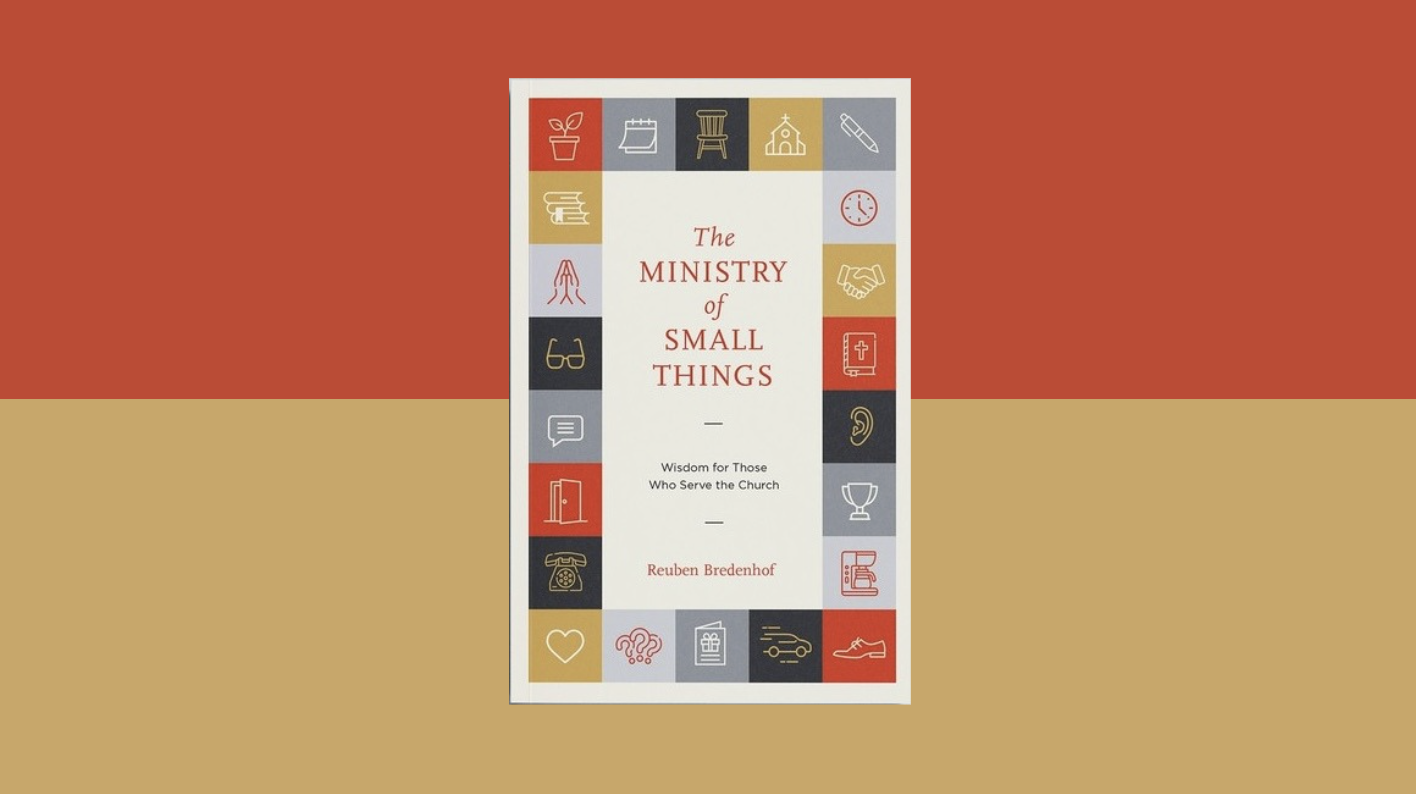
Reuben Bredenhof. The Ministry of Small Things. P&R Publishing, 2026. $12.99 (pb). 144 pp.
What ought to occupy a pastor’s time? Reuben Bredenhof, who pastored Reformed congregations for almost two decades in both Canada and Australia and now teaches at Canadian Reformed Theological Seminary offers the expected answer: the Word, sacraments and prayer.
And yet, The Ministry of Small Things, is not a book about preaching, nor sacraments, nor is it primarily about prayer (some portions notwithstanding) but rather it seeks “to unpack one more significant element in the minister’s job description: pastoral care.”
While English resources on preaching and prayer are virtually endless (resources on the sacraments, less so), it is the view of this author that for every young minister who needs to have the ordinary means of grace underscored, there are five, if not ten, who need a reminder not to despise the small things.
Reflecting on church farewells, Bredenhof recalls what he most often received gratitude for: checking in, remembering birthdays, pausing to answer a question, baptizing families, and listening. “Maybe,” writes Bredenhof, “we would like to be appreciated for more impressive accomplishments.” A few ministers will be; the majority will not. Can we still stand with the psalmist and say, “The lines have fallen for me in pleasant places”?
The Ministry of Small Things is a scrapbook of sorts with thirty snapshots (i.e. chapters) which depict pastoral care in its usual scene: inefficient, unremarkable, anonymous, and glorious.
An Inefficient Ministry
It is a mistake to confuse effective ministry with efficient ministry. The basis of any effective ministry is love and Bredenhof warns, “Love is inefficient because it doesn’t follow a predictable timetable of outcomes: Love this much, and for this long, and achieve these good results.”
Now, a pastor need not dawdle in the discharge of his duties. Few ministers are ignorant of their options when it comes to their personal calendar: sink or swim. (Like Peter, they may cry: “Lord, if it is You, command me to come to You on the water.”) Even so, inefficiency is intrinsic to good ministry because good ministry is born out of love, love which “bears all things, believes all things, hopes all things, endures all things.”
“There should be no question in the minds of [the] people that their pastor cherishes them. They must know for certain that he has an affection for them, a loyalty that will outlast the present season of their lives, whether it is good or bad.”
Even sharper is Bredenhof’s encouragement to embrace the ordinariness of life. Bredenhof writes that many pastors feel “pulled upward and away from an ordinary ministry by “bigger” things.” Whether it's a teaching position or an exciting downtown mission opportunity or starting a podcast, it's easy to become enamored with the exciting over the ordinary.
“Over the years, there were too many occasions when I felt like I was bigger than the present moment.” Bredenhof confesses, “The hour came when I needed to make a pastoral visit in my congregation, but my mind felt like it was a thousand miles away from the living room in this cramped condominium. It was going to be hard to climb down from the lofty heights of academia or the exciting possibilities of a publishing contract, and to enter into the humble life of one of my sheep.”
It is the humble lives of people—with their marriages and migraines—to which pastors are called. Actually, we might interrogate the presupposition that it is the creation of content that is most effective in forming people. Ministers mourn the sparse minutes spent preaching in comparison to the deluge of online content their people digest all week. But Bredenhof challenges us not to measure our impact by the words we’ve shared but by the moments. Yes, ideas shape people, but it is largely people that shape people. It’s inefficient, but not ineffective.
A Simple Ministry
“The distinctive element of pastoral care,” writes Bredenhof, “is the privilege of speaking this living and active Word into people’s lives. It is always appropriate to read Scripture with them.” (emphasis mine)
We need Bredenhof’s encouragement to tolle lege (“Take up and read!”). If we're not careful, we can slip into a “Martha-mentality” when during a visit we feel ourselves stretching for questions or fumbling for encouragements. These things are good, but they can also muck up the mind of a pastor to become like Martha: distracted with much serving. The pastor’s privilege is to point to a power beyond his own.
Now, this requires that a pastor nurture an active knowledge of God’s word. Which scriptures speak to anxiety? To God’s design for sex? To gracious yet firm parenting? To the hope of the resurrection? To shame? With this in view, Bredenhof urges ministers to prepare beforehand for pastoral visits and clearly know why they are there.
“You can easily slip into a thoughtless repetition of duties: another week, another three visits. And next week, three or four more. Driving home from the café one afternoon, you might be struck by the nagging thought ‘Now, what did that visit accomplish? What was I even there for?’”
To combat this, ministers should pause before the visit to ask: What would I like to hear more about? What message should I bring today? What would be a good outcome? What does this person need? Questions like these will guide the pastor towards a portion of scripture to share.
Even so, pastoral care requires dialogue. “I sometimes wonder,” says Bredenhof, “how pastors would feel if they could see a transcript of their conversations, a written record of everything said during a visit.” Small Things is rightfully critical: “In our visits, who is doing the talking? What are we saying? Is it helping?” Here then, is a formula for simple ministry:
- Know Why You’re There
- Open The Word
- Use Your Ears
A Self-Forgetful Ministry
The best pastors, to borrow from C.S. Lewis, can be described thus: “He will not be thinking about humility: he will not be thinking about himself at all.” Indeed, humility, a core qualification for church overseers is key to profiting from The Ministry of Small Things.
This is in view when Bredenhof encourages: “Be the predictable pastor.” Few aspire towards predictability, but it is a noble task. Becoming predictable demands dying to the self: subjugating emotions, not scratching the itch for the new, entrusting ourselves to God no matter the moment.
Attentive husbands and fathers will notice how their own steadiness or lack thereof can bolster or wobble their family. It is no different for the church of God. “For a pastor, this predictability is freeing. You need not be innovative in your message. You need not have a radical counseling technique. You simply ought to pray for God’s help to be faithful, even as you keep reflecting: “What kind of ministry does the Lord Jesus call me to have? Let me pursue such a ministry with all my heart.”
Predictability requires self-forgetfulness as does the next principle: “Don’t take the credit—or the blame.” Bredenhof is ruthless in the application: “Refuse all acknowledgement.” Pastors should be diligent, yet only God gives growth. “When we are faithful messengers of his Word, we can leave the results to God. This frees us from pride in our own efforts. It frees us from false guilt when there are disappointments. And it frees us from the pressure of trying to save someone by our own exertions.”
Finally, there is a freedom from cynicism as Bredenhof reminds pastors to “believe that people can change.” It takes months, not years, for pastors to flirt with cynicism. People don’t seem to change or they leave before they can. Repeated efforts to care for the poor seem to do little good. Marital intervention seems to arrive too late. Fighting cynicism requires its own brand of self-forgetfulness: a refusal to project past pain into the present moment. The Living God is making all things new. Pastors, believe that people can change.
***
Charles Bridges, after devoting his largest section (by far) in his The Christian Ministry to the topic of preaching admits, “Let us not think that all our work is done in the study and in the pulpit. Preaching—the grand lever of the Ministry—derives much of its power from connexion with the Pastoral work; and its too frequent disjunction from it is a main cause of our inefficiency.”
Bredenhof’s work sits right next to Bridges on my bookshelf. If my son shows an interest in pastoral ministry, I would want him to grab both. We need time-tested tomes that remind us of the primacy of preaching, the sacraments, and prayer. But it is not only in the study and in the pulpit that a pastor does his work. The Ministry of Small Things re-emphasizes the minister’s calling to pastoral care. A calling which, according to Bridges, is not a distraction from the word and prayer, but an empowerment.
The Weekly Digest
Premier Thought Every Thursday.
All of our recent essays and podcasts, delivered to you. Free.
Free. Delivered Thursday mornings.