
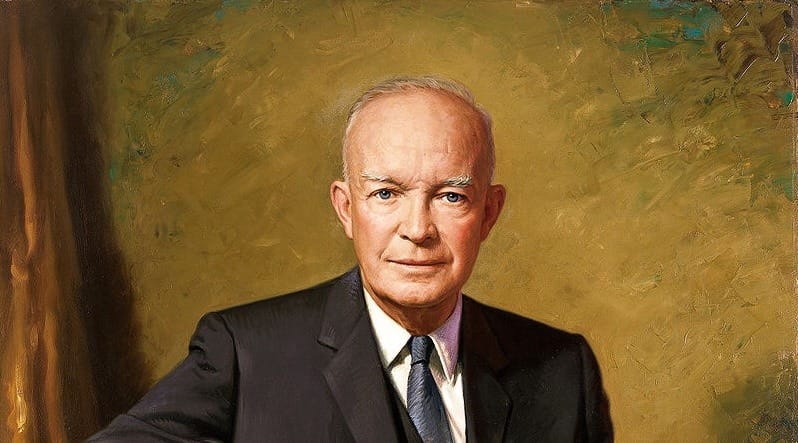
Among the various proponents of Christian nationalism in America, there is general agreement that the cultural Christianity of the Eisenhower era presents a model to which we should aspire (see here and here). The 1950s references to “under God” or “In God We Trust” are taken as evidence that America has always been a Christian nation. Until recently, the narrative goes, America recognized the “lordship of Christ,” and it is only fitting that we now openly reassert what has always been the case. At the fourth annual National Conservatism Conference (NatCon 4) in Washington, D.C. earlier this year, this claim was repeated. According to Moscow ID pastor Douglas Wilson, a coalition of American anti-communists successfully rolled back Soviet ideology during the opening stages of the Cold War. Now, faced with the existential threat of the “Gramscian commies,” we need a “new” Christian nationalism which will openly promote public morality and defeat “godless secularism.”
As always, however, the devil is in the details. A closer examination of the late 1940s and 1950s shows that today’s Christian nationalists are simply recycling the propaganda of what historian Jonathan Herzog has called Eisenhower’s “spiritual-industrial complex.” During the opening stages of the Cold War, US leaders at the highest levels of government were proclaiming that, unless we bring back religion to the public sphere, America is doomed to fail.
Thus, they engineered and heavily promoted a spiritual movement to roll back the advance of “godless atheism.” But what were the consequences of their government-sponsored great awakening? Though history demonstrates that the cultural Christianity they engineered failed in its primary mission to end the ideological conflict with the Soviet Union and its allies, it did succeed in reshaping American religion as a whole.
The Third Great Awakening
In his 1943 book, The Predicament of Modern Man, the philosopher D. Elton Trueblood wrote that Americans’ unshakeable belief in progress and the inherent goodness of mankind had been shattered on the battlefields of WWI and WWII. The irony of it all, as Étienne Gilson observed in his essay The Terrors of the Year 2000, was that science, the former hope and joy of the West, had culminated in the discovery of nuclear fission; the very key to humanity’s destruction, as had just been seen in the flash and roar that devoured Hiroshima and Nagasaki. Trueblood and Gilson agreed that WWII was not the cause of the West’s ongoing decay. For Gilson, the unrest and conflict of the 20th Century culminating in the atomic detonations in Japan were merely symptoms of Nietzsche’s declaration, “God is dead.” The growing sense of anxiety and restlessness in post-war America, for Trueblood, was the result of cutting society off from its historic religious heritage. The message was simple: unless the root of America’s founding faith was revitalized, the fruit of democracy and freedom were bound to wilt away.
For many, the greatest existential threat facing the US was the looming specter of Soviet Communism. Beyond the race to stockpile weapons of mass destruction, it was thought that the fundamental issue was one of metaphysics. Marx-Leninism denied the existence of God. Religion was the “opiate of the masses.” It was nothing but a wishful projection of the proletariat, who dreamed of “pie in the sky” to help them cope with life under the decadent rule of Capitalism. By exposing religion for a farce, the Communists believed they could jolt the oppressed workers out of their doldrums and into a revolutionary spirit. On the other hand, American media, lawmakers, and propagandists responded by claiming that the United States had traditionally been defined by its deep and abiding faith in the God of Christianity, while simultaneously highlighting the Kremlin’s role in persecuting clergy and destroying church buildings.
The early Cold War was increasingly depicted by American leaders as a contest between two opposed systems of religion. It was the godless Soviet Union against the God-fearing United States. Dialectical materialism versus freedom under God. Light against dark. Good versus evil. This, according to a growing narrative, was what fundamentally separated Americans from the “godless” Muscovites. And so, a sustained campaign began to reawaken the sleeping giant of American religion in direct opposition to Soviet Communism.
These efforts resulted in a massive (though short-lived) surge of public religious fervor. Church attendance soared from the conclusion of WWII to the end of the 1950s. All the mainline denominations increased their membership. By 1953, ninety-nine percent of surveyed respondents professed belief in a “higher power.” Books such as Billy Graham’s Peace with God (1953) and Norman Vincent Peale’s The Power of Positive Thinking (1952) topped the non-fiction bestseller lists. As of 1952, the Revised Standard Version of the Bible had sold over 26 million copies. Hollywood joined the movement as well, releasing a slew of religiously-themed blockbusters such as Cecil B. DeMille’s Ten Commandments (1956) starring Charlton Heston and Yul Brynner. Historian Andrew Finstuen, says that this “astounding renewal within Protestantism” was the “twentieth-century equivalent of the First and Second Great Awakenings.”
Perhaps the most visible and vocal advocate for the religious revival was President Dwight D. Eisenhower. “What is our battle against communism,” he asked, “if it is not a fight between anti-God and a belief in the Almighty? Communists know this. They have to eliminate God from their system. When God comes in, communism has to go.” Eisenhower oversaw the development of much of our modern-day civil religion. Under his administration, “under God” was officially added to the Pledge of Allegiance, “In God We Trust” was added to the currency and made the national motto, and the National Prayer Breakfast was instituted. All of Eisenhower’s cabinet meetings began with prayer, and, in January 1953, he was the first and only president to offer up his own Inauguration Day prayer.
Nor was Eisenhower the only prominent American politician to promote religion. During the outbreak of the Korean War in 1950, Truman noted that the prophet Isaiah had urged his readers to “beat [their] plowshares into swords and [their] pruninghooks into spears.” It was time to “succeed in our quest for righteousness” and “in St. Paul’s luminous phrase, put on the armor of God.” Truman’s Administration also worked to forge alliances with the Vatican and Jewish leaders to present a united front against Communism. For these two American presidents, Secretary of State John Foster Dulles, and “tens of millions of Americans,” writes historian Seth Jacobs, “the conflict with international communism was in its quintessence a holy war.” Andrew Preston notes that “faith seemed to be an obvious ideological, rhetorical, and political–and at times even diplomatic–weapon in the Cold War.”
One of the fundamental tenets of religious anti-communism in America was the assertion that all human beings were made in the image of God. In a speech given by the Eisenhower Administration’s Chief of Religious Information to the United States Information Agency (a US Government propaganda organization), he told them their job was to spread the “wonderful idea... that every human being, made in God’s image, is important in God’s eye.” Totalitarian governments, on the other hand, consistently treated the individual as an expendable tool to achieve Utopia. “We too want a Utopian society,” he said, “but we hold that essential to that Utopian society that no individual is run over rough shod in the means of arriving there.”
In 1953, Eisenhower proclaimed that “we who are free must proclaim anew our faith ... It is our faith in the deathless dignity of man, governed by eternal moral and natural laws. ... It establishes, beyond debate, those gifts of the Creator that are man’s inalienable rights, and that make all men equal in his sight.” Not to be outdone, a 1954 report by the US House of Representatives on whether to include “under God” in the Pledge of Allegiance stated:
Our American Government is founded on the concept of the individuality and the dignity of the human being. Underlying this concept is the belief that the human person is important because he was created by God and endowed by Him with certain inalienable rights which no civil authority may usurp. The inclusion of God in our pledge therefore would further acknowledge the dependence of our people and our Government upon the moral directions of the Creator.
For Eisenhower, Truman, Dulles, and hosts of other American leaders, this religion was further defined as Protestant Christianity. Christ was seen as the fullest revelation of God to humanity as well as the presumed author of the ethical basis for the American way of life.
Yet the religion of anti-communism was neither “pinched” nor “narrow.” The desire to keep America a traditional Christian nation continually ran up against the need for a broad, successful coalition to fight against Marx-Leninist ideology. It is telling that Roman Catholics and Jews were largely excluded from Protestant efforts to reestablish public morality in America leading up to and during WWI. By the time WWII ended, however, many thought that the inclusion of Jews and Catholics was a necessary step to better combat their atheistic foe.
Fast forward to the early 1950s and we find organizations like the Foundation for Religious Action in the Social and Civil Order (with board members such as Billy Graham, Edward L. R. Elson, Eisenhower’s pastor, and Norman Vincent Peale) inviting Buddhist, Hindu, and Muslim religious leaders to the United States to give presentations on religious unity. Eisenhower’s United States Information Agency (USIA) even sent “missionaries” abroad to help bolster Buddhism in Thailand in their own battle against communism. In short, the concerted battle against atheistic communism necessitated a less dogmatic and narrow definition of Christianity and ultimately gave way to an inclusive form of spiritual-not-religious-ism.
For this reason, many in the contemporary news press were skeptical of the validity of anti-communist religion. One reporter said that, at its core, it was nothing more than faith in the “American way of life.” In 1958, theologian Martin E. Marty referred to the brief religious surge as a “relativist, pragmatist, common-creed religion-in-general.” Social scientists noted that, because the US Government had posed the Cold War as a religious conflict, there was incredible social pressure to claim one attended church or to respond to queries about belief in God in the affirmative. To stay home on Sunday or to admit disbelief in a higher power would be unpatriotic. Some American leaders who touted the abundant signs of spiritual life, such as granite monuments of the Ten Commandments popping up all over the country, were privately troubled by indications of increasing societal unrest.
Coinciding with the Third Great Awakening was a growing sense of public anxiety, alienation, and inequality. When Brown v. Board of Education was passed in 1954, for example, the Voice of America radio propaganda stations broadcast flash bulletins behind the Iron Curtain to announce the news. The desegregation of public schools in America, it claimed, was proof that Soviet accusations of American inequality and racism were outdated. Yet, the brutal lynching of Emmet Till in 1955, protests over Autherine Lucy’s enrollment at the University of Alabama in 1956, and the Montgomery bus boycotts indicated that, despite the propaganda, there was still incredible resistance to racial equality in America.
By the end of the 1950s, the religious fervor in American society had largely petered out. Where his predecessor had emphasized the power of prayer, John F. Kennedy inspired the nation with his vision of putting a man on the moon as the best response to the Soviet launch of Sputnik. What was left in the wake of Eisenhower’s “spiritual-industrial complex,” writes historian Jonathan Herzog, was a carefully developed system of religiously-themed signs and symbols which are indelible facets of American civil religion.
Later, these symbols were lying close at hand for the emerging Religious Right to pick up and wield on behalf of the Conservative movement. One of the most significant consequences of the 1950s spiritual movement was to shape the nation's understanding of itself. As Kevin Kruse puts it, during Eisenhower’s era, “Americans were told time and time again that the nation not only should be a Christian nation but also that it had always been one. They soon came to believe that the United States of America was ‘one nation under God.’ And they’ve believed it ever since.”
Mere Christendom?
Today’s Christian nationalists are committing the golden age fallacy. What they are proposing has already been tried by the Truman and Eisenhower Administrations with dubious results. The general consensus is that, although the anti-communist coalition failed to end communism, it did succeed in diluting American religion. Historically, the unintended consequences of government-sponsored spirituality in the US during the early Cold War was negative for Christianity.
Yet, I can imagine someone reading this might admonish that the past doesn’t necessarily dictate the future. If only the right person were to lead this Christian nation, perhaps it would successfully and permanently turn around American societal decay. This is a valid point. In his book, The Landscape of History, John Lewis Gaddis warns of the difficulties faced by social scientists who attempt to predict future events based on past occurrences. The innumerable possible contingencies of the future means that even the most complete and precise understanding of history does not allow us to know definitively what will happen. In other words, anything is possible.
History, however, can help us live wisely in the present. The warning signs which remind us of attempts to use Christianity as a tool in service of political or social transformation projects are all around us. The change in our pockets bears “In God We Trust” as a monument to the spiritual war against communism in the 1950s. The American flag flies in many of our church sanctuaries as a reminder of the American Social Gospel warriors’ battle against “Prussianism” during WWI. The “Battle Hymn of the Republic” is still in our hymnals pointing to the spiritualization of the American Civil War. To ignore these patterns of the past when planning our future actions would be ill-advised. The secret is that the “new” Christian nationalism isn’t new at all—it’s an ancient impulse which has frequently led to complicated and even harmful results for the Christian church. Future contingencies may prove me wrong, but until then I remain doubtful, and you should too.
The Weekly Digest
Premier Thought Every Thursday.
All of our recent essays and podcasts, delivered to you. Free.
Free. Delivered Thursday mornings.