Mere Orthodoxy is a reader-supported ministry. Join us in our mission to renew the Church and culture.

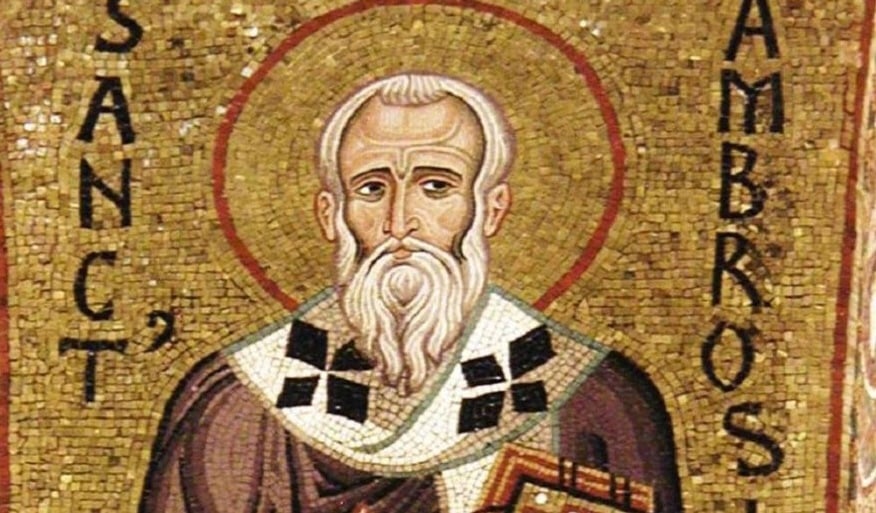
O God, Creator of All Things: A Hymn of St Ambrose

December 22nd, 2025 | 5 min read

By E. J. Hutchinson

A few years ago, I translated a hymn of St. Ambrose on the Incarnation (Intende Qui Regis Israel) for First Things, which you can read here. This year, I have versified another of his hymns in English, Deus Creator Omnium (“O God, Creator of All Things”).

It is an evening hymn, asking for God’s protection through the dark hours of the night. Though the hymn is not about the Incarnation, the Incarnation is not irrelevant to it. For God is the light that shines in our darkness.1 And what is the Incarnation? St. John tells in his Gospel that “[i]n the beginning was the Word”; that in the Word was life; that this life was “the light of men” that “shineth in the darkness”; and that this Word was “made flesh, and dwelt among us” (John 1:1, 4-5, 14).2

The hymn proved very popular right away. St. Augustine refers to it at least nine times in his writings, from his earliest works (On the Happy Life; On Music) to his latest (City of God), perhaps most significantly in Confessions 9.12.32, where he quotes two entire verses in the context of his grief over the death of his mother:

Now came the moment when the body was borne away….[A]ll day long I was secretly weighed down by sorrow, and in my mental turmoil I begged you as best I could to heal my hurt. You did not, and this because, as I believe, you were reminding me that any sort of habit is bondage, even to a mind no longer feeding on deceitful words.

I thought it a good idea to go and take a bath, because I had heard that baths derived their name from the Greeks, who called a bath balaneion because it banishes worry from the mind. This too I must confess to your mercy, O Father of orphans, that I bathed, and afterward was quite unchanged, for I had not sweated the bitter sorrow out of my heart. But then I went to sleep, and on awakening felt a good deal better. As I lay in bed alone I remembered some lines by your servant Ambrose, which rang true for me:

Creator God, O Lord of all
who rule the skies, you clothe the day
in radiant color, bid the night
in quietness serve the gracious sway
of sleep, that weary limbs, restored
to labor’s use, may rise again,
and jaded minds abate their fret,
and mourners find release from pain.  

St. Augustine, then, found comfort in the words of his spiritual father in a moment of great pain.3

I cannot prove it, but “I went to sleep, and on awakening” (dormivi et evigilavi) sounds to me like an allusion to Psalm 3:5 (“I laid me down and slept; I awaked; for the Lord sustained me”). Interestingly enough, it is on just that verse that we find Martin Luther, about a thousand years later, referring to the same hymn. Commenting on the third Psalm, Luther writes:

“I laid down,” he says, “and slept.”...[J]ust as sleep is useful and necessary for the better renewal of our powers, as Ambrose says in the hymn (“so that sleep can relieve weary limbs”), so death is useful and has now been instituted so that we might obtain a better life. That is what he will say in the next Psalm: “In peace I will sleep and rest, since you, O Lord, have especially established me in hope.”4

May we find the same comfort in the hymn that saints have found throughout the ages. Merry Christmas!

“O God, Creator of All Things”

O God, Creator of all things,
The guide of heaven, you who dress
The day with fair illumining,
The night with gracious gift of rest,

So sleep can take unfettered limbs
And ready them for labor’s use,
Relieve minds weary with life’s din,
Unbind anxiety’s raw noose:

Now that the day is done, and night
Begins, we pay the debt we owe,
Vow-bound to grateful prayer. O Light,
Please help those hymning here below.

You are the one our hearts would chant,
You, singing voice would magnify,
For you, our chaste desire would pant,
You, sober mind would glorify,

So that, when daylight is shut out
By nighttime’s claustrophobic haze,
Faith may not know the dark of doubt,
And night grow bright from faith’s strong blaze.

Do not allow the mind to sleep;
Let sin know how to sleep instead.
Let faith refresh the chaste, and keep
Befogging dreams from pious beds.

Unburdened of perception’s wiles,
Let all our dreams be you; and please
Let not the jealous foe beguile
With fitful dread our sleeping ease.

O God the Father, God the Son,
O Son and Father’s Spirit, three,
In essence, light, and power, one:
Bless those who pray, O Trinity. 

Footnotes

1. My version makes this somewhat more explicit than St. Ambrose’s: The address to God as “Light” in line 11 is my addition, as is the reference to “light” in the concluding doxology, where I have also taken other liberties. Cf. the comments of Brian P. Dunkle, SJ: “[T]he reflection on the opposition between night and day draws on basic biblical themes. There is an echo of John’s language in the fifth stanza, where the hymn treats the onset of the night in diction that resembles the Gospel’s prologue (‘the darkness did not comprehend the light’ (Jn. 1:5), as well as images from Revelation (‘And night shall be no more…for the Lord God will be their light’ (Rev. 22:5)). Yet…the term lux is absent from the hymn, along with most of the language of ‘light.’ Ambrose instead substitutes fides for the lux of the biblical original, expressing the hope that faith not be overcome by the night, thereby offering a particular, mystical reading of a central Scriptural image; the singers ask that faith, especially the Nicene faith, be their guide” (Enchantment and Creed in the Hymns of Ambrose of Milan, 113).

2. Scripture quotations are from the King James Version.

3. Trans. Maria Boulding, O.S.B.

4. From Luther’s Operationes in Psalmos on Psalm 3 (WA 5,89-90). The translation is my own. 

E. J. Hutchinson

E.J. Hutchinson is Associate Professor of Classics at Hillsdale College, where he also directs the Collegiate Scholars Program. He is the editor and translator of Niels Hemmingsen’s On the Law of Nature: A Demonstrative Method.